Vendor:
Logic Fruit Technologies
Category:
LIN
LIN Master Slave Controller
The vendor has designed LIN RTL IP Core, supporting data rate up to 20Kbps.
Overview
The vendor has designed LIN RTL IP Core, supporting data rate up to 20Kbps.
Local Interconnect Network (LIN) is a broadcasting, Single Master, and Multi Slave (up to 16) communication protocol designed to support those features where CAN is not required.
Key features
- LIN is a single wire-based interface, it reduces the cost and complexity of implementation.
- LIN is the best-suited and best alternative to CAN for applications that do not need high Bandwidth and that are of low speed.
- LIN is self-synchronized and therefore no need for external oscillators.
Block Diagram
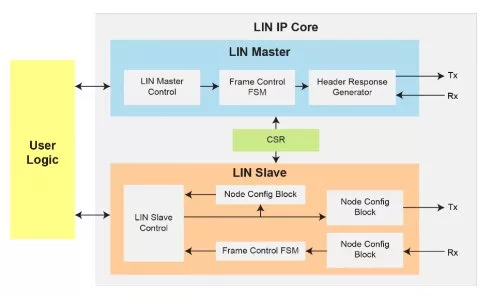
LIN Master Slave Controller block diagram
Benefits
- LIN is a single wire-based interface, it reduces the cost and complexity of implementation.
- LIN is the best-suited and best alternative to CAN for applications that do not need high Bandwidth and that are of low speed.
- LIN is self-synchronized and therefore no need for external oscillators.
Specifications
Identity
Part Number
LIN Master Slave Controller
Vendor
Logic Fruit Technologies
Type
Silicon IP
Files
Note: some files may require an NDA depending on provider policy.
Provider

Logic Fruit Technologies
HQ:
India
Logic Fruit Technologies designs and deploys embedded solutions for customers around the world. The company has specific experience FPGA Design Services, Hardware Design Services, RTL Testing, variety of Digital Protocols, Communication Buses and Tools, including 1G, 10G Ethernet, PCIe, DIGRF, USB3.0, STM, HDMI, and software-defined radio (SDR), as well as Encryption, Protocol Compliance, Signal Generation, Data Analysis, IoT Technology, and Multiple Image Processing Techniques.
Learn more about LIN IP core
Understanding the LIN PHY (physical) layer
The physical layer of the Local Interconnection Network is a key part of this automotive networking standard; it has unique attributes of which designers should be aware.
New opportunities for automotive LIN interfaces
Bart Keppens, Sofics
VitaLLM: A Versatile and Tiny Accelerator for Mixed-Precision LLM Inference on Edge Devices
The authors present VitaLLM, a mixed-precision accelerator that enables ternary-weight large language models to run efficiently on edge devices. The design combines two compute cores—a multiplier-free TINT core for ternary–INT projections and a BoothFlex core that reuses a radix-4 Booth datapath for both INT8×INT8 attention and ternary–INT—sustaining utilization without duplicating arrays
GenAI for Systems: Recurring Challenges and Design Principles from Software to Silicon
Generative AI is reshaping how computing systems are designed, optimized, and built, yet research remains fragmented across software, architecture, and chip design communities. This paper takes a cross-stack perspective, examining how generative models are being applied from code generation and distributed runtimes through hardware design space exploration to RTL synthesis, physical layout, and verification.
ChipBench: A Next-Step Benchmark for Evaluating LLM Performance in AI-Aided Chip Design
While Large Language Models (LLMs) show significant potential in hardware engineering, current benchmarks suffer from saturation and limited task diversity, failing to reflect LLMs’ performance in real industrial workflows. To address this gap, the authors propose a comprehensive benchmark for AI-aided chip design that rigorously evaluates LLMs across three critical tasks: Verilog generation, debugging, and reference model generation.
Frequently asked questions about LIN IP cores
What is LIN Master Slave Controller?
LIN Master Slave Controller is a LIN IP core from Logic Fruit Technologies listed on Semi IP Hub.
How should engineers evaluate this LIN?
Engineers should review the overview, key features, supported foundries and nodes, maturity, deliverables, and provider information before shortlisting this LIN IP.
Can this semiconductor IP be compared with similar products?
Yes. Buyers can compare this product with similar semiconductor IP cores or IP families based on category, provider, process options, and structured technical specifications.