Overview
Solution for UET-TSS transform with rates up to 1.6Tbps
In the data center environment, the servers, storage and AI/HPC clusters need to move confidential data quickly and securely. Traditionally, RDMA is used as a transport protocol along with the network security based on MACsec and IPsec ESP protocols. To improve efficiency of using Ethernet in AI/HPC systems, the Ultra Ethernet Consortium introduced the new, IP-based transport protocol (UET), along with a new security protocol (TSS), that uses concepts from IPsec and PSP to protect or isolate the traffic. The UET protocol is implemented in SmartNICs that are connected to front-end and scale-out (backend) networks. For line rate performance and lowest latency, the TSS layer shall be implemented fully in hardware, close to the Ethernet port.
How the UET-TSS-IP-69 Works
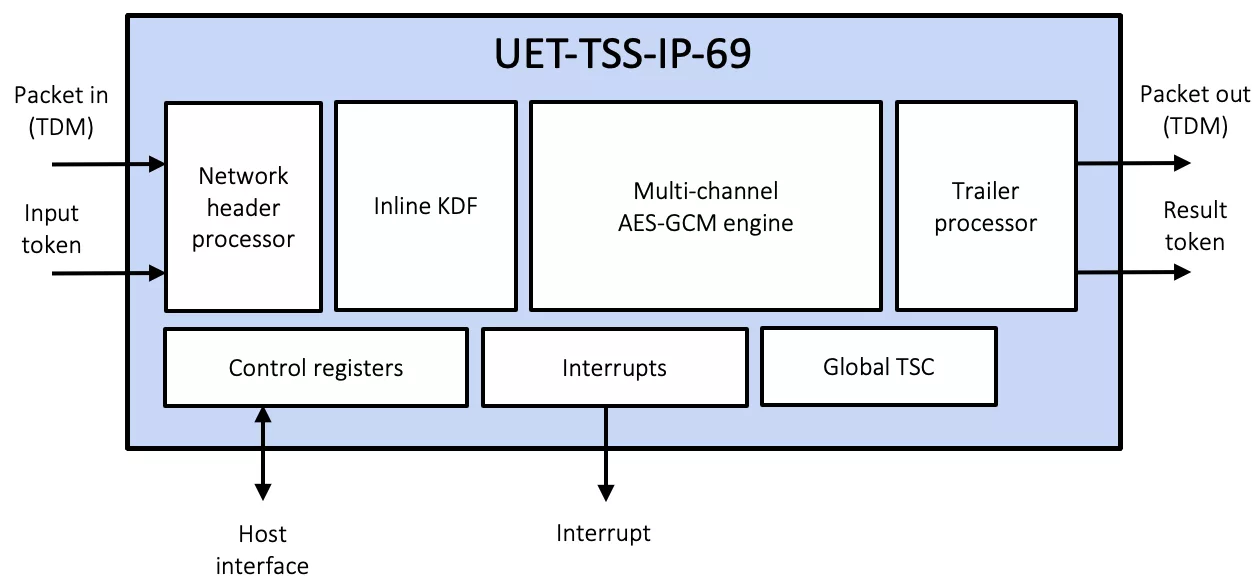
The UET-TSS-IP-69 (EIP-69) is a high-performance, multi-channel transform engine that provides the complete TSS packet transformation (including KDF and IP/UDP updates), bypass/drop and basic crypto processing at rates up to 1.6Tbps. The engine is designed for integration into the systems that require TSS processing for one or more ports. The engine is provided as separate ingress and egress data paths.
It receives a packet with input parameters that select one of the possible operations:
- TSS: A complete TSS layer handling is performed. IP header location is parsed or received externally. At egress, SD index is received from the host, at ingress it is searched in the CAM. The SDKDB is stored in the local SRAM. If the TSS operation cannot be performed, the packet is marked for dropping. The result contains security checks and processing results. The TSS compliant statistics are counted.
- Authenticated Encryption mode: Basic AES-GCM/GMAC operation with byte-aligned data. Can be used to offload crypto operations for other protocols and run NIST CAVP vectors.
- Bypass/Drop: A packet is bypassed without or with drop signaling.
Learn more about Ethernet IP core
Rambus, having successfully served the data center, enterprise and infrastructure markets with line rate MACsec and IPsec products (Secure Networking), adds two new solutions for securing UET transport protocol with TSS.
As artificial intelligence and high-performance computing (AI/HPC) reshape industries, the need for robust, scalable, and secure connectivity has never been greater. Built from tightly integrated CPUs, GPUs, and SmartNICs, today’s compute clusters demand high-throughput, low-latency networks that can scale from die-to-die to multi-rack deployments.
The Rambus Multi-Channel Engine MACsec-IP-364 (+363) is purpose-built to meet the demands of next-generation Ethernet. It delivers full line-rate MACsec and optional IPsec support for 1.6T and 3.2T Ethernet ports, offering a highly scalable and configurable solution for securing high-speed data traffic.
Ultra Accelerator Link (UA Link) standard has been specified to enable the creation of systems comprised of multiple nodes targeting AI applications.
As factories, process plants, and robotics platforms become increasingly intelligent and interconnected, the demand for stable, low-latency data links has pushed Ethernet deeper into embedded systems. However, since designing Ethernet connectivity into industrial chips comes with its technical and logistical hurdles, engineers may face challenges when implementing Ethernet in industrial designs.
Ultra Ethernet, designed for scale out architectures, is an open, interoperable, high-performance protocol solution tailored for AI, supported by industry leaders across switch, networking, semiconductor, and system providers, as well as hyperscalers.