Overview
All Platypus eFPGA hardened IP cores are backed up by an open architecture guarantee. Complete machine readable descriptions of standard architectures can be found in the Logiklib open source repository.
Parametrized soft RTL logic wrap the hardened IP core to handle reset, boot-up, security, and bitstream loading. Bitstream programming is done via a standardize memory mapped register interfaces (APB, AXI-Lite, or UMI) selectable by the user during design integration.
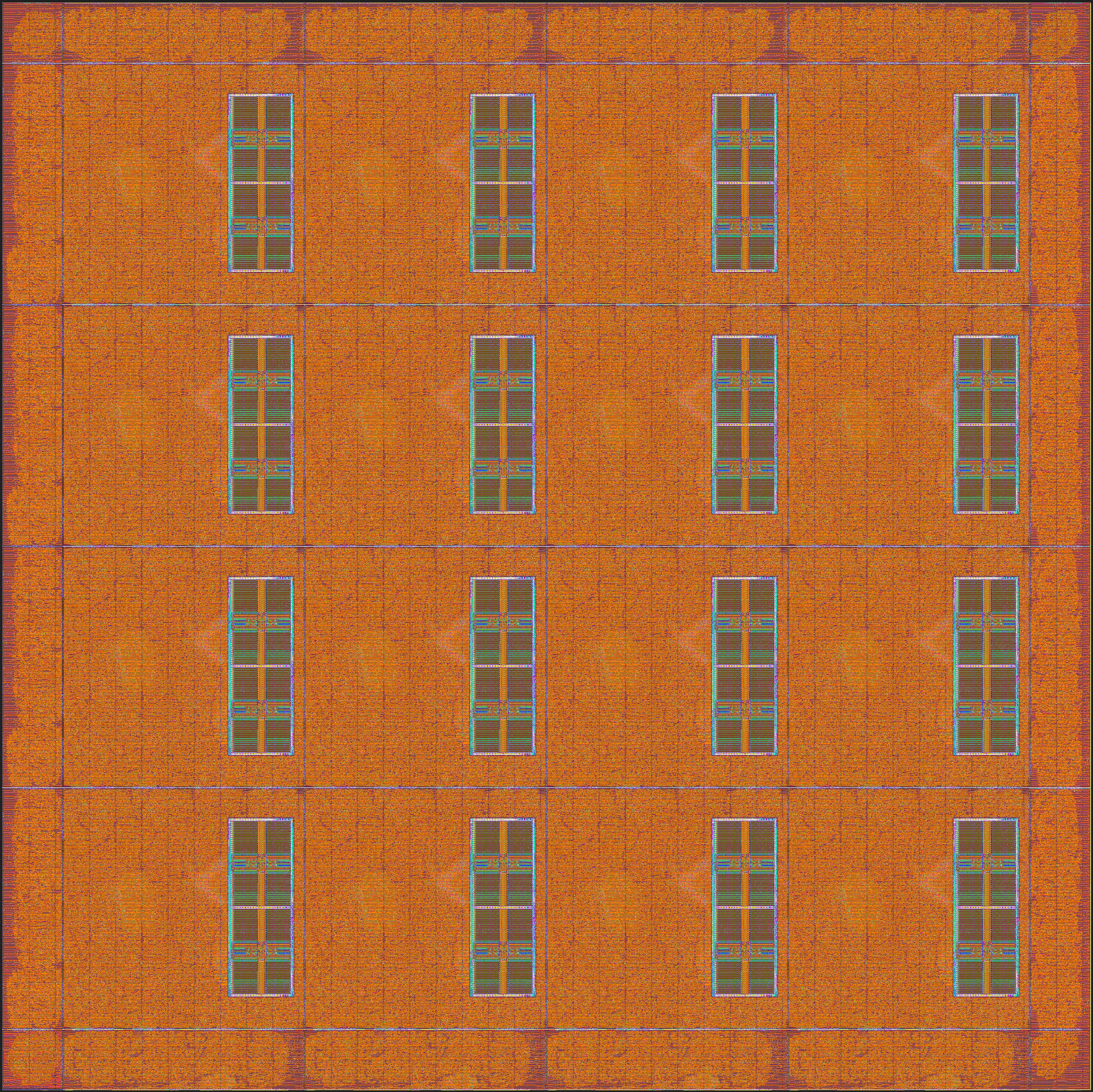
An experimental Z1010 heterogeneous eFPGA architecture with LUTs, DSPs, and BRAMs has been ported to the GlobalFoundries GF12LP process. The picture below shows the full layout of the experimental architecture. The official Z1010 standard will include a different ratio of LUTs, DSPs, and BRAM.
| Process |
LUTs |
Regs |
I/O |
DSPs |
BRAM |
Width |
Height |
| GF12LP |
512 |
512 |
1,024 |
16 |
1Mb |
1036.8um |
1037.2um |
Learn more about eFPGA IP core
In the high-stakes world of aerospace and defense (A&D) microelectronics, the primary currency isn’t just performance—it’s predictability. When architecting a new ASIC, the specter of “unknown unknowns” is what keeps Program Managers awake at night.
For architects, adding flexibility via embedded FPGA (eFPGA) is a natural solution for post-silicon requirements, allowing for evolving standards and late-breaking feature additions. However, a critical question remains: Does adding programmable logic help your schedule, or does it introduce a new layer of uncertainty and risk? The answer lies in the delivery format. While soft IP offers configuration flexibility, hardened eFPGA IP blocks are the secret weapon for teams prioritizing tapeout predictability.
For embedded FPGA (eFPGA) to succeed in defense, we must change the narrative. It cannot be treated as a hobbyist FPGA dropped into an SoC. It must be treated as an assured ASIC IP block governed by disciplined processes, verifiable artifacts, and increasingly by open-source toolchains that guarantee long-term independence.
This blog reframes the “flexibility vs. cost” debate in modern SoC design, positioning eFPGA not as a luxury feature, but as a critical financial hedge against the rising costs of advanced silicon nodes.
As system requirements evolve toward multi-standard, reconfigurable platforms, signal processing architectures are under pressure to deliver both ASIC-class performance and software-like flexibility. Semiconductor engineers face a fundamental tradeoff: fixed logic yields, unmatched throughput, and efficiency, but cannot adapt once taped out. Software-programmable solutions offer flexibility but often miss hard real-time performance constraints and can consume more power.
First-Pass Success with QuickLogic eFPGA Hard IP on TSMC e12n