eFPGA Soft IP
These eFPGA IP cores offer designers the flexibility to tailor resources to their application requirements, available as either S…
Overview
These eFPGA IP cores offer designers the flexibility to tailor resources to their application requirements, available as either Soft RTL or Hard GDSII IP. Our standard-cell-based approach facilitates rapid porting to new process geometries or variants, including industrial and rad-hard grade versions.
Unique Features of Menta eFPGA soft IP
At Menta, we specialize in maximizing process portability for our eFPGAs, ensuring successful silicon-proven results across a wide range of technology nodes from 350nm to 5nm or less. Our eFPGA IPs can be provided on any technology node and variants. Our eFPGAs have been manufactured on diverse technologies including GLOBALFOUNDRIES 22FDX, GLOBALFOUNDRIES 12LP, Intel 16, Skywater RH90, STM130, STM65, TSMC 28HPC+, TSMC 12FFC and XFAB 180nm. Additionally, Menta eFPGAs are qualified on GLOBALFOUNDRIES® 32 SOI and 12LP, and we are honored to be a 22 FDXceleratorTM Partner. In addition, Menta’s customers are currently desiging SoCs including Menta eFPGA IPs on Intel 18A and TSMC N7.
Versatile Applications of Our eFPGA soft IP
Menta Soft IP offers a flexible and efficient solution for implementing custom hardware functionalities across a wide range of applications, empowering designers to innovate and create tailored solutions to address diverse market needs.
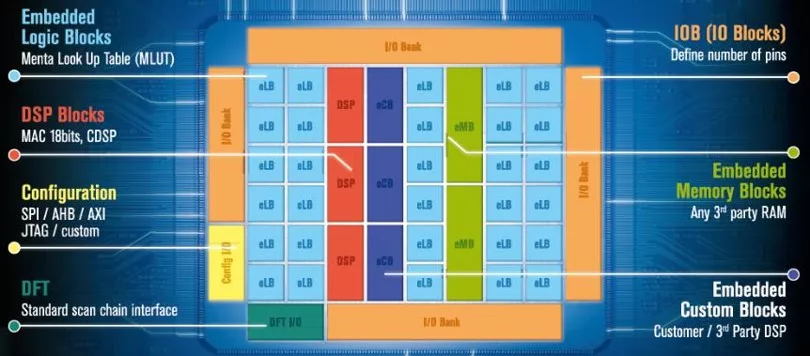
Key features
- Higher Performance of eFPGA Soft IP: With Menta eFPGA, concerns regarding board-space, I/O latency, and bandwidth are alleviated as accelerators are brought on-chip, eliminating limitations and overhead associated with I/O pad count or chip-to-chip communication interfaces.
- eFPGA Means Lower Power Consumption: In a COT FPGA, all the extra to the programmable logic, such as high-speed interfaces, PLL, and controllers consume around half of the power. All our power saving advances lead an algorithm on a Menta eFPGA IP to consume between 10 and 50% of the power of the same algorithm on a FPGA.
- Design Insurance with Menta eFPGA: To maximize flexibility, it's crucial to prioritize process-portability. Menta eFPGA stands out as the sole 100% standard-cell-based solution, facilitating rapid porting of your eFPGA to any new process geometry or variant of your choice. This is achieved using the same automated, standard EDA flow as for the rest of your SoC. Leveraging our industry gold-standard Synopsys-based implementation flow, Menta ensures portability within mere weeks, empowering you to adapt swiftly to evolving technological landscapes.
- Security with eFPGA Soft IP: In today’s global design chain, protecting intellectual property (IP) and trade secrets is increasingly vital. Menta eFPGA allows you to delay delivering proprietary technology to end customers until it is delivered as a field-upgrade, minimizing the chance for competitors to reverse engineer your product. This strategic approach enhances security and preserves valuable IP throughout the product lifecycle.
- Protection of Industrial Intellectual Property: With Menta eFPGA, you can securely deliver your proprietary technology to end customers through field-upgrade capabilities, significantly reducing the risk of competitors reverse-engineering your product.
- Reduction of Costs Thanks to eFPGA: As production volumes increase, onboard FPGAs can rapidly become financially impractical. With Menta eFPGA, you can seamlessly integrate FPGA functionality directly onto the chip, effectively reducing manufacturing cost up to 85% and conserving valuable board space, all while ensuring full field-upgradability.
- Higher Performance of eFPGA Soft IP: With Menta eFPGA, concerns regarding board-space, I/O latency, and bandwidth are alleviated as accelerators are brought on-chip, eliminating limitations and overhead associated with I/O pad count or chip-to-chip communication interfaces.
- eFPGA Means Lower Power Consumption: In a COT FPGA, all the extra to the programmable logic, such as high-speed interfaces, PLL, and controllers consume around half of the power. All our power saving advances lead an algorithm on a Menta eFPGA IP to consume between 10 and 50% of the power of the same algorithm on a FPGA.
- Design Insurance with Menta eFPGA: To maximize flexibility, it's crucial to prioritize process-portability. Menta eFPGA stands out as the sole 100% standard-cell-based solution, facilitating rapid porting of your eFPGA to any new process geometry or variant of your choice. This is achieved using the same automated, standard EDA flow as for the rest of your SoC. Leveraging our industry gold-standard Synopsys-based implementation flow, Menta ensures portability within mere weeks, empowering you to adapt swiftly to evolving technological landscapes.
- Security with eFPGA Soft IP: In today’s global design chain, protecting intellectual property (IP) and trade secrets is increasingly vital. Menta eFPGA allows you to delay delivering proprietary technology to end customers until it is delivered as a field-upgrade, minimizing the chance for competitors to reverse engineer your product. This strategic approach enhances security and preserves valuable IP throughout the product lifecycle.
- Protection of Industrial Intellectual Property: With Menta eFPGA, you can securely deliver your proprietary technology to end customers through field-upgrade capabilities, significantly reducing the risk of competitors reverse-engineering your product.
- Reduction of Costs Thanks to eFPGA: As production volumes increase, onboard FPGAs can rapidly become financially impractical. With Menta eFPGA, you can seamlessly integrate FPGA functionality directly onto the chip, effectively reducing manufacturing cost up to 85% and conserving valuable board space, all while ensuring full field-upgradability.
- Higher Performance of eFPGA Soft IP: With Menta eFPGA, concerns regarding board-space, I/O latency, and bandwidth are alleviated as accelerators are brought on-chip, eliminating limitations and overhead associated with I/O pad count or chip-to-chip communication interfaces.
- eFPGA Means Lower Power Consumption: In a COT FPGA, all the extra to the programmable logic, such as high-speed interfaces, PLL, and controllers consume around half of the power. All our power saving advances lead an algorithm on a Menta eFPGA IP to consume between 10 and 50% of the power of the same algorithm on a FPGA.
Block Diagram
Benefits
- HIGHLY DESIGN ADAPTIVE IP
- Support of any technology node, foundry and process option
- High LUTs density
- Support of any kind of arithmetic block right within the IP
- Support of any type and amount of memories, right within the IP
- Specific IP specification software available to help defiing the perfect IP for customer SoC and application (Origami Designer)
- ASIC like options: power management
- Can be rad-hard by design
- EASIEST SOC INTEGRATION
- No specific interface
- Highest yield and reliability
- Best testability and cost (TC & FC of 99.7%+). Standard scan chain
- Best and simplest verification flow
- No change in customer EDA flow. No extra software required
- BEST USABILITY
- State of the art programming software (Origami Programmer)
- Several distribution models possible
- No export restrictions
Applications
- Aerospace & Defence
- Cryptography
- Motor Controls
- Adaptive Data conversion
- Avoid trojan/hacking at Foundry
- Automotive
- Autonomous driving - AI for vision applications
- Security algorithms over lifetime
- Checker and voting logic for lock-steps mode
- Motor controls
- Battery monitoring systems
- HPC / Networking / 5G
- AI learning accelerator
- Cryptography accelerators
- 5G base stations evolving standards
- Post production customizable CPU
- SSD controller
- Risk reduction
- IoT / IIoT
- AI inference at the edge
- System time to market and cost reduction
- Reduction of variants
What’s Included?
- Origami Programmer software
- GDSII and all files necessary for integration, verification, simulation and test
- Datasheets, documention
- Can deliver on any CMOS process at any foundry.
- Off the shelf IPs available on XFAB XH018 (rad-hard), STM 28FDSOI, GF12LP and TSMC 12FFC.
Files
Note: some files may require an NDA depending on provider policy.
Specifications
Identity
Provider
Learn more about eFPGA IP core
Tapeout Predictability with Hardened eFPGA IP Blocks
Accreditation Without Compromise: Making eFPGA Assurable for Decades
Silicon Insurance: Why eFPGA is Cheaper Than a Respin
Integrating eFPGA for Hybrid Signal Processing Architectures
Epson Achieves 50% Energy Efficiency with QuickLogic eFPGA
Frequently asked questions about eFPGA IP cores
What is eFPGA Soft IP?
eFPGA Soft IP is a eFPGA IP core from Menta listed on Semi IP Hub.
How should engineers evaluate this eFPGA?
Engineers should review the overview, key features, supported foundries and nodes, maturity, deliverables, and provider information before shortlisting this eFPGA IP.
Can this semiconductor IP be compared with similar products?
Yes. Buyers can compare this product with similar semiconductor IP cores or IP families based on category, provider, process options, and structured technical specifications.