Vendor: Agile Analog Category: Mixed Signal Subsystem

Power Management Subsystem

The agilePMU Subsystem is an efficient and integrated Power Management Unit for SoCs/ASICs.

Overview

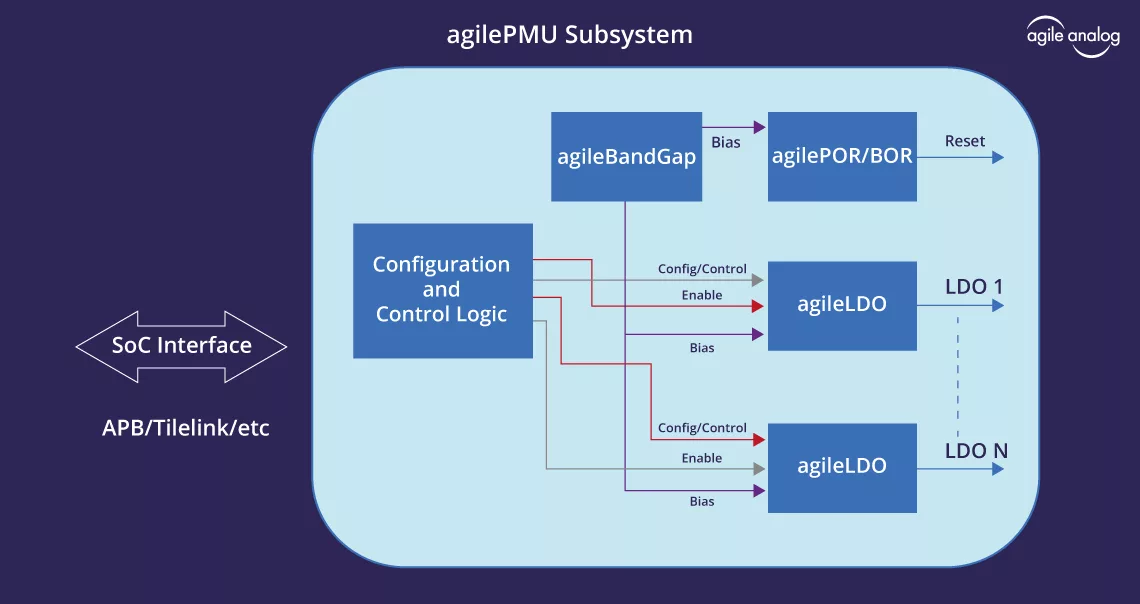
The agilePMU Subsystem is an efficient and highly integrated Power Management Unit for SoCs/ASICs. Featuring a Power-On-Reset (POR), multiple Low Drop-Out (LDO) regulators, and an associated reference generator. The agilePMU Subsystem is designed to ensure low power consumption while providing optimal power management capabilities.

Agile Analog designs are based on tried and tested architectures to ensure reliability and functionality. Our design methodology is programmatic, systematic and repeatable leading to analog IP that is more verifiable, more robust and more reliable. Our methodology also allows us to quickly re-target our IP to different process options. We support all the major foundries including TSMC, GlobalFoundries, Intel Foundry, Samsung Foundry, UMC and Other Foundries.

Key features

  • agilePOR/BOR
    • Assertion Time: 5us (typ)
    • Configurable Trigger Thresholds
    • Programmable Delay
    • Current Consumption: 1.5uA (typ)
  • agileLDO
    • Output Voltage: Programmable
    • Load Current: User defined
    • Active Current: 1uA (typ)
    • Power Down Current: 10nA (typ)
    • PSSR: 40dB (@DC)
  • agilePMU Subsystem
    • Start-up Time: Typ 20us
    • Industry standard digital interface
    • Configurable logic to control sequencing and monitoring
    • Fully integrated macro
    • Standard AMBA APB interface

Block Diagram

Files

Note: some files may require an NDA depending on provider policy.

Specifications

Identity

Part Number
agilePMU
Vendor
Agile Analog
Type
Silicon IP

Provider

Agile Analog
HQ: United Kingdom
Agile Analog is transforming the world of analog IP with Composa™, its innovative, configurable, multi-process analog IP technology. Headquartered in Cambridge, UK, with a growing number of partners and customers across the globe, Agile Analog has developed a unique way to automatically generate analog IP that meet the customer’s exact specifications on almost any process from any foundry. The company provides a wide and ever expanding selection of analog IP and subsystems for power management, data conversion, IC health and monitoring, security and always-on domains. Agile Analog's novel approach utilises tried and tested analog circuits within its Composa library to create customised and verified analog IP solutions. This reduces the time to market and increases quality, helping to accelerate innovation in semiconductor design.

Learn more about Mixed Signal Subsystem IP core

The Case for Developing Custom Analog

Increasingly, product managers are considering a custom Analog SoC as an effective way to drastically reduce BOM costs. What would have been considered a radical product innovation just a few years ago, is now viewed as a viable route as even where product volumes are considered low NRE costs can in fact be recovered in short period of time. Innovative SoC solutions are challenging but the benefits are compelling where risk can be mitigated by choosing a development partner with a clear understanding of all the system components and of the various technology options for the SoC implementation. In a recently issued paper, S3 Group’s experts talk about the advantages of custom SoCs and build a strong business case for investment in a SoC development.

Mixed Signal Design & Verification Methodology for Complex SoCs

This paper describes the design & verification methodology used on a recent large mixed signal System on a Chip (SoCs) which contained radio frequency (RF), analog, mixed-signal and digital blocks on one chip. We combine a top-down functional approach, based on early system-level modelling, with a bottom-up performance approach based on transistor level simulations, in an agile development methodology. We look at how real valued modelling, using the Verilog-AMS wire that carries a real value (wreal) data type, achieves shorter simulation times in large SoCs with high frequency RF sections, low bandwidth analogue base-band sections and appreciable digital functionality including filtering and calibration blocks.

Systematic approach to verification of a mixed signal IP - HSIC PHY case study

This paper discusses verification process of a mixed signal core of an HSIC PHY. After explaining the specific topic related with HSIC comparison to USB, the verification strategy is shown. The strategy is explained from the top level point of view, and detailed description is covered in subsequent sections. In following sections the system level testbench and interoperability testbenches are explained parallel to local testbenches for analog block characterization.

How to specify and integrate successfully a measurement analog front-end including its power computation engine in an energy metering IC

Based on the system specification of a typical smart meter, this article demonstrates the importance of carefully selecting the power metering IP solution so that its specification matches the standard requirements and copes with the application challenges. This article then pinpoints thoroughly the various issues that must be taken into account for the selection of the Silicon IP and helps identify the possible trade-offs between the performance of the Mixed-signal Front-end (MFE) and that of the Power and energy Computation Engine (PCE).

Frequently asked questions about Mixed-Signal Subsystem IP cores

What is Power Management Subsystem?

Power Management Subsystem is a Mixed Signal Subsystem IP core from Agile Analog listed on Semi IP Hub.

How should engineers evaluate this Mixed Signal Subsystem?

Engineers should review the overview, key features, supported foundries and nodes, maturity, deliverables, and provider information before shortlisting this Mixed Signal Subsystem IP.

Can this semiconductor IP be compared with similar products?

Yes. Buyers can compare this product with similar semiconductor IP cores or IP families based on category, provider, process options, and structured technical specifications.

×
Semiconductor IP