Vendor:
Cadence Design Systems, Inc.
Category:
USB
eUSB2V2 Controller
Proven solution featuring host and peripheral eUSB2V2 scales up to 4.8Gbps of data rate with the flexibility to configure asymmet…
Overview
Proven solution featuring host and peripheral
eUSB2V2 scales up to 4.8Gbps of data rate with the flexibility to configure asymmetrical or symmetrical links to build an efficient system, depending on the intended application. In asymmetrical link mode, one direction can achieve speeds of up to 4.8Gbps, while the reverse can operate at a lower rate of 480Mbps. This flexibility allows for simpler designs, optimized power consumption, and reduced EMI noise. Symmetrical links can be configured to run at speeds between 960Mbps and 4.8Gbps.
Key features
- Meet low voltage requirement (1.0V – 1.2V)
- Up to 4.8Gbps scalable data rate
- Leverages existing USBSSP2 IP
- Burst transactions improvement for Isochronous Endpoints
- New MaxPacketSize for Bulk Endpoint (1024 bytes)
- Support for Legacy Protocol (HS Native Mode) operation
- Design flexibility with both asymmetrical and symmetrical links
- Configurable number of eUSB2V2 Ports
- No change in existing USB2/USB3 Port
Block Diagram
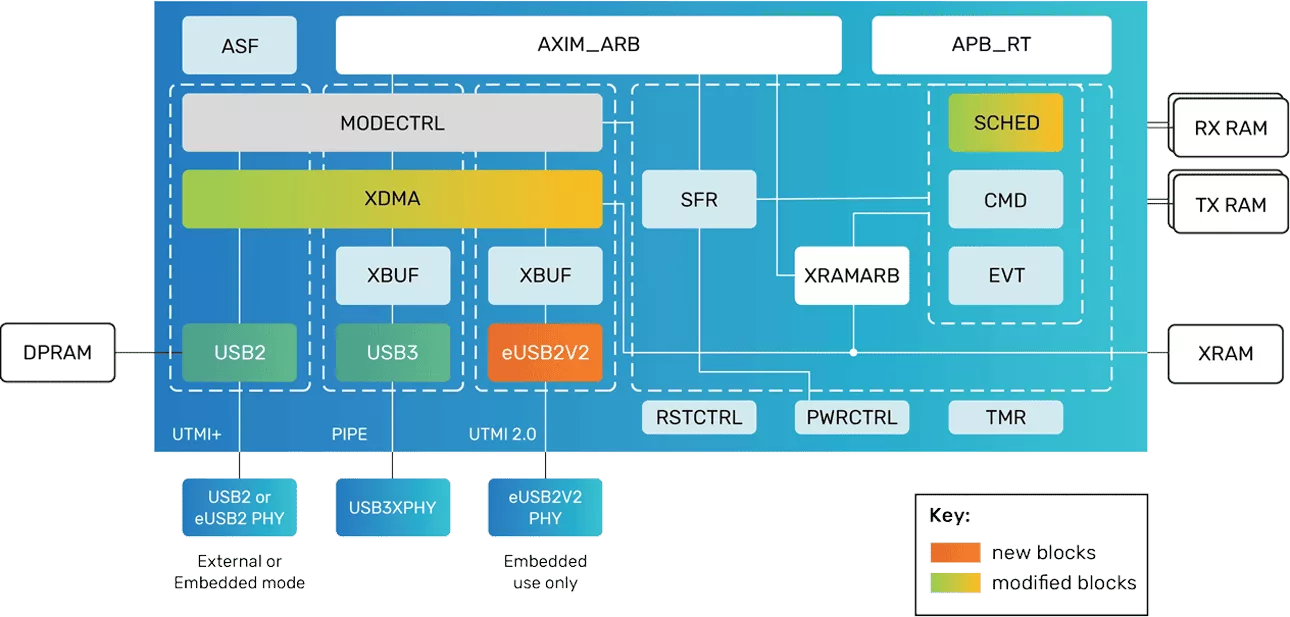
eUSB2V2 Controller block diagram
Specifications
Identity
Part Number
eUSB2V2 Controller
Vendor
Cadence Design Systems, Inc.
Type
Silicon IP
Provider

Cadence Design Systems, Inc.
HQ:
USA
If you want to achieve silicon success, let Cadence help you choose the right IP solution and capture its full value in your SoC design. Cadence® IP solutions offer the combined advantages of a high-quality portfolio, an open platform, a modern IP factory approach to quality, and a strong ecosystem.
Now you can tackle IP-to-SoC development in a system context, focus your internal effort on differentiation, and leverage multi-function cores to do more, faster.
The Cadence IP Portfolio includes silicon-proven Tensilica® IP cores, analog PHY interfaces, standards-based IP cores, verification IP cores, and other solutions as well as customization services for current and emerging industry standards. The Cadence IP Factory provides you with an automated approach to the customization, delivery, and verification of SoC IP. As a result, you can spend more time on differentiation, with the assurance that you'll meet your performance, power, and area requirements.
Choosing Cadence IP enables you to design with confidence because you have more freedom to innovate your SoCs with less risk and faster time to market.
Learn more about USB IP core
Exploring USB Applications and the Impact of USB IP
Understanding USB IP and Its Role in SOC Integration
What Designers Need to Know About USB Low-Power States
In addition to performance and interoperability, achieving low power has been one of the requirements for industry standards specifications. Some of the key specifications like Universal Serial Bus (USB), PCI Express (PCIe), and MIPI have defined power saving features for burst traffic. This whitepaper explains how Synopsys USB IP offers low power using various low power states that go beyond the basic features.
New USB 80Gbps Specification Boosts Data Rate, Enables Four Protocols on One Bus
Gervais Fong, Synopsys
New USB Device Class Specification Broadens Use Cases for I3C and I3C Basic
Sharmion Kerley, MIPI Alliance
Frequently asked questions about USB IP cores
What is eUSB2V2 Controller?
eUSB2V2 Controller is a USB IP core from Cadence Design Systems, Inc. listed on Semi IP Hub.
How should engineers evaluate this USB?
Engineers should review the overview, key features, supported foundries and nodes, maturity, deliverables, and provider information before shortlisting this USB IP.
Can this semiconductor IP be compared with similar products?
Yes. Buyers can compare this product with similar semiconductor IP cores or IP families based on category, provider, process options, and structured technical specifications.