Overview
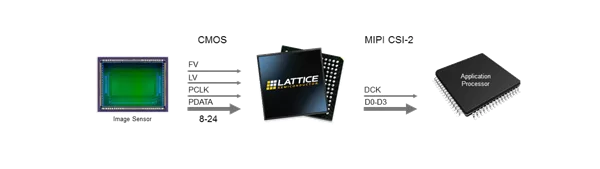
Many traditional image sensors have a CMOS interface. However, many mobile applications processors only have MIPI CSI-2 interfaces. Many new applications want to leverage mobile innovations, while utilizing traditional image sensors with specific requirements and capabilities.
Lattice CrossLink™ is a programmable video interface bridging device capable of converting image sensors with CMOS interfaces up to 300 MHz to MIPI CSI-2 interfaces at up to 6 Gbps. This bridge is available as free IP in Lattice Diamond® for allowing easy configuration and setup.
Features * Supports MIPI DSI and MIPI CSI-2 outputs up to 6 Gbps: 1, 2 or 4 data lanes
* Supports parallel MIPI DPI, CMOS, RAW and RGB interfaces at up to 300 MHz
* Supports CSI-2 compatible video formats (RAW, RGB, and YUV): * 8-bit YUV420/422
* 10-bit YUV420/422
* 8-bit RAW8
* 10-bit RAW10
* 12-bit RAW12
* 24-bit RGB888
* Supports DSI compatible video formats (RGB) : * 18-bit RGB666
* 24-bit RGB888
* Supports multiple pixels per clock mode * 10, 8, 6, 4, and 1 for RAW8/10/12
* 4, 2, and 1 for RGB888/666
* Provides a DCS (Display Command Set) controller to program the display, ROM data used only for DSI in HS or LPDT mode – ROM is programmable by user
* Configurable 2-bit VC (Virtual Channel), 6-bit DT (Data Type), and 16-bit WC (Word Count)
* Supports Non-burst Mode with Sync Events for Transmission Packet Sequence
* Compliance with MIPI D-PHY Specification v1.1
* Compliance with DSI and CSI-2 Specification v1.1
Learn more about MIPI IP core
Imagine a camera subsystem that responds in microseconds, consumes less power, and offers a more straightforward route to time-to-market. For SoC architects and IP integration teams, that vision is increasingly possible with MIPI Camera Control Interface (CCI) over I3C.
High-speed chip-to-chip data transfer is continuously evolving to meet increasing performance demands. MIPI MPHY is a high-speed physical layer interface developed by the MIPI Alliance. This protocol is used for high-speed chip-to-chip interfaces, mainly in mobile and automotive devices.
From the first monochrome mobile displays to today’s ultra-high-definition automotive dashboards and immersive AR/VR headsets, MIPI technology has quietly become the backbone of modern data connectivity. Let’s explore how MIPI standards have evolved, the markets they serve, and why Rambus is at the forefront of this transformation.
The latest advancements in the MIPI D-PHY and MIPI C-PHY specifications and their potential to transform vision and imaging technologies.
Higher link speeds, security and a compliance program have been added to the MIPI Automotive SerDes Solutions framework.
Andrew Elias (NVIDIA), SriDeepti Pisipati (Synopsys)