Overview
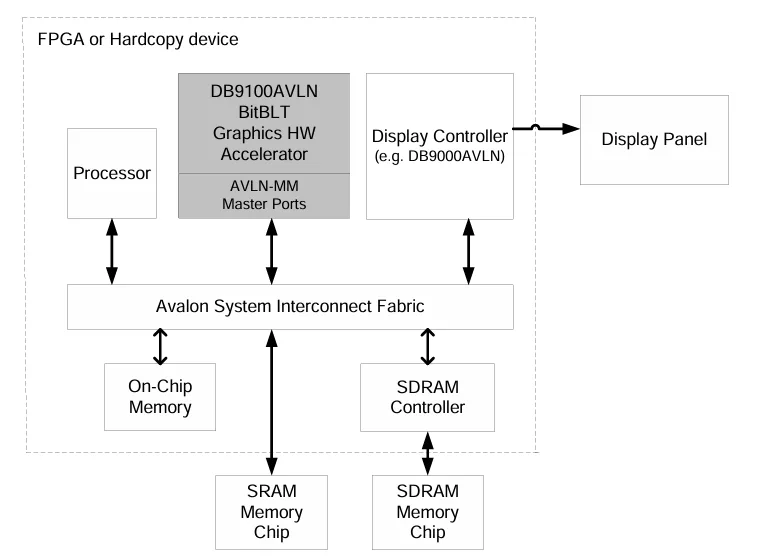
The DB9100AVLN BitBLT Graphics Hardware Accelerator Verilog IP Core renders a graphics frame by generating new bitmaps from commands to combining existing bitmaps on and off-screen using one of 256 Raster Operations. A Raster Operation (ROP) is a bitwise Boolean operation (such as AND, OR, XOR, NOT).
The DB9100AVLN also contains a Monochrome Bitmap Color Expansion feature, typically used for font expansion of compressed character bitmaps. A 1-bit depth bitmap is expanded to one of two colors, a foreground or background color, with the foreground color representing the text, and the background color the non-text background.
The DB9100AVLN also contains a programmable Alpha Blend unit, blending two bitmaps into one.
The DB9100AVLN interfaces to a microprocessor and frame buffer memory via the Altera Avalon Interconnect, providing a lower power solution. The DB9100AVLN contains a DMA Command Linked-List Processing Unit, for independently reading and processing graphics commands from the host processor.
Learn more about GPU IP core
A full SoC tape-out at 5nm approaches $400M in fully loaded, non-recurring engineering and mask costs. At 3nm, estimates push past $600M. Every IP block on that die is a commitment to a set of assumptions about what the silicon will need to do. In AI, those assumptions have a shorter shelf life than they used to.
Discover why the future of edge GPU design focuses on power efficiency over area, driven by thermal constraints at sub-2nm nodes. Learn about architectural shifts and Imagination's innovative solutions.
The automotive industry is undergoing the most significant transformation since the advent of electronics in cars. Vehicles are becoming software-defined, connected, AI-driven, and continuously updated. This evolution brings extraordinary new capability – but it also brings greater levels of cybersecurity and functional-safety risks.
Scaling GPU performance across multiple cores sounds simple in theory: add more cores, get more performance. In practice, it’s one of the toughest challenges in graphics architecture. While some workloads scale well thanks to their independent nature, some workloads, especially geometry processing, introduce order dependencies that make linear performance scaling a tricky problem to solve for every GPU architecture in the industry.
In this paper, the authors aim to demystify the implementation of NVIDIA GPU-CC system by piecing together the fragmented and incomplete information disclosed from various sources.