Vendor: Mixel, Inc. Category: Single-Protocol PHY

ASA Motion Link PHY

Overview

The Mixel Automotive SerDes Alliance Motion Link (ASA-ML) PHY is a high-speed Automotive SerDes solution compliant with the Automotive SerDes Alliance (ASA) Motion Link standard. Mixel was the first IP provider to announce support for this IP in 2025.
It provides an asymmetric high-bandwidth link optimized for automotive applications, enabling efficient connectivity between cameras, sensors, and displays in modern vehicle architectures.
It supports multi-gigabit data rates, up to 8 Gbps downstream and up to 4 Gbps upstream, depending on the target application and use case.

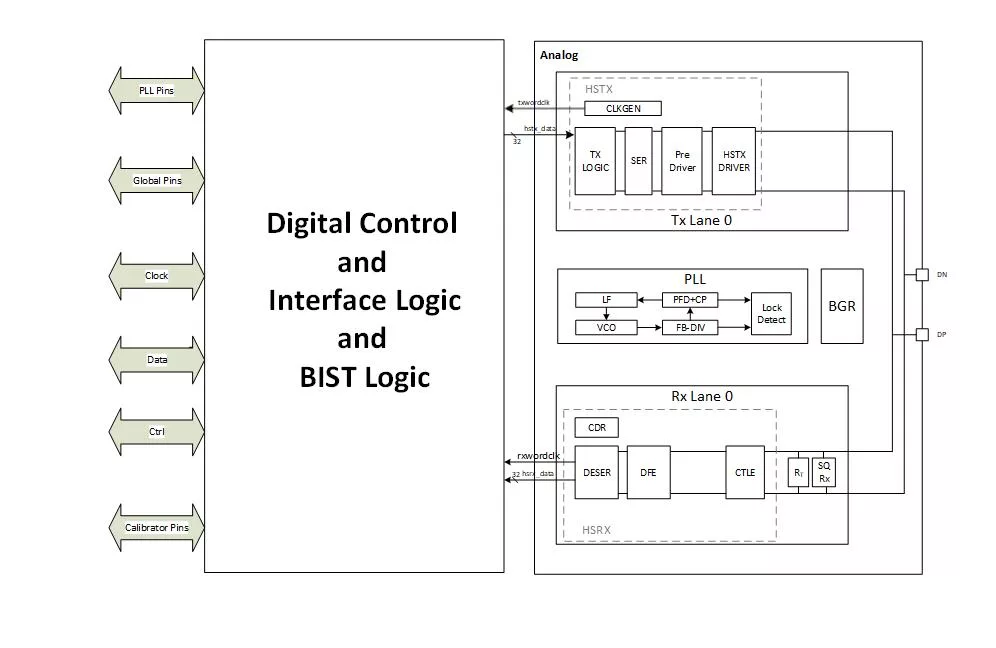
The PHY is organized at the lane level, where each lane comprises analog and digital components. The digital portion manages lane operation by controlling the analog front-end and interfacing with the Data Link layer, ensuring proper coordination between data processing and high-speed signaling.
On the transmit (TX) side, the analog front-end includes a serializer and transmitter. The serializer converts parallel data into a serial bitstream, which is then driven onto the channel by the transmitter. On the receive (RX) side, the incoming serial data is recovered and converted back into parallel data using a clock-and-data recovery mechanism and a deserializer, ensuring accurate data reconstruction.

The PHY is designed to operate over typical automotive channels, including coaxial cables and shielded twisted pair (STP), supporting reach on the order of several meters up to 10–15 meters, depending on cable quality, data rate, and system design. Advanced equalization techniques in the receiver compensate for channel loss and signal degradation, enabling robust performance over challenging automotive channel conditions.

This lane-based architecture, combining digital control with high-performance analog transmission and reception, enables robust, high-speed, and scalable data communication across automotive links.

Key features

  • Supports Automotive SerDes Alliance Transceiver Specification v2.1
  • Supports up to 8 Gbps (Speed Grade 3) downstream for TX and RX directions
  • Supports up to 4 Gbps (Speed Grade 2) upstream for TX and RX directions
  • Supports different Equalization options for link speed enhancement
    • RX Equalization (CTLE & DFE)
    • TX FIR Equalization
  • Analog Test Coverage through internal loopback
  • Eye monitor for internal eye-opening measurement
  • Supports differential signaling on STP cabling and single-ended signaling on coaxial cabling
  • On-chip calibrator for resistance termination
  • Line fault detection
  • Automotive Grade ESD (4kV HBM and 750V CDM)

Block Diagram

Specifications

Identity

Part Number
ASA Motion Link PHY
Vendor
Mixel, Inc.
Type
Silicon IP
Application
Automotive
Controller / PHY
PHY

Files

Note: some files may require an NDA depending on provider policy.

Provider

Mixel, Inc.
HQ: USA
Mixel is a leading provider of mixed-signal IPs and offers a wide portfolio of high-performance mixed-signal connectivity IP solutions. Mixel’s mixed-signal portfolio includes PHYs and SerDes, such as MIPI D-PHY, M-PHY, C-PHY, LVDS, and many dual mode PHY supporting multiple standards. Mixel‘s IPs have been integrated into many of today’s most exciting applications, such as mobile platforms, automotive, IoT, VR, and wearables, among many others. Mixel was founded in 1998 and is headquartered in San Jose, CA, with global operation to support a worldwide customer base.

Learn more about Single-Protocol PHY IP core

UFS Goes Mainstream

UniversalFlash Storage (UFS) was created for mobile applications and computer systems requiring high performance and low power consumption. These systems typically use embedded Flash based on the JEDEC standard eMMC. UFS was defined by JEDEC as the evolutionary replacement for eMMC offering significantly higher memory bandwidth. The standard builds on existing standards such as the SCSI command set, the MIPI Alliance M-PHY and UniPro as well as eMMC form factors to simplify adoption and development.

Design IP Faster: Introducing the C~ High-Level Language

In this paper, we introduce a new high-level, dataflow programming language called C~ (“C flow”) that further increases productivity by raising the level of abstraction from behavioral descriptions, while overcoming the limitations of C for hardware design. We present the syntax and semantics of this language, and the framework that provides hardware and software code generation. This paper illustrates the benefits of using C~ for hardware design of a IEEE 802.3 MAC, synthesized for FPGA and for 90nm CMOS technology.

Universal Flash Storage: Mobilize Your Data

Universal Flash Storage (UFS) was created for mobile applications and computer systems requiring high performance and low power consumption. These systems typically use embedded Flash based on the JEDEC standard eMMC. UFS was defined by JEDEC as the evolutionary replacement for eMMC offering significantly higher memory bandwidth. The standard builds on existing standards such as the SCSI command set, the MIPI Alliance M-PHY and UniProSM as well as eMMC form factors to simplify adoption and development.

Can MIPI and MDDI Co-Exist?

Since MIPI and MDDI standards both target interfaces to cameras and displays on mobile devices, are two separate standards really needed?

Frequently asked questions about Single-Protocol PHY IP

What is ASA Motion Link PHY?

ASA Motion Link PHY is a Single-Protocol PHY IP core from Mixel, Inc. listed on Semi IP Hub.

How should engineers evaluate this Single-Protocol PHY?

Engineers should review the overview, key features, supported foundries and nodes, maturity, deliverables, and provider information before shortlisting this Single-Protocol PHY IP.

Can this semiconductor IP be compared with similar products?

Yes. Buyers can compare this product with similar semiconductor IP cores or IP families based on category, provider, process options, and structured technical specifications.

×
Semiconductor IP