AMBA APB 5,4,3,2 Verification IP
The AMBA APB Verification IP provides an effective & efficient way to verify the components interfacing with the AMBA® APB bus of…
Overview
The AMBA APB Verification IP provides an effective & efficient way to verify the components interfacing with the AMBA® APB bus of an IP or SoC. The AMBA APB VIP is fully compliant with standard AMBA® 2APB, AMBA® 3 APB v1.0, AMBA 3 APB v.2.0 (aka APB4), and AMBA APB5 specification from ARM. This VIP is a lightweight VIP with an easy plug-and-play interface so that there is no hit on the design cycle time.
Key features
- Compliant to AMBA APB5, AMBA APB v.2.0 (aka APB4), AMBA® 3 APB v1.0 and AMBA® 2APB.
- Support for all types of AMBA APB devices.
- Supports Parameterized data and address bus.
- Supports bus-endian converter/checker.
- Supports continuous transfer mode configuration (SETUPACCESS-SETUP) and protected accesses.
- Rich set of configuration parameters to control APB functionality including constrained randomization of protocol attributes.
- Supports various and Configurable types of memory accesses (read-only, secure, reserved etc.)
- Configurable wait states.
- Support for both secure and non-secure transactions.
- Support for Wakeup signals, User signals, and odd parity checking for all signals.
- Support for Realm Management Extension for physical address spaces.
- Supports UVM_RAL Model.
- Provides detailed performance monitoring for all the transfers.
- Supports advanced System Verilog features like constrained random testing.
- Supports dynamically configurable modes.
- Strong Protocol Monitor with real-time exhaustive programmable checks.
- Supports Dynamic as well as Static Error Injection scenarios.
- On-the-fly protocol checking using protocol check functions, static and dynamic assertion.
- Built-in Coverage analysis.
- Provides a comprehensive user API (callbacks) in all BFMs.
- Graphical analyzer to show transactions for easy debugging.
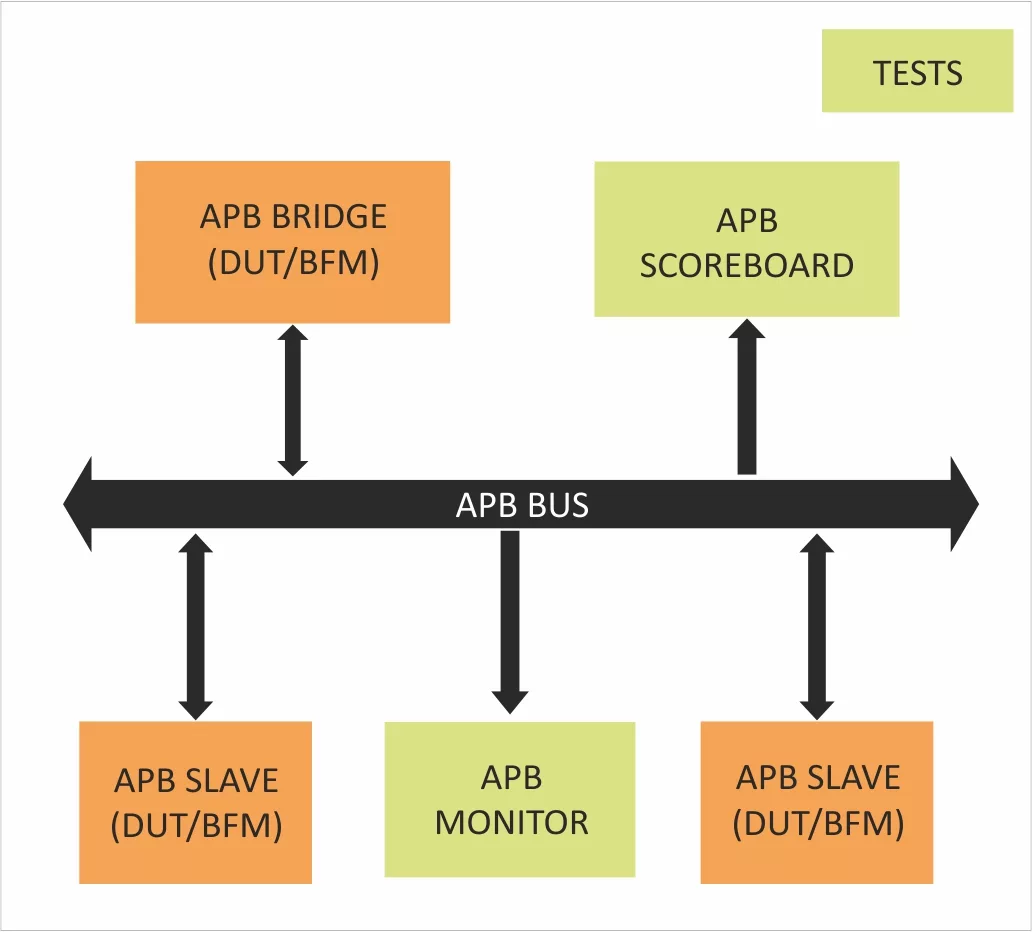
Block Diagram
Benefits
- Available in native SystemVerilog (UVM/OVM/VMM) and Verilog
- Unique development methodology to ensure highest levels of quality
- Availability of various Regression Test Suites
- 24X5 customer support
- Unique and customizable licensing models
- Exhaustive set of assertions and cover points with connectivity example for all the components
- Consistency of interface, installation, operation and documentation across all our VIPs
- Provide complete solutions and easy integration in IP and SoC environment
What’s Included?
- AMBA APB Bridge/Slave Agent
- AMBA APB Bus Monitor and Scoreboard
- Test Environment & Test Suite:
- Basic and Directed Protocol Tests
- Random Tests
- Error Scenario Tests
- Assertions & Cover Point Tests
- Integration Guide, User Manual, and Release Notes
Specifications
Identity
Files
Note: some files may require an NDA depending on provider policy.

Provider
- To create world class Verification IP Solutions
- To provide expert consultancy to ASIC & SoC Design companies
- To design SOCs from Architecture to Working Silicon
- To be the leading provider of Semiconductor IP Solutions
- To be a one-stop-shop for Design and Verification
- Customer Success
- Commitment to Quality
- Quality of Products
- Quality of Engineers
- Best in class Customer Support
- Ethics and Integrity
Learn more about Protocol Bridge IP core
Script/simulation approach speeds SoC verification
A comparison of Network-on-Chip and Busses
Synthesizable verification IP speeds design cycle
Synthesizable Verification IP
IP Core for an H.264 Decoder SoC
Frequently asked questions about Protocol Bridge IP cores
What is AMBA APB 5,4,3,2 Verification IP?
AMBA APB 5,4,3,2 Verification IP is a Protocol Bridge IP core from Truechip Solutions listed on Semi IP Hub.
How should engineers evaluate this Protocol Bridge?
Engineers should review the overview, key features, supported foundries and nodes, maturity, deliverables, and provider information before shortlisting this Protocol Bridge IP.
Can this semiconductor IP be compared with similar products?
Yes. Buyers can compare this product with similar semiconductor IP cores or IP families based on category, provider, process options, and structured technical specifications.