Vendor: NTLab Category: Filters

9.6 MHz to 25 MHz Low pass filter

Low pass filter (3rd order Chebyshev filter) is based on the gyrators with cut-off frequency adjustment in wide range.

Overview

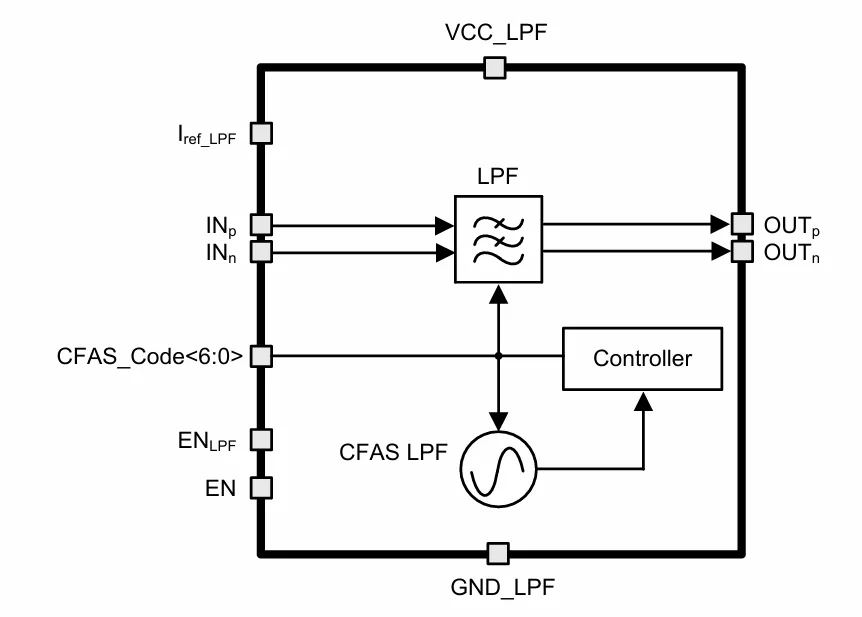
Low pass filter (3rd order Chebyshev filter) is based on the gyrators with cut-off frequency adjustment in wide range. There are two modes for cut-off frequency programming: manually and automatically. The generator is used to adjust filter cut-off (CO) frequency in automatic mode. Also CO frequency can be fixed by the digital code CFAS_Code<6:0>.
The block fabricated on AMS BiCMOS 0.35 um technology.
Key features

  • AMS BiCMOS 0.35 um
  • Wide pass band frequency adjustment range (9.6 MHz…25 MHz)
  • Low group delay time ripple vs. Frequency
  • Low pass filter cut-off frequency adjustment system (LPF CFAS)
  • Portable to other technologies (upon request)

Block Diagram

Applications

  • Signal processing systems
  • Navigation systems

What’s Included?

  • Schematic or NetList
  • Abstract model (.lef and .lib files)
  • Layout view (optional)
  • Behavioral model (Verilog)
  • Extracted view (optional)
  • GDSII
  • DRC, LVS, antenna report
  • Test bench with saved configurations (optional)
  • Documentation

Specifications

Identity

Part Number
350AMS_LPF_04
Vendor
NTLab
Type
Silicon IP

Files

Note: some files may require an NDA depending on provider policy.

Provider

NTLab
HQ: Lithuania
NTLab is a vertically integrated microelectronics design center. It has 70+ experienced and qualified engineers. NTLab specializes in the designing of mixed-signal and RF ICs and Systems-on-Chip. It has a wide range of own silicon-verified IP blocks: processor cores, interfaces, analog and high-frequency PHYs, etc., thus allowing customized design to be fast and predictable. In-company unique combination of competences in digital, analog and RF circuits and embedded software enables NTLab to participate in the projects that require deep research and utilize most sophisticated and advanced techniques: multi-system GPS/GLONASS/Galileo/BeiDou/NavIC(IRNSS)/QZSS/SBAS navigation, RF ID, wireless communications, etc. All designed ICs are provided with test and development tools, as well as with reference software. NTLab offers a wide range of silicon proven analog/mixed-signal IPs in 0.35µm, 0.25 µm, 0.18 µm, 0.13 µm, 0.09 µm, 65nm, 55nm, 40nm, 28nm, 22 nm CMOS and SiGe BiCMOS processes. These IPs are suitable for devices targeted both consumer and industrial markets. Most of these IPs have been proven in silicon on the foundries: Samsung, UMC, GlobalFoundries, SMIC, VIS, Tower, X-FAB, iHP, AMS, SilTerra, STMicroelectronics, Winfoundry.

Learn more about Filters IP core

Understanding cascaded integrator-comb filters

The previously obscure CIC filter is now vital to many high-volume wireless communications tasks and equipment. Using CIC filters can cut costs, improve reliability, and help performance. Here's a primer to get you started.

Revisiting the analogue video decoder: Brushing up on your comb filters

With such a large number of video decoders in the market it might seem an unnecessary indulgence to spend time looking again at the design of this fundamental but apparently obsolete building block, and certainly new designs are not appearing on the market and haven't done so for three or four years.

Ensuring reliability in Advanced IC design

To complete our task as engineers we rely on the tools we use. We collaborated with Siemens EDA solutions back in 2025 on a webinar about how we use their tools to develop our designs and layouts.

Frequently asked questions about filter IP cores

What is 9.6 MHz to 25 MHz Low pass filter?

9.6 MHz to 25 MHz Low pass filter is a Filters IP core from NTLab listed on Semi IP Hub.

How should engineers evaluate this Filters?

Engineers should review the overview, key features, supported foundries and nodes, maturity, deliverables, and provider information before shortlisting this Filters IP.

Can this semiconductor IP be compared with similar products?

Yes. Buyers can compare this product with similar semiconductor IP cores or IP families based on category, provider, process options, and structured technical specifications.

×
Semiconductor IP