2D Graphics Hardware Accelerator (AXI Bus)
The Digital Blocks DB9200AXI 2D Graphics Hardware Accelerator / Engine Verilog IP Core renders graphics frames as follows: Genera…
Overview
The Digital Blocks DB9200AXI 2D Graphics Hardware Accelerator / Engine Verilog IP Core renders graphics frames as follows:
- Generates bitmaps from graphics instructions as well as combining existing bitmaps on and off-screen using one of 256 Raster Operations. A Raster Operation (ROP) is a bitwise Boolean operation (such as AND, OR, XOR, NOT) which lay the foundation for power hardware graphics primitive operations
- Generates characters from compressed bitmaps using its FONT Bitmap Color Expansion Unit
- Performs Alpha Blend operations of bitmaps with its Alpha Blend unit
- Draws lines, polygons, circles using its hardware efficient & pixel accurate Bresenham Algorithm Line Drawing Unit
The DB9200 2D Graphics Hardware Engine provides options for higher graphics performance as a Graphics Processing Unit (GPU) as follows:
- Display List Processing Unit - reads in the graphics instructions for execution
- Parallel Pixel Processing - as wide as the AXI Interconnect Data
- Memory Interface Units - with DMA Controller that can burst in and out pixels, helping to unlock the graphics memory bottleneck.
Key features
- Bit Block Transfer – 3 Independent Memory Sources of data:
- On-Screen & Off-Screen Data Block (SRC)
- Off-Screen Fixed Pattern Data Block (PTN)
- On-Screen visible Data Block (DST)
- Raster Operations (ROP) performed on Block Transfers:
- 256 Raster Operations
- ROP0, ROP1, ROP2, & ROP3 operations
- Includes industries most popular 16 ROPs
- BitBLT Draw Features:
- Pixels, Horizontal & Vertical Lines
- Overlapping & Non-Overlapping Block Transfers
- Solid Color Block Fills
- FONT Monochrome Bitmap to Color Expansion, either Transparent or Opaque
- Rotation Block Transfers: 0, 90, 180, 270 degrees
- Block Stretch on X & Y Axis
- Alpha Blending
- Sprite Moves
- Line Draw Graphics Operations:
- Pixel Draw
- Line (Vector) Draw
- Poly Line Draw (up to 16 segments)
- Circle Draw
- Ellipse - (Option – Please contact Digital Blocks)
- Command FIFO or Link-List Display Processing Unit:
- Simplifies Processor Interface
- Minimizes Processor Overhead
- High-performance Read/Write DMA Controllers for data transfer from/to memory
- Frame Buffer & Display Features Supported:
- Display Resolutions 4K x 4K
- 4 GB Memory Range
- 8, 16 , 24, & 32 bits-per-pixel color depths
- Interrupt Controller with 3 sources of internal interrupts with masking control
- Reference Software Driver Included
- Reference Driver
- Graphics API Reference Design
- On-Chip Interconnect Compliance - AXI:
- AMBA AXI Protocol Specification (V2.0)
- FPGA Integration Support:
- Altera Quartus II & Qsys Integration & ARM / NIOS II EDS Reference Design
- Xilinx Vivado IP Integrator & Reference Design
- ASIC / ASSP Design-In Support:
- Compliance to RTL Design, Coding, & Verification Standards
- Digital Blocks Support Services
- Compatible with optional Digital Blocks DB9000 Family of TFT LCD Controller IP Cores and Reference Designs
- Fully-synchronous, synthesizable Verilog RTL core.
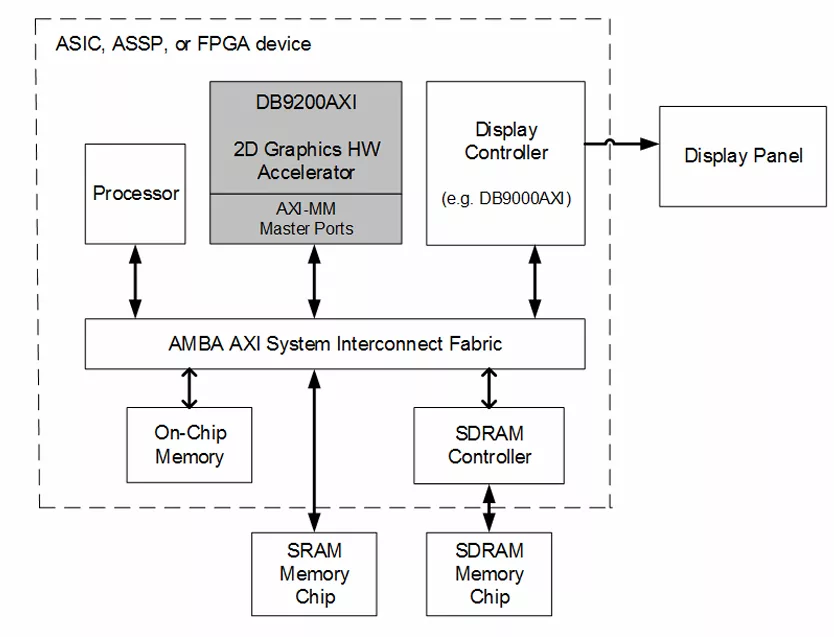
Block Diagram
What’s Included?
- The DB9200AXI is available in RTL Verilog, along with synthesis scripts, a simulation test bench with expected results, reference design, datasheet, and user manual.
Files
Note: some files may require an NDA depending on provider policy.
Specifications
Identity
Provider
Learn more about GPU IP core
Power, Not Area: Why Edge GPU Design Is Entering a New Era
What Does a GPU Have to Do With Automotive Security?
How Alternate Geometry Processing Enables Better Multi-Core GPU Scaling
Desktop-Quality Ray-Traced Gaming and Intelligent AI Performance on Mobile with New Arm Mali G1-Ultra GPU
NVIDIA GPU Confidential Computing Demystified
Frequently asked questions about GPU IP cores
What is 2D Graphics Hardware Accelerator (AXI Bus)?
2D Graphics Hardware Accelerator (AXI Bus) is a GPU IP core from Digital Blocks, Inc. listed on Semi IP Hub.
How should engineers evaluate this GPU?
Engineers should review the overview, key features, supported foundries and nodes, maturity, deliverables, and provider information before shortlisting this GPU IP.
Can this semiconductor IP be compared with similar products?
Yes. Buyers can compare this product with similar semiconductor IP cores or IP families based on category, provider, process options, and structured technical specifications.