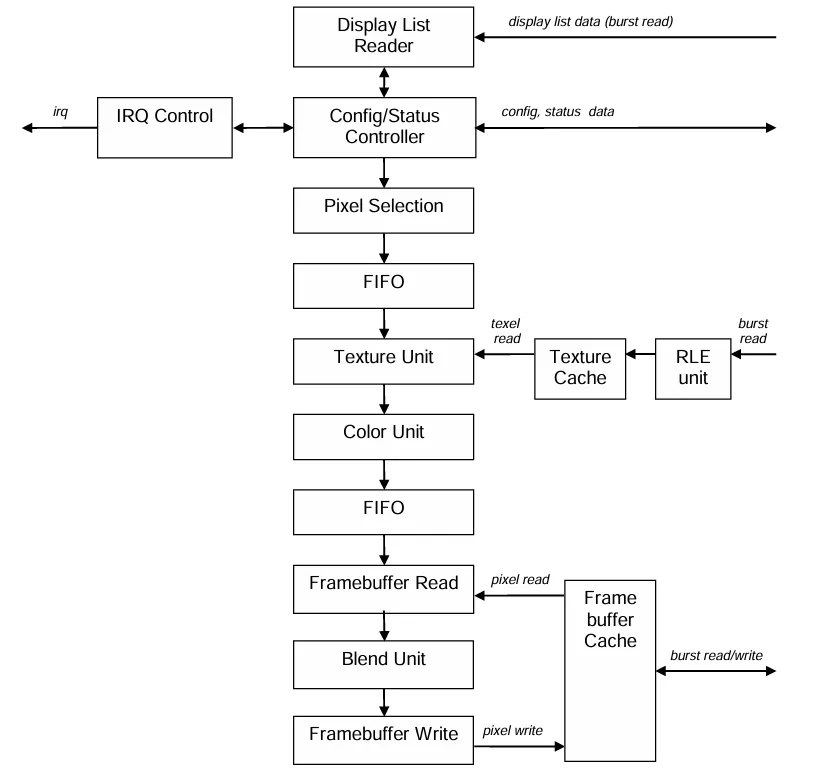
Overview
D/AVE 2D is a 2D GPU Hardware IP Core, optimized for easy integration into FPGAs and ASICs. Focus of D/AVE 2D is to provide cost efficient high quality vector graphics with subpixel processing and an extended anti-aliasing functionality.
D/AVE 2D has been developed for all applications that benefit from high quality vector graphics. Examples are Graphical User Interface (GUI), Navigation, Dashboard and OSD applications in the Consumer, Wearable, Industrial, Automotive and Aviation area.
D/AVE 2D Variants
The D/AVE 2D core is available in two different variants. A ‘standard’ version named D/AVE 2D-TS and footprint optimized ‘lite’ version named D/AVE 2D-TL. The major differences between both cores are that D/AVE 2D-TL is not supporting performance counting and is slower in terms of pixel processing. The D/AVE 2D-TS render pipeline produces one pixel per cycle, D/AVE 2D-TL needs four cycles for a pixel.Since this peak performance cannot be fully reached in most use cases anyway due to bus bandwidth and latency limitations, the performance difference from application point of view is in the range of a factor of 2-3 instead of 4.
D/AVE 2D-TL feature restrictions vs. D/AVE 2D-TS :
- Sub-byte texture formats (1,2 and 4bpp) as well as CLUT formats are not available in D/AVE 2D-Lite.
- Color-keying is not available in D/AVE 2D-Lite.
- Run Length Encoded textures are not available in the current version of D/AVE 2D-Lite.
- Alpha channel blending in the blend unit is not available in the current version of D/AVE 2D-Lite.
Contents of D/AVE 2D EvalKit
- D/AVE 2D Qsys component, run-time limited
- Precompiled FPGA configurations (.sof files) for Altera Development Kits
- Precompiled demo applications for Altera Development Kits
- Example Quartus II projects for hardware integration of D/AVE 2D
- Example Nios II IDE projects for software integration of D/AVE
- D/AVE 2D API documentation
- Demo source code for showing usage of D/AVE 2D API
- Nios II libraries of D/AVE 2D driver
- Nios II sources of lowlevel driver
- Windows software emulation of D/AVE 2D (SoftDAVE)
Learn more about GPU IP core
A full SoC tape-out at 5nm approaches $400M in fully loaded, non-recurring engineering and mask costs. At 3nm, estimates push past $600M. Every IP block on that die is a commitment to a set of assumptions about what the silicon will need to do. In AI, those assumptions have a shorter shelf life than they used to.
Discover why the future of edge GPU design focuses on power efficiency over area, driven by thermal constraints at sub-2nm nodes. Learn about architectural shifts and Imagination's innovative solutions.
The automotive industry is undergoing the most significant transformation since the advent of electronics in cars. Vehicles are becoming software-defined, connected, AI-driven, and continuously updated. This evolution brings extraordinary new capability – but it also brings greater levels of cybersecurity and functional-safety risks.
Scaling GPU performance across multiple cores sounds simple in theory: add more cores, get more performance. In practice, it’s one of the toughest challenges in graphics architecture. While some workloads scale well thanks to their independent nature, some workloads, especially geometry processing, introduce order dependencies that make linear performance scaling a tricky problem to solve for every GPU architecture in the industry.
In this paper, the authors aim to demystify the implementation of NVIDIA GPU-CC system by piecing together the fragmented and incomplete information disclosed from various sources.