Overview
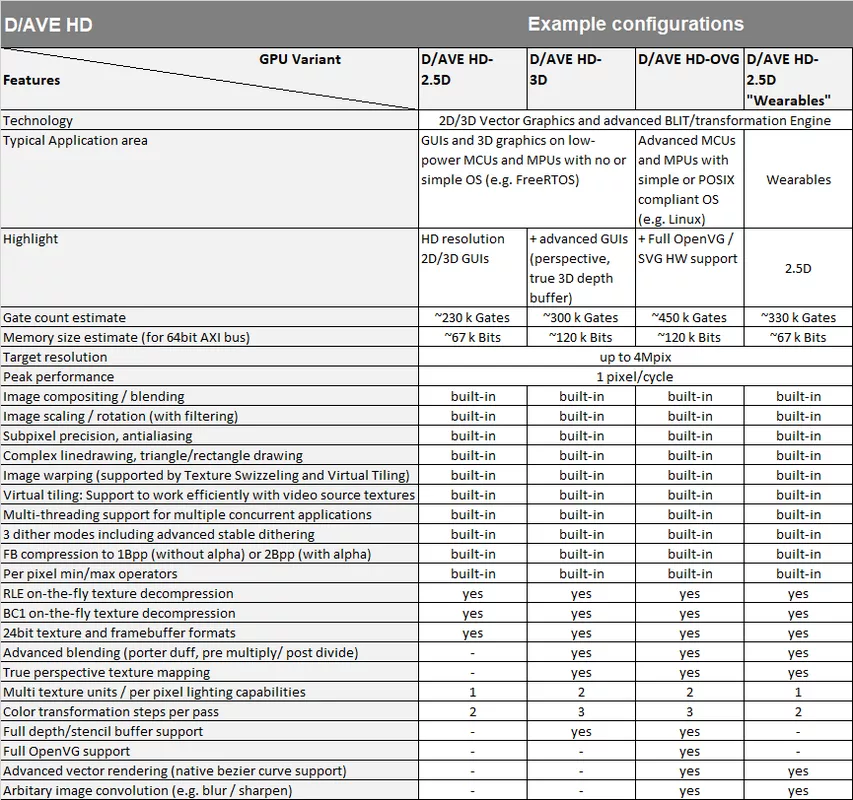
The D/AVE HD 2.5D GPU family is an evolution of the D/AVE 2D family supporting high quality 2D and 3D rendering for displays up to 4K x 4K. Targeting modern graphics applications on high resolution displays in the Industrial, Medical, Military, Avionics, Automotive and Consumer markets, the D/AVE HD fixed-function 2.5D GPU core is designed to be fast with powerful functionality. In addition, it is configurable regarding feature set versus footprint. The resource optimized variants are the ideal choice e.g. for feature rich wearables, smart watches and IoT devices with animated vector graphics 2D and 3D GUIs, while the fully featured variants target performance demanding graphics in professional and high-end consumer electronics applications including full OpenVG 1.1 vector graphics support.
D/AVE HD is available for both FPGA and ASIC integration with high customizability and scalability and silicon proven for many years e.g. in automotive products.
Product Updates
In 2022 D/AVE HD got several updates especially targeting low-power and low-cost mass market applications such as wearables and general purpose MCUs. Here a summary of the most important improvements:
- TES new Framebuffer Compression down to 1 byte per pixel
- TES new Stable Dithering modes - allowing additional "high-quality framebuffer compression" down to 2 byte per pixel
- BC1 texture compression
- Support for additional frambuffer and texture formats:
- 24bit color formats RGB 888, BGR 888, ARGB 8565, RGBA 5658
- 8bit formats ARGB 2222, RGBA 2222
- Excellent customizability for optimal feature/footprint balance
- Improved integrability
Learn more about GPU IP core
A full SoC tape-out at 5nm approaches $400M in fully loaded, non-recurring engineering and mask costs. At 3nm, estimates push past $600M. Every IP block on that die is a commitment to a set of assumptions about what the silicon will need to do. In AI, those assumptions have a shorter shelf life than they used to.
Discover why the future of edge GPU design focuses on power efficiency over area, driven by thermal constraints at sub-2nm nodes. Learn about architectural shifts and Imagination's innovative solutions.
The automotive industry is undergoing the most significant transformation since the advent of electronics in cars. Vehicles are becoming software-defined, connected, AI-driven, and continuously updated. This evolution brings extraordinary new capability – but it also brings greater levels of cybersecurity and functional-safety risks.
Scaling GPU performance across multiple cores sounds simple in theory: add more cores, get more performance. In practice, it’s one of the toughest challenges in graphics architecture. While some workloads scale well thanks to their independent nature, some workloads, especially geometry processing, introduce order dependencies that make linear performance scaling a tricky problem to solve for every GPU architecture in the industry.
In this paper, the authors aim to demystify the implementation of NVIDIA GPU-CC system by piecing together the fragmented and incomplete information disclosed from various sources.