Overview
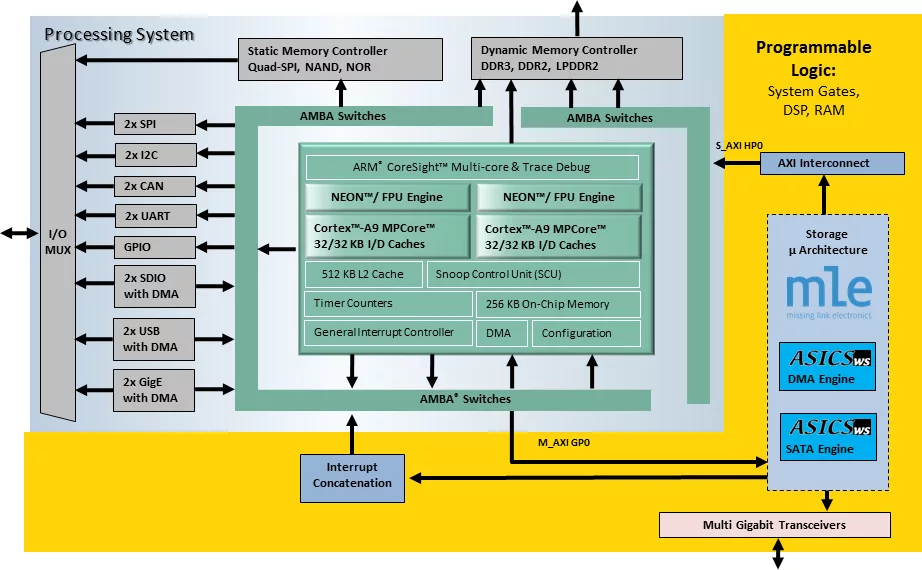
MLE's Zynq SATA Storage Extension (Zynq SSE) is a fully integrated and pre-validated system stack comprising 3rd-party SATA Host Controller and DMA IP cores from ASICS World Services, a storage micro-architecture from MLE, Xilinx PetaLinux, and an Open Source SATA Host Controller Linux kernel driver, also from MLE. Zynq SSE utilizes the Xilinx GTP/GTX Multi-Gigabit Transceivers to integrate physical SATA connectivity.
Zynq SSE is delivered as a complete reference design for the Xilinx Zynq-7000 All Programmable SoC (Zynq), and effectively extends Zynq with one single SATA host port for HDD and SSD storage connectivity.
A novel license fee structure reflects the needs of Zynq's Embedded Linux users for simple and affordable SATA.
Learn more about SATA Controller IP core
Many times we are not aware of very useful EDA tool options which are already available. Even if such options are very well documented, we don't look at them and try them. But some options are very useful and if you know them, it makes job of design engineer and/or verification engineer very easy. Here, I am going to talk about one very powerful and useful VSIM option of QuestaSim. It is VCDSTIM option of VSIM.
The paper describes the methodology used for functional verification of the USB 3.0 device controller core. The core model has been developed at two different levels of abstraction: RTL model for synthesis and SystemC TLM model for high speed simulation, early software development and early test-bench creation.
Oftentimes, in order to save on the cost of IP, a company will select an encrypted netlist as the deliverable instead of the RTL source code. This is especially common among companies looking to develop in FPGA devices where they can often get the necessary IP from their FPGA vendor.
To support High Definition Television (HDTV) application, the System on Chip (SoC) presented in this paper has to support multiple and concurrent internal processes. Most of these operations read data from memory, process them and store the resulting data into memory. Each functional unit of the system is responsible for a specific data processing, but all the data are stored in the same shared external memories.
Eric Esteve
Eric Esteve