Xccela PSRAM Memory Model
Xccela PSRAM Memory Model provides an smart way to verify the Xccela PSRAM component of a SOC or a ASIC.
Overview
Xccela PSRAM Memory Model provides an smart way to verify the Xccela PSRAM component of a SOC or a ASIC. The SmartDV's Xccela PSRAM memory model is fully compliant with standard Xccela PSRAM Specification and provides the following features. Better than Denali Memory Models.
Xccela PSRAM Memory Model is supported natively in SystemVerilog, VMM, RVM, AVM, OVM, UVM, Verilog, SystemC, VERA, Specman E and non-standard verification env
Xccela PSRAM Memory Model comes with optional Smart Visual Protocol Debugger (Smart ViPDebug), which is GUI based debugger to speed up debugging.
Key features
- Supports Xccela PSRAM memory devices from all leading vendors
- Supports 100% of Xccela PSRAM protocol standard
- Supports all the Xccela PSRAM commands as per the specs
- Supports below Low Power Features
- Partial Array Self-Refresh (PASR)
- Auto Temperature Compensated Self-Refresh (ATCSR) by built-in temperature sensor
- User configurable refresh rate
- Ultra Low Power (ULP) Half Sleep mode with data retained
- Supports Software Reset
- Reset Pin Available
- Supports Data Mask (DM) for write data
- Supports Data Strobe (DQS) enabled high speed read operation
- Supports Register Configurable write and read initial latencies
- Supports Write Burst Length, maximum 1024 bytes, minimum 2 bytes
- Supports Wrap & Hybrid Burst in 16/32/64/1K lengths
- Supports Linear Burst Command
- Row Boundary Crossing (RBX) for Read can be enabled via Mode Register
- RBX Write is NOT supported
- RA[13] Boundary Crossing is NOT supported between 2 dies
- Supports 16MB, 32MB, 64MB, 128MB, 256MB density
- Supports x16, x8, x1/x4 IO configuration
- Checks for following
- Check-points include power on, Initialization and power off rules
- State based rules, Active Command rules
- Read/Write Commands rules etc
- All timing violations
- Bus-accurate timing for min, max and typical values
- Notifies the test bench of significant events such as transactions, warnings, timing and protocol violations
- Constantly monitors Xccela PSRAM behavior during simulation
- Protocol checker fully compliant with Xccela PSRAM JEDEC draft Specification
- Models, detects and notifies the test bench of significant events such as transactions, warnings, timings and protocol violations
- Built in functional coverage analysis
- Supports callbacks, so that user can access the data observed by monitor
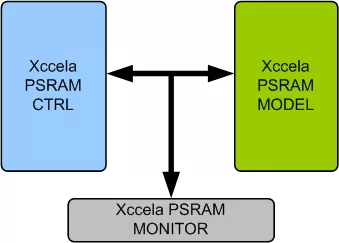
Block Diagram
Benefits
- Faster testbench development and more complete verification of Xccela PSRAM designs.
- Easy to use command interface simplifies monitor control and configuration.
- Simplifies results analysis.
- Runs in every major simulation environment.
What’s Included?
- Complete regression suite containing all the Xccela PSRAM testcases.
- Complete UVM/OVM sequence library for Xccela PSRAM controller.
- Examples showing how to connect and usage of Model.
- Detailed documentation of all class, task and function's used in verification env.
- Documentation also contains User's Guide and Release notes.
Files
Note: some files may require an NDA depending on provider policy.

Specifications
Identity
Provider
Learn more about SRAM IP core
Novel Trade-offs in 5 nm FinFET SRAM Arrays at Extremely Low Temperatures
Why SRAM PUF Technology Is the Bedrock of Dependable Security in Any Chip
AI-driven SRAM demand needs integrated repair and security
A comparison of SRAM vs quantum-derived semiconductor PUFs
Basics of SRAM PUF and how to deploy it for IoT security
Frequently asked questions about SRAM IP cores
What is Xccela PSRAM Memory Model?
Xccela PSRAM Memory Model is a SRAM IP core from SmartDV Technologies listed on Semi IP Hub.
How should engineers evaluate this SRAM?
Engineers should review the overview, key features, supported foundries and nodes, maturity, deliverables, and provider information before shortlisting this SRAM IP.
Can this semiconductor IP be compared with similar products?
Yes. Buyers can compare this product with similar semiconductor IP cores or IP families based on category, provider, process options, and structured technical specifications.