Vendor: Eureka Technology, Inc. Category: System Controller

System Controller

The system controller core connects the system CPU to system memory, PCI bus, IO ports and external communication links.

Overview

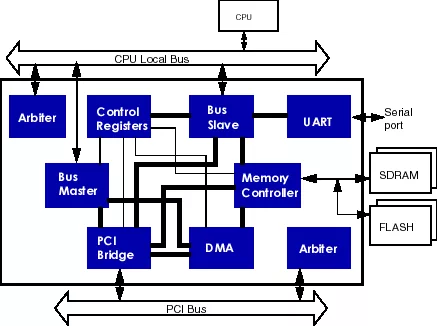
The system controller core connects the system CPU to system memory, PCI bus, IO ports and external communication links. While the CPU’s task in the system is to process data, the system controller’s main function is to coordinate data movement in the system. The system controller contains all the major functional modules required for most System-on-Chip (SOC) application. The entire system controller function can be easily integrated into a single ASIC or PLD.

The system controller contains SDRAM controller, PCI bridge, DMA function, UART, bus arbiter and system control registers. Internal to the system controller, these modules are connected to each other directly to achieve high performance and concurrent data movement between various source and data destinations. Since each module is implemented as synthesizable HDL code, each function can be re-configured or modified as required. All modules are designed with a common interface. The connectivity between the modules can be modified easily to meet different system requirements. Modules not needed for specific application can be removed from the core to minimize die size and gate count.

Different system controllers are available for different CPU types. Currently the CPU supported are: ARM CPU, MIPS CPU with SysAD bus and EC Interface, PowerPC 603, 604, 740, 750, MPC8260, 860, Hitachi SH2, SH3 and SH4. The CPU bus can be 32-bit or 64-bit wide depending on the CPU type. Burst data transfer is supported by the system controller.

CPU Interface

  • Different modules to support ARM, MIPS, PowerPC 603, 604, 740, 750, MPC8260, 860, ARM, Hitachi SH2, SH3 and SH4.
  • Supports different data sizes as required by the CPU.
  • Dispatches CPU request to SDRAM controller, PCI and system registers.
  • Provides direct path for CPU to access DMA, UART and optional user-designed logic block.
  • Centralized control of all access to system control registers.
  • Optionally map PCI target access to system control registers.
  • Optional bus master function to access resource on the CPU bus.

Memory Controller

  • Allows different modules to access system memory.
  • Three request ports to support request from CPU interface, PCI and DMAC.
  • Supports industry standard SDRAM and FLASH.
  • Programmable memory size and data width.
  • Support industry standard 64Mbit, 128Mbit and 256Mbit SDRAMs.
  • Supports zero wait state burst data transfer to maximize data bandwidth.
  • Programmable SDRAM access timing parameters.
  • Automatic refresh generation with programmable refresh intervals.
  • Byte collection for FLASH devices with narrow data width.

DMA Module

  • Multiple independent DMA channels. Each channel transfer data between SDRAM, PCI and IO ports.
  • Burst data transfer optimized for SDRAM access.
  • Optimized for single read FIFO in PCI master read to speed up DMA transfer.
  • Supports both hardware initiated transfer and software initiated block transfer.

PCI Module

  • Operates at different clock domain from CPU bus.
  • PCI specification 2.2 compliant.
  • Dual FIFO to process master write and target write data transfer.
  • Supports data bursting with and without wait states.
  • Master receives requests from DMAC and CPU interface.
  • Base address registers to map to SDRAM, FLASH, and/or System Register.
  • Contains all PCI configuration registers.
  • Host bridge generates configuration access to external PCI devices.
  • Supports PCI type0 and type1 configuration.
  • Arbiter supports 4 or 8 PCI devices.

Key features

  • Designed for ASIC and PLD implementations.
  • Fully static design with edge triggered flip-flops.
  • Supports ARM, I960, PowerPC and SH2-SH4 microprocessors.
  • Fully integrated single chip design provide complete system level functions for all external data access.
  • Replaces multiple discrete devices on the system.
  • Flexible design adaptive to different system requirements.
  • Two different clock domains for CPU and PCI bus interface.
  • Supports concurrent data transfer between CPU, System memory, DMA and PCI bus.
  • System control register distributed in each functional blocks.
  • On-chip connection to user-defined logic blocks.
  • PCI spec 2.2 compliant.
  • Supports industrial standard SDRAMs.

Block Diagram

Files

Note: some files may require an NDA depending on provider policy.

Specifications

Identity

Part Number
System Controller
Vendor
Eureka Technology, Inc.
Type
Silicon IP

Provider

Eureka Technology, Inc.
HQ: USA
Eureka Technology Inc. provides reusable IP cores for ASIC, PLD and system designs. These system level function cores are designed to:
  • Shorten Time-to-market
  • Eliminate Design Risks
  • Reduce Development Costs
As today's technologies evolve in a very fast pace, design engineers are constantly looking for ways to speed up the design cycle in order to have product in the market ahead of the competitions. The use of reusable IP cores in IC and system design has emerged as the methodology of choice to address the needs for rapid productization, fast prototyping and software/hardware co-development. Eureka Technology help design engineers stay in the forefront of this new design methodology by providing reusable IP cores. Our reusable IP cores are silicon proven and pre-verified to meet and exceed customer requirements. Design risk is virtually eliminated since each one of these cores has been fully tested and proven in real world applications. Since founded in 1993, Eureka Technology has established itself as a leading reusable IP core provider with customer base in the United States, Japan, and Europe. We have provided reusable IP cores to many market leaders in the computer, electronics and semiconductor industries. Our technologies have been incorporated into tens of million dollars' worth of products sold by our customers. We also have entered partnership agreements with leading silicon vendors to incorporate our reusable IP cores into their silicon products. However, our important partnership is the one with our customers and we would like to be the design partner for your next project.

Learn more about System Controller IP core

Cortex-M And Classical Series ARM Architecture Comparisons

ARM has introduced many processors. Each set or groups of processors are having different core and different Features. A new entrant or Designer to the ARM can make use of this paper for easy understanding and choose a processor that is well suited for the requirements. This paper gives brief comparison of the Architectures.

DDR2 Signal Integrity

This paper highlights a typical design approach that can be adopted for an embedded PC (X86 based) board memory subsystem using a VIA VX700 system controller DDR2 interface. Boards with this chipset can feature either an Intel Pentium processor or VIA processor on front side bus (FSB).

Extreme partitioning

Small changes in the initial design of a complex embedded system can often have an unpredictable outcome and have a significant impact on the final system performance

Frequently asked questions about system controller IP cores

What is System Controller?

System Controller is a System Controller IP core from Eureka Technology, Inc. listed on Semi IP Hub.

How should engineers evaluate this System Controller?

Engineers should review the overview, key features, supported foundries and nodes, maturity, deliverables, and provider information before shortlisting this System Controller IP.

Can this semiconductor IP be compared with similar products?

Yes. Buyers can compare this product with similar semiconductor IP cores or IP families based on category, provider, process options, and structured technical specifications.

×
Semiconductor IP