SNOW-V Stream Cipher Engine
The SNOW-V IP core implements the SNOW-V stream cipher mechanism, aiming to meet the security demands of modern high-speed commun…
Overview
The SNOW-V IP core implements the SNOW-V stream cipher mechanism, aiming to meet the security demands of modern high-speed communication systems. It conforms to the official SNOW-V mechanism, published in 2019 by the IACR Transactions on Symmetric Cryptology, as an extensive revision of SNOW 3G stream cipher.
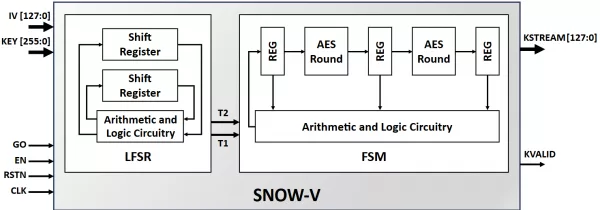
Receiving a 256-bit Key and a 128-bit Initialization Vector (IV), the core processes 128 bits of information in one cycle and it produces a stream of 128-bit keys. It employs two main building blocks, a Linear Feedback Shift Register (LFSR) and a Finite State Machine (FSM) that applies an Advanced Encryption Standard (AES) round function.
The core can be easily incorporated in a Galois/Counter mode (GCM) topology and by interoperating with a Galois Message Authentication Code (GMAC) realize an Authenticated Encryption with Associated Data (AEAD) mechanism. What is more, the core is a drop-in replacement for SNOW 3G in EPS Encryption/Integrity Algorithm (EEA/EIA) architectures and New Radio Encryption/Integrity Algorithm (NEA/NIA) architectures for 4G and 5G communications, while also targeting future mobile network generations (e.g. 6G).
The SNOW-V IP core is a microcode-free and fully synchronous design developed for reuse in ASIC and FPGA implementations, aiming at throughput-demanding environments. The efficient and compact hardware design enables notably high throughput, achieving over 100 Gbps in mainstream ASIC technologies and over 40 Gbps in high-end AMD and Altera FPGAs. Moreover, being a scan-ready, LINT-clean, and single-clock design with a simple handshake interface, facilitates straightforward integration
Key features
Security Mechanism Support
- SNOW-V stream cipher
- IACR 2019 publication
- AEAD-mode ready
- Easy adoption to a GCM core
- Seamless interoperation with a GMAC block
- Drop-in replacement of SNOW 3G in 4G/5G security architectures
High-throughput and Compact Design
- Processing 128 bits/cycle
- Over 100 Gbps and less than 37k eq. gates in mainstream ASIC technologies
Easy Integration and Technology Mapping
- Simple handshake interface
- Fully synchronous, single-clock domain, re-usable design
- No false or multicycle timing paths, scan-ready, LINT-clean
Block Diagram
Applications
-
The SNOW-V IP core can help provide fast and secure communication in high-speed 4G, 5G, and future 6G networks. Furthermore, it can safeguard device interactions and prevent cyber threats in IoT ecosystems, while for multimedia streaming, it will enable real-time encryption to protect content from unauthorized access. Additionally, the SNOW-V IP core may be used for data storage encryption and high-quality pseudo-random number generation.
What’s Included?
- RTL source code (VHDL or Verilog) or targeted FPGA netlist
- Complete testbenches
- C model and test-vector generator
- Simulation and synthesis scripts
- Documentation
Specifications
Identity
Files
Note: some files may require an NDA depending on provider policy.
Provider
Learn more about Symmetric Crypto IP core
CXL - The Latest Specification in Secured Network Traffic
Securing your apps with Public Key Cryptography & Digital Signature
RoT: The Foundation of Security
Tailoring Root Of Trust Security Capabilities To Specific Customer Needs
Symmetric Cryptographic Offload Options for SoC Designers
Frequently asked questions about Symmetric Cryptography IP cores
What is SNOW-V Stream Cipher Engine?
SNOW-V Stream Cipher Engine is a Symmetric Crypto IP core from CAST listed on Semi IP Hub.
How should engineers evaluate this Symmetric Crypto?
Engineers should review the overview, key features, supported foundries and nodes, maturity, deliverables, and provider information before shortlisting this Symmetric Crypto IP.
Can this semiconductor IP be compared with similar products?
Yes. Buyers can compare this product with similar semiconductor IP cores or IP families based on category, provider, process options, and structured technical specifications.