XIP7213E implements the Internet Protocol Security (IPsec) as standardised in RFC4303 and RFC4305. The IPsec protocol defines a security infrastrucure for Layer 3 (as per the OSI model) traffic by assuring that a received packet has been sent by the transmitting station that claimed to send it. Furthermore, the traffic between stations is both encrypted to provide data confidentiality and authenticated to provide data integrity.
XIP7213E uses Advanced Encryption Standard [1] (AES) with 128/256-bit key in Galois Counter Mode (GCM) [2] to protect data confidentiality, data integrity and data origin authentication. The cipher suite is denoted as GCM-AES(-XPN)-128/192/256 and with 8/12/16 byte authentication tag. Both 32 or 64-bit sequence numbering is supported. XIP7213E uses Xiphera’s extreme-speed AESGCM IP core XIP1113E as the underlying building block for Authenticated Encryption and Associated Data (AEAD).
Secure Association Database (SAD) lookup for frames is performed by XIP7213E independently and Secure Association (SA) management (IKEv2 / RFC4306) is offloaded to a CPU/MCU via separate secure interface.
XIP7213E has been designed for easy integration with FPGA- and ASIC-based designs in a vendoragnostic design methodology, and the functionality does not rely on any vendor or process-specific features
Functionality
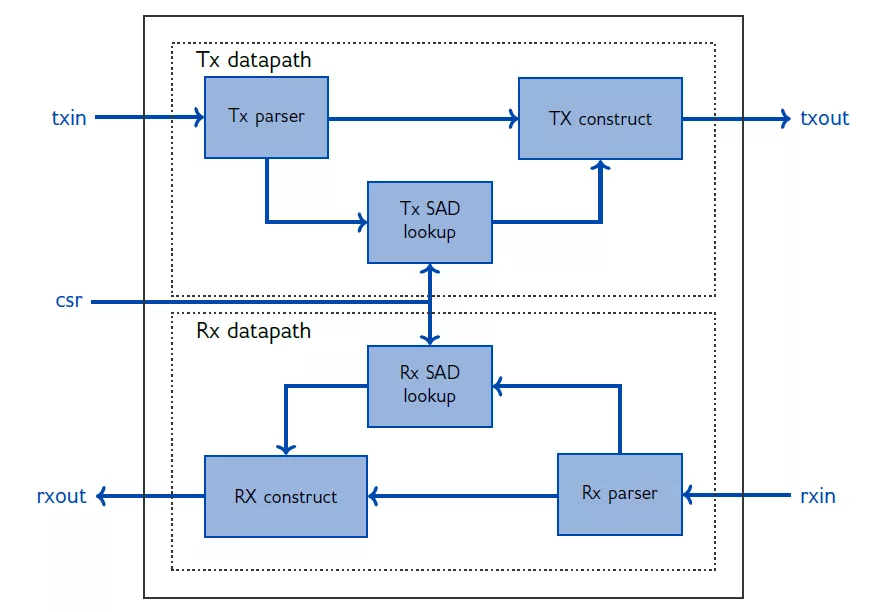
The functionality of XIP7213E is divided into the transmit (Tx) and receive (Rx) datapaths, which operate independently of each other. The underlying cipher suite AES-GCM is consequently instantiated for both the Rx and Tx datapaths.
IPsec operation is based on the concepts of unidirectional Security Associations (SA) within each channel. Each SA uses its own Secure Association Key (SAK); establishing and managing keys is not part of the IPsec standard.
The high-level functionality of Tx datapath includes parameter lookup based on source and destination IPs, ports and protocol. Based on these parameters the IP constructs the TX output frame with encrypted and authenticated ESP frame. TX path also has an option to insert IKEv2 frames from internal buffer, which can be updated by CPU interface.
The high-level functionality of RX datapath includes IPsec frame detection, either based on ESP protocol type or UDP encapsulated frames, with port numbers 500 or 4500. IKEv2 frames are regonised based on SPI information and state of IKEv2 process.
XIP7213E also supports the bypass mode, where an incoming packet passes through the XIP7213E unaltered.