RapidIO Synthesizable Transactor
RapidIO Synthesizable Transactor provides a smart way to verify the RapidIO bi-directional two-wire bus.
Overview
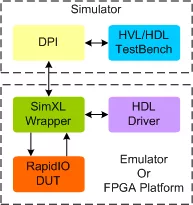
RapidIO Synthesizable Transactor provides a smart way to verify the RapidIO bi-directional two-wire bus. RapidIO Synthesizable Transactor provides a smart way to verify the RapidIO component of a SOC or a ASIC in Emulator or FPGA platform. The SmartDV's RapidIO Synthesizable Transactor is compliant with RapidIO Trade Association, RapidIO Interconnect Specification version 1.3, 2.0, 2.1, 2.3, 3.0, 3.1, 3.2 and 4.0. RapidIO VIP is implemented in a layered fashion. Whichis basically divided into a physical layer, transport layer and logical layer.
Key features
- Supports RapidIO specification 1.3, 2.0, 2.1, 2.2, 3.0, 3.1, 3.2, 4.0 and 4.1.
- Supports Serial 1x/2x/4x/8x and 16x Physical lanes.
- Supports 25.78125Gbaud/s, 12.5Gbaud/s, 10.3125Gbaud/s, 6.25Gbaud/s, 5Gbaud/s,3.125 Gbaud/s, 2.5 Gbaud/s, 1.25 Gbaud/s.
- 8b/10b Encode and Decode functions.
- 64b/67b Encode and Decode functions.
- Supports scrambler/Descrambler.
- 66, 50, or 34-bit addressing on the RapidIO interface.
- Supports Parallel Physical 8/16 bits interfaces.
- Supports all types of packets and sizes.
- Supports all types of IDLE sequences, Control and Status Symbols.
- Supports 8-bit, 16-bit and 32-bit device IDs.
- Automatic freeing of resources used by acknowledged packets.
- Supports I/O system, message passing and globally shared distributed memory (GSM).
- Supports communication with mailboxes via messages.
- Supports generation and reaction to flow control.
- Supports out of order transaction delivery based on the prioritization.
- Supports critical request flow ordering.
- Very flexible to insert errors in serial lanes.
- Supports Error Management Extensions.
- Provides error injection and error detection with a wide variety of error types. Which includes,
- Under and oversize packet.
- CRC errors.
- Invalid code group insertion.
- Invalid /K/ characters insertion.
- Lane Skew insertion.
- Error on control symbol.
- Unsupported packet types.
- Supports cancellation and retrying of packets mechanisms.
- Support all types of timing and protocol violation detection.
- Status counters to keep track of various events.Which includes
- Corrupted/uncorrupted packets.
- Corrupted/uncorrupted control symbols.
- Type of packet.
- CRC error.
- Total number of errors detected.
- Rapidio verification IP comes with complete testsuite to test every feature of Rapidio spec and also as per RIO LAB testsuite.
- Notifies the testbench of significant events such as transactions, warnings, timing and Protocol violations.
Block Diagram
Benefits
- Compatible with testbench writing using SmartDV's VIP
- All UVM sequences/testcases written with VIP can be reused
- Runs in every major emulators environment
- Runs in custom FPGA platforms
What’s Included?
- Synthesizable transactors
- Complete regression suite containing all the RapidIO testcases
- Examples showing how to connect various components, and usage of Synthesizable Transactor
- Detailed documentation of all DPI, class, task and functions used in verification env
- Documentation contains User's Guide and Release notes
Files
Note: some files may require an NDA depending on provider policy.

Specifications
Identity
Provider
Learn more about RapidIO IP core
How to pick a RapidIO switch
Tips for maximizing RapidIO
RapidIO moves up to Fabric
Enter the Inner Sanctum of RapidIO: Part 1
Enter the Inner Sanctum of RapidIO: Part 2
Frequently asked questions about RapidIO IP cores
What is RapidIO Synthesizable Transactor?
RapidIO Synthesizable Transactor is a RapidIO IP core from SmartDV Technologies listed on Semi IP Hub.
How should engineers evaluate this RapidIO?
Engineers should review the overview, key features, supported foundries and nodes, maturity, deliverables, and provider information before shortlisting this RapidIO IP.
Can this semiconductor IP be compared with similar products?
Yes. Buyers can compare this product with similar semiconductor IP cores or IP families based on category, provider, process options, and structured technical specifications.