Vendor:
FortifyIQ, Inc.
Category:
Public Key
Public Key Accelerator
Modern asymmetric cryptography algorithms such as RSA or elliptic curve cryptography over prime fields require complex mathematic…
Overview
Modern asymmetric cryptography algorithms such as RSA or elliptic curve cryptography over prime fields require complex mathematical calculations of large numbers up to 4096 bits. FortiPKA-RISC-V is a public key accelerator that allows offloading all the computationally heavy operations from the main CPU, while offering excellent balance between small footprint and high performance.
One of the key features of FortiPKA-RISC-V is a unique computation technology that eliminates the necessity for data transformations to and from the Montgomery domain, which leads to superior performance compared to alternative solutions. The efficient resource usage is ensured by implementation of cryptographic algorithms in firmware that is executed on an internal miniature RISC-V core. The core instruction set is extended to support custom modular arithmetic for large integers. Hardware configuration options are available to balance area and performance for specific applications. Moreover, FortiPKA-RISC-V supports CPU interfacing through AMBA AXI4, APB, AHB or custom memory-like slave interface.
To ensure smooth integration of FortiPKA-RISC-V to a customer’s product, a software library which performs high-level operations, such as encryption, decryption, signing and verifying for a variety of cryptographic algorithms is provided. Supported algorithms include RSA, DH, DSA, ECDH, ECDHE, ECDSA, EdDSA, DH and SM2. Additionally, FortiPKA-RISC-V's technology-agnostic design ensures compatibility across diverse semiconductor technologies.
FortiPKA-RISC-V includes all the necessary countermeasures against modern side-channel and fault injection attacks. The protection level is configurable, allowing to further improve security characteristics at the cost of resource usage or computation speed. To minimize the overhead of protections from physical attacks, countermeasures are employed in hardware, firmware and software when appropriate.
Key features
- Modular exponentiation operations with up to 4096-bit modulus
- Prime field ECC operations with up to 571-bit modulus
- Fastest implementation is 58 kGE and 68 Op/s for 2048-bit RSA, 431 Op/s for 1024-bit RSA, 150 Op/s for 384-bit scalar multiplication
- Smallest implementation is 33 kGE and 67 Op/s for 1024-bit RSA, 24 Op/s for 384-bit scalar multiplication
- Up to 350 MHz on the 45 nm process
- Unique mathematical solution that eliminates the need for preprocessing
- Software library with support for RSA, DH, DSA, ECDH, ECDHE, ECDSA, EdDSA, DH, SM2
- CPU interface support for AMBA AXI4, APB, AHB and custom memory-like slave interface
- RAM and ROM option for firmware storage
- Strong protection against modern side-channel and timing attacks, and fault injection attacks, tunable security level
- Technology agnostic
- Native support for standard NIST curves, optional support for custom curves
- Shared memories between host CPU and FortiPKA-RISC-V that enables memory reuse
- High level of customization on software, firmware and hardware level
Block Diagram
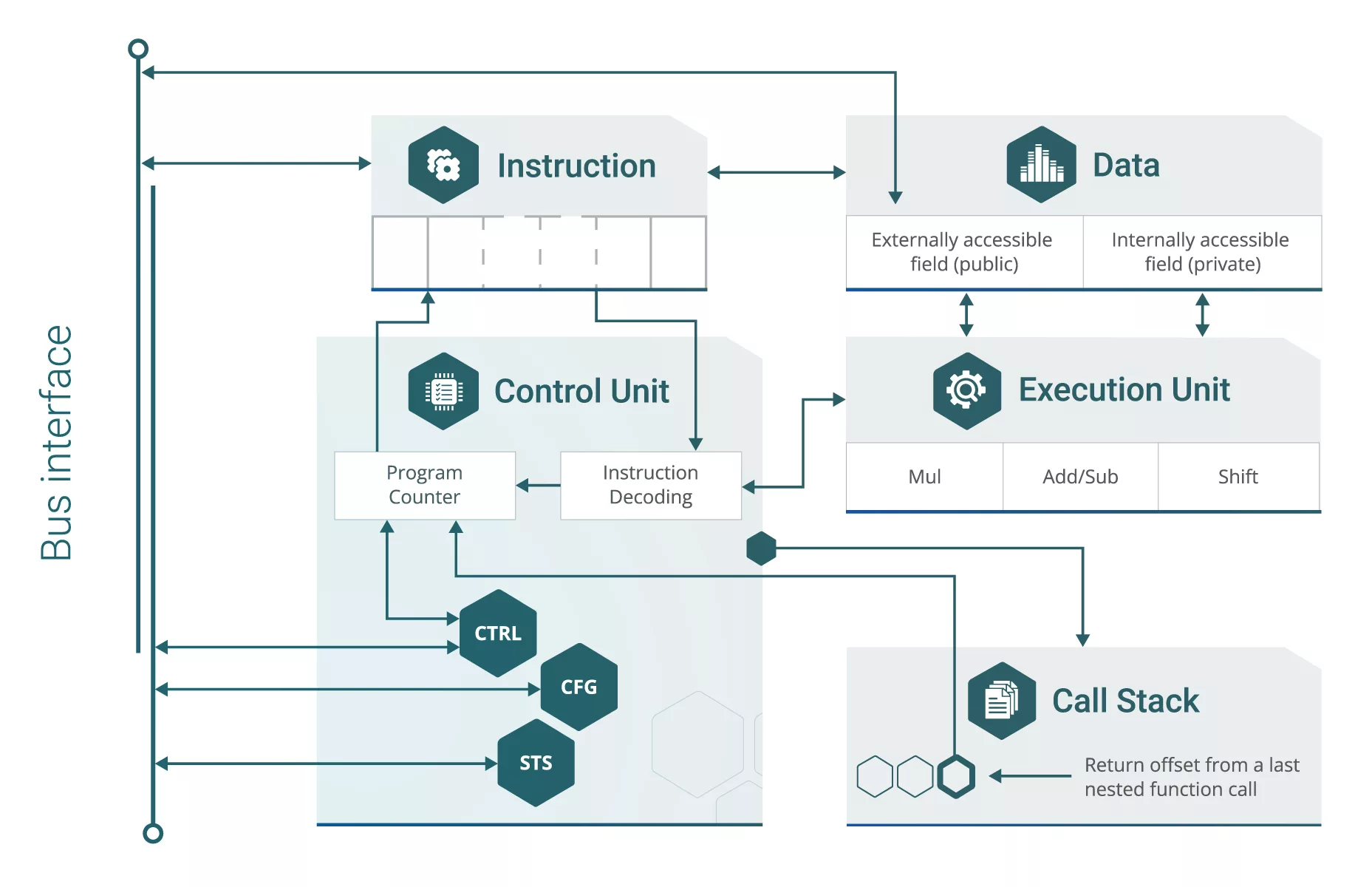
FortiPKA-RISC-V block diagram
Benefits
- Enhanced performance with no need for data preprocessing
- Optimal balance between high performance and low area
- Robust defense against side-channel and fault injection attacks, with customizable options to meet diverse cryptographic requirements
- Hardware configuration options allowing to optimize FortiPKA-RISC-V for specific applications
- Versatile CPU Interfaces: AMBA AXI4, APB, AHB, or a custom memory-like slave interface
- Extensive Algorithm Support: RSA, DH, DSA, ECDH, ECDHE, ECDSA, EdDSA, DH, and SM2
- Facilitation of memory reuse due to shared memory resources
- Seamless integration into customer products, supported by a comprehensive set of deliverables and documentation
Applications
- Networks
- Communications
- Payment Systems
- Authentication Devices
- IoT Devices
- Embedded Systems
What’s Included?
- SystemVerilog source code or netlist
- Testbench, input vectors and expected results
- Sample timing constraints, synthesis and simulation scripts
- Hardware Abstraction Layer (HAL) reference implementation
- Integration, configuration and usage manuals
- Firmware code
- Software library
Files
Note: some files may require an NDA depending on provider policy.
Specifications
Identity
Part Number
FortiPKA-RISC-V
Vendor
FortifyIQ, Inc.
Provider

FortifyIQ, Inc.
HQ:
USA
FortifyIQ develops HW security IP cores fortified against Side-Channel (SCA) and Fault Injection attacks (FIA), while preserving the original AES goals of speed, low latency, and low power usage. We also offer high-performance software libraries and EDA tools for pre- and post-silicon security assessment.
Our core protection algorithm was tested rigorously, passing the Test Vector Leakage Assessment (TVLA) test at 1 billion traces, and was certified by a third-party Common Criteria lab. Our cores are fully synthesizable, eliminating the need for custom cells or special place & route handling. Being algorithm-based, they are technology-agnostic, ensuring compatibility and security across diverse platforms and devices.
Secure IP Cores and SW libraries
FortiCrypt: Our Advanced AES IP cores provide robust protection against SCA, FIA, (including Differential Power Analysis-DPA, and Statistically Ineffective Fault Attacks-SIFA), alongside high performance, low latency, low gate count, and low power usage. Purely mathematically-driven, these cores achieve a high maximum frequency, and one clock cycle per AES round.
Our FortiCrypt high-performance software library can be used to protect security vulnerabilities in HW in unprotected field devices even though they are already deployed, by a simple software download. They are based on the same security proven algorithm (STORM) as our ultra-low power IP cores, and are silicon proven. They have extremely high performance. Even on a low-end 1.1 GHz ARM processor the performance is high enough for Ultra HD (3840×2160) video streaming.
FortiMac: These HMAC SHA2 cores provide robust protection against SCA, DPA, FIA, and SIFA, are suitable for lightweight applications and are purely algorithmic and thus implementation-agnostic. Our products, including the software library, offer protection of HMAC SHA2, based on the threshold implementation approach, validated analytically and on physical devices.
FortiPKA-RISC-V: A Public Key Algorithm coprocessor with modular multiplication and SCA and FIA protection that streamlines operations by eliminating Montgomery domain transformations, enhancing the coprocessor's performance and reducing area.
FortiPKEx: A low-cost key exchanger for companies currently using preinstalled symmetric keys due to cost constraints, but are considering shifting to key exchange protocols based on asymmetric cryptography with built-in resistance to SCA and FIA.
EDA Tools:
Comprehensive pre-silicon and post-silicon security assessment tools, including TVLA charts that pinpoint vulnerabilities down to specific modules and gates, greatly simplifying security debugging against a spectrum of physical attacks, including SCA, DPA, FIA, and SIFA. This effectively moves the security assessment to the same stage as the functional assessment. These tools were instrumental in developing all our secure IP cores and software libraries.
Learn more about Public Key IP core
Securing the IoT: Part 1 - Public key cryptography
The authors detail security risks facing the developer of an Internet of Things device and recommend the best public key-based algorithms to use.
Smart Engine for Public Key cryptography
This white paper explains why and how the Smart Engine is ideally applied to Public Key cryptography. It provides more details about the architecture as Baco Silex has implemented it in the BA414E Public Key Crypto Engine
Public key cryptography and security certificates
This article explains public key cryptography and the role of security certificates and the way they are used by the secure protocols to provide ultimate security.
Securing your apps with Public Key Cryptography & Digital Signature
Formally verifying AVX2 rejection sampling for ML-KEM
Formal verification of cryptography comes in many flavours. The levels of abstraction range from high-level protocol designs to machine-level implementations. At each level of abstraction, different target properties and formal verification technologies apply. In this post we look at the latter end of this spectrum and consider a highly-optimized architecture-specific implementation of a core routine of the recent NIST post-quantum standard FIPS-203: Module-Lattice-Based Key Encapsulation Mechanism (ML-KEM)
Frequently asked questions about Public-Key Cryptography IP cores
What is Public Key Accelerator?
Public Key Accelerator is a Public Key IP core from FortifyIQ, Inc. listed on Semi IP Hub.
How should engineers evaluate this Public Key?
Engineers should review the overview, key features, supported foundries and nodes, maturity, deliverables, and provider information before shortlisting this Public Key IP.
Can this semiconductor IP be compared with similar products?
Yes. Buyers can compare this product with similar semiconductor IP cores or IP families based on category, provider, process options, and structured technical specifications.