Vendor:
Digital Core Design
Category:
Public Key
EdDSA Curve25519 signature generation engine
EdDSA IP Core — When Safety and Security Meet the Best Size/Performance Ratio The EdDSA Curve25519 extension adds hardware suppor…
Overview
EdDSA IP Core — When Safety and Security Meet the Best Size/Performance Ratio
The EdDSA Curve25519 extension adds hardware support for modern elliptic-curve cryptography inside DCD-SEMI’s configurable cryptographic co-processor. The implementation is based on Curve25519, a widely adopted 255-bit elliptic curve designed for efficient key exchange and digital signatures, with strong resistance to side-channel attacks and high performance in constrained embedded environments.
The solution enables support for X25519 key agreement and EdDSA25519 signature operations, using the Edwards-curve family and the prime field defined by Curve25519. It is widely used because it combines compact arithmetic, predictable execution flow, and efficient hardware mapping, making it well suited for secure SoC and FPGA-based systems.
Architecture
CryptOne is implemented as a dedicated IP core tailored to specific customer requirements rather than a general-purpose processor. The Curve25519 module is integrated into the existing CryptOne architecture through new hardware instructions, modular arithmetic accelerators, and control logic for scalar multiplication, modular reduction, and field operations over the Curve25519 prime field.
The design approach focuses on minimizing latency while improving area and energy efficiency. Special attention is given to modular multiplication, reduction modulo, and the removal of unnecessary branches and exceptional cases, which improves predictability and reduces potential attack surfaces in hardware implementations.
Security Properties
The Curve25519 implementation is designed with side-channel resilience in mind. Compared with traditional Weierstrass-based curves, Edwards-curve implementations are often preferred in secure hardware because they support more regular computation patterns and simpler arithmetic, which helps reduce timing leakage and other implementation risks.
The extension is aligned with current cryptographic standards and deployment trends, including RFC 7748 for X25519 and RFC 8032 for EdDSA. This makes it suitable for security-sensitive use cases where interoperability, robustness, and conformance to modern cryptographic guidance are required.
Verification Flow
Development includes algorithm modelling, HDL implementation, and full verification using automated test environments. The implementation is validated against RFC-compliant test vectors and exercised in simulation and FPGA environments to confirm functional correctness and parameter optimization before deployment.
The final result is a verified Curve25519-enabled CryptOne platform ready for secure digital systems in IoT, automotive, telecom, FinTech, cloud, and critical infrastructure applications.
Key features
- Supported Elliptic Curves
- NIST SECP P-256 R1
- NIST SECP P-384 R1
- Koblitz SECP P-256 K1
- Koblitz SECP P-384 K1
- Brainpool P-256 R1
- Brainpool P-384 R1
- Brainpool P-512 R1
- other/custom curves optional support
- Optional Side Channel Attacks countermeasures
- Input/Output EC point verification
- Fully synthesizable, synchronous design
- Highly configurable in terms of performance and
- resource consumption
- Minimum operation delay at 200 MHz:
- Point multiplication:
- EC256: 2.5 ms
- EC384: 5.0 ms
- ECDSA signature generation
- EC256: 2.6 ms
- EC384: 5.2 ms
- ECDSA signature verification
- EC256: 3.1 ms
- EC384: 6.3 ms
- Estimated resource usage
- from 30k to 110k NAND gates
- Point multiplication:
Block Diagram
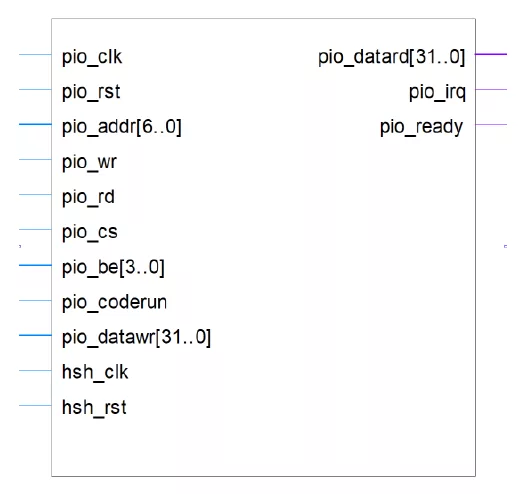
EdDSA Curve25519 block diagram
Applications
- Digital signature
- Data integrity
- Key derivation
- TLS/SSH/PGP IPsec communication
What’s Included?
- HDL Source Code
- Testbench environment
- Automatic Simulation macros
- Tests with reference responses
- Synthesis scripts
- Technical documentation
- 12 months of technical support
Files
Note: some files may require an NDA depending on provider policy.
Specifications
Identity
Part Number
EdDSA Curve25519
Vendor
Digital Core Design
Provider

Digital Core Design
HQ:
Poland
Founded in 1999, Digital Core Design is a global leader in IP core development, specializing in microprocessor, microcontroller, and communication solutions. With a portfolio of over 100 IP cores, DCD continues to drive innovation in embedded systems, providing cutting-edge solutions for automotive, industrial, IoT, and security applications.
Learn more about Public Key IP core
Securing the IoT: Part 1 - Public key cryptography
The authors detail security risks facing the developer of an Internet of Things device and recommend the best public key-based algorithms to use.
Smart Engine for Public Key cryptography
This white paper explains why and how the Smart Engine is ideally applied to Public Key cryptography. It provides more details about the architecture as Baco Silex has implemented it in the BA414E Public Key Crypto Engine
Public key cryptography and security certificates
This article explains public key cryptography and the role of security certificates and the way they are used by the secure protocols to provide ultimate security.
Securing your apps with Public Key Cryptography & Digital Signature
Formally verifying AVX2 rejection sampling for ML-KEM
Formal verification of cryptography comes in many flavours. The levels of abstraction range from high-level protocol designs to machine-level implementations. At each level of abstraction, different target properties and formal verification technologies apply. In this post we look at the latter end of this spectrum and consider a highly-optimized architecture-specific implementation of a core routine of the recent NIST post-quantum standard FIPS-203: Module-Lattice-Based Key Encapsulation Mechanism (ML-KEM)
Frequently asked questions about Public-Key Cryptography IP cores
What is EdDSA Curve25519 signature generation engine?
EdDSA Curve25519 signature generation engine is a Public Key IP core from Digital Core Design listed on Semi IP Hub.
How should engineers evaluate this Public Key?
Engineers should review the overview, key features, supported foundries and nodes, maturity, deliverables, and provider information before shortlisting this Public Key IP.
Can this semiconductor IP be compared with similar products?
Yes. Buyers can compare this product with similar semiconductor IP cores or IP families based on category, provider, process options, and structured technical specifications.