Vendor: Qbit labs Category: Multi-Protocol PHY

PCIe Gen 6 Phy

PCIe Gen 6 Phy

Key features

  • Architecture optimized for HPC, AI/ML, storage, and networking
  • Ultra-long reach, low latency, and low power
  • Advanced DSP delivers unmatched performance and reliability
  • PCIe Gen 6 Phy IPPCIe Gen 6 Phy IPComprehensive real-time diagnostic, monitor, and test features
  • Bifurcation support for x1, x2, x4, x8, and x16 lanes

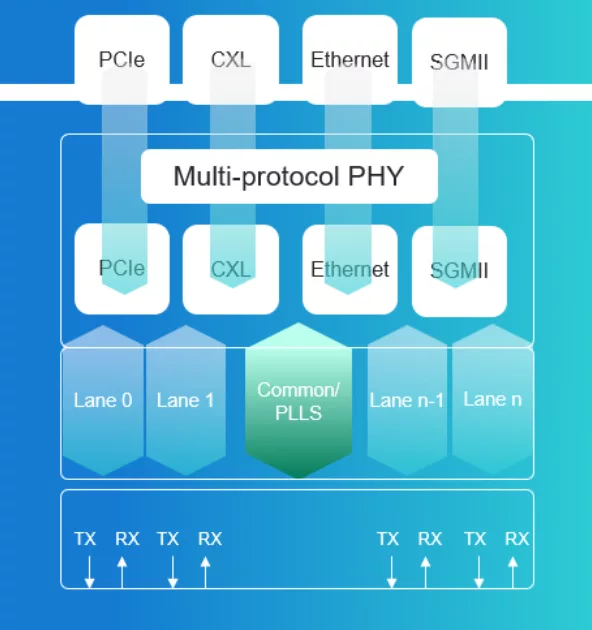
Block Diagram

Benefits

  • High Performance: DSP-based equalization and clock-data-recovery (CDR) offer unmatched channel loss handling performance and    reliability
  • Flexibility: Highly configurable PHY with support for PCIe, CXL, and common electrical standards
  • Ease of use: Fully verified, pre-integrated IP delivery, with package and signal integrity support and firmware for faster bring-up

Applications

  • Data Center and Cloud Computing: PCIe 6.0 can be employed in data center environments and cloud computing infrastructure to meet the growing demands for high-speed data transfer between various components such as CPUs, GPUs, storage devices, and networking cards.
  • High-Performance Computing (HPC): In HPC clusters, PCIe 6.0 can enhance communication between nodes and accelerators, facilitating faster data access and    computation.
  • Storage Solutions: PCIe 6.0 can be utilized in storage solutions, including solid-state drives (SSDs) and storage controllers, to achieve higher data    transfer rates and reduce latency.
  • Networking Equipment: Networking cards and equipment can benefit from PCIe 6.0 to support faster data communication between servers and networking devices, improving overall network performance.

Files

Note: some files may require an NDA depending on provider policy.

Specifications

Identity

Part Number
PCIe Gen 6 Phy
Vendor
Qbit labs

Provider

Qbit labs
HQ: USA
We’re Qbit labs, an engineering services company made of smart people who provide solutions to the problems.

Learn more about Multi-Protocol PHY IP core

How a 16Gbps Multi-link, Multi-protocol SerDes PHY Can Transform Datacenter Connectivity

Increasingly, more of the focus on mobile has centered around cloud datacenters and the networking to get the data back and forth between these datacenters and the mobile device. Functions like voice recognition and mapping depend on the ability to split the functionality between the smartphone, for local processing like encryption and compression, and the back end, where a large number of servers can do the heavier lifting before returning the results.

One PHY, Zero Tradeoffs: Multi-Protocol PHY for Edge AI Interface Consolidation

The Cadence 10G multi-protocol PHY was architected to address this exact challenge. Designed to scale across multiple process nodes, it consolidates PCI Express (PCIe), USB, DisplayPort, Ethernet, and other interfaces into a single, compact, silicon-efficient block. What sets it apart is simultaneous multi-protocol support, which enables multiple data paths without duplicating hardware, requiring extra board connectors, or paying the area and power penalty of separate IP blocks.

Frequently asked questions about Multi-Protocol PHY IP cores

What is PCIe Gen 6 Phy?

PCIe Gen 6 Phy is a Multi-Protocol PHY IP core from Qbit labs listed on Semi IP Hub.

How should engineers evaluate this Multi-Protocol PHY?

Engineers should review the overview, key features, supported foundries and nodes, maturity, deliverables, and provider information before shortlisting this Multi-Protocol PHY IP.

Can this semiconductor IP be compared with similar products?

Yes. Buyers can compare this product with similar semiconductor IP cores or IP families based on category, provider, process options, and structured technical specifications.

×
Semiconductor IP