Vendor: Rambus, Inc. Category: Single-Protocol PHY

PCIe 6.2 Switch

The PCI Express® (PCIe®) 6.2 Switch is a customizable, multiport embedded switch for PCIe designed for ASIC implementations.

Overview

The PCI Express® (PCIe®) 6.2 Switch is a customizable, multiport embedded switch for PCIe designed for ASIC implementations. It enables the connection of one upstream port and multiple downstream ports as a fully configurable interface subsystem. It is backward compatible to PCIe 5.0.

How the PCIe 6.2 Switch Works

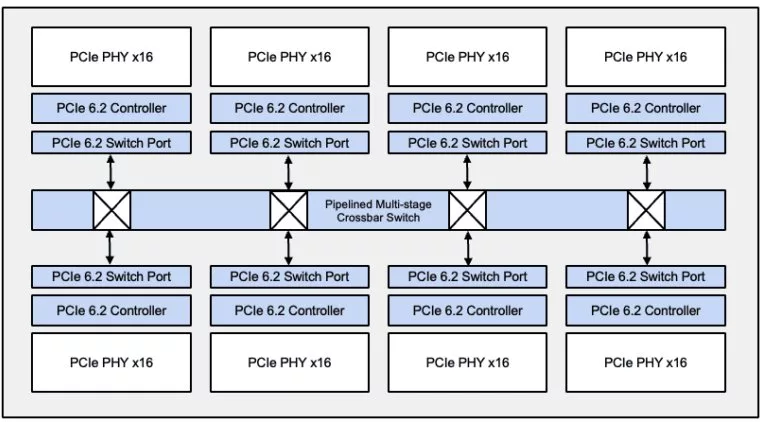
The PCIe 6.2 Switch is the first embedded switch IP available on the market architected to be physically aware.  The switch IP leverages configurable pipeline stages and a fully non-blocking multi-stage routing crossbar to enable implementation of embedded switch logic even in large chips with large physical separation between ports.

The PCIe switch IP transparently manages upstream-downstream data flow as well as peer-to-peer transfers between downstream ports, delivering the flexibility, scalability and configurability required for connecting multiple devices, including NVMe SSDs.

Key features

  • PCI Express Interfaces
    • 1 upstream port, up to 7 downstream ports
    • Up to 128 lanes
    • Up to x16 link width per port
    • Link rate of 2.5, 5, 8, 16, 32 and 64 GT/s per lane
    • Supports PCIe Base Revision 6.2
    • Supports PHY Interface for PCIe (PIPE) 6.2.1
    • Single Virtual Channel (VC) implementation
    • Configurable PIPE interface (8-bit, 16-bit, 32-bit, 64-bit, 128 bit)
    • Configurable Receive and Replay buffer sizes
    • Advanced Error Reporting (AER) supported on each port
    • ECRC generation and check
    • ARI supported
    • Lane reversal supported
    • Independent configuration of link width, link speed, equalization settings, and PIPE interface width per-PCIe port
    • Support for Hot Plug on every downstream port
  • Switching Logic
    • PCIe TLP routing: Configuration, Memory Write/Read, I/O and Messages Packets
    • L1 and wake-up events forwarding
    • Peer-to-Peer transactions support between downstream ports
    • Configurable Egress Buffer for non-blocking output queueing switch performance
    • Downstream Port Containment (DPC) supported
    • Round-Robin arbitration
    • Built-in advanced data protection including ECRC, LCRC, ECC and Parity
    • Test port available for switch monitoring
    • Integrated Clock Domain Crossing to support user-specified frequency in the Switching logic
    • Physically aware switch architecture: configurable pipeline stages and fully non-blocking multi-stage routing crossbar
    • Data Bus Inversion support for EM/IR reduction of large busses
    • Manages multiple packets per clock cycle

Block Diagram

Files

Note: some files may require an NDA depending on provider policy.

Specifications

Identity

Part Number
PCIe 6.2 Switch
Vendor
Rambus, Inc.
Type
Silicon IP

Standards & Interfaces

PCIe Version
PCIe 6.0

Provider

Rambus, Inc.
HQ: USA
Rambus delivers industry-leading chips and silicon IP for the data center and AI infrastructure. With over three decades of advanced semiconductor experience, our products and technologies address the critical bottlenecks between memory and processing to accelerate data-intensive workloads. By enabling greater bandwidth, efficiency and security across next-generation computing platforms, we make data faster and safer.

Learn more about Single-Protocol PHY IP core

Realizing the Performance Potential of a PCI-Express IP

This paper describes challenges involved in realizing the maximum performance of a configurable interconnect IP (GPEX - Rambus PCI Express Digital Controller). The following sections describe how various performance metrics such as roundtrip latency and bandwidth can be used to characterize a PCI Express IP performance and its impact on the system. The ideas presented can also be applied to other high speed interconnect architectures like RapidIO and Hypertransport

UFS Goes Mainstream

UniversalFlash Storage (UFS) was created for mobile applications and computer systems requiring high performance and low power consumption. These systems typically use embedded Flash based on the JEDEC standard eMMC. UFS was defined by JEDEC as the evolutionary replacement for eMMC offering significantly higher memory bandwidth. The standard builds on existing standards such as the SCSI command set, the MIPI Alliance M-PHY and UniPro as well as eMMC form factors to simplify adoption and development.

Design IP Faster: Introducing the C~ High-Level Language

In this paper, we introduce a new high-level, dataflow programming language called C~ (“C flow”) that further increases productivity by raising the level of abstraction from behavioral descriptions, while overcoming the limitations of C for hardware design. We present the syntax and semantics of this language, and the framework that provides hardware and software code generation. This paper illustrates the benefits of using C~ for hardware design of a IEEE 802.3 MAC, synthesized for FPGA and for 90nm CMOS technology.

Universal Flash Storage: Mobilize Your Data

Universal Flash Storage (UFS) was created for mobile applications and computer systems requiring high performance and low power consumption. These systems typically use embedded Flash based on the JEDEC standard eMMC. UFS was defined by JEDEC as the evolutionary replacement for eMMC offering significantly higher memory bandwidth. The standard builds on existing standards such as the SCSI command set, the MIPI Alliance M-PHY and UniProSM as well as eMMC form factors to simplify adoption and development.

Can MIPI and MDDI Co-Exist?

Since MIPI and MDDI standards both target interfaces to cameras and displays on mobile devices, are two separate standards really needed?

Frequently asked questions about Single-Protocol PHY IP

What is PCIe 6.2 Switch?

PCIe 6.2 Switch is a Single-Protocol PHY IP core from Rambus, Inc. listed on Semi IP Hub.

How should engineers evaluate this Single-Protocol PHY?

Engineers should review the overview, key features, supported foundries and nodes, maturity, deliverables, and provider information before shortlisting this Single-Protocol PHY IP.

Can this semiconductor IP be compared with similar products?

Yes. Buyers can compare this product with similar semiconductor IP cores or IP families based on category, provider, process options, and structured technical specifications.

×
Semiconductor IP