Overview
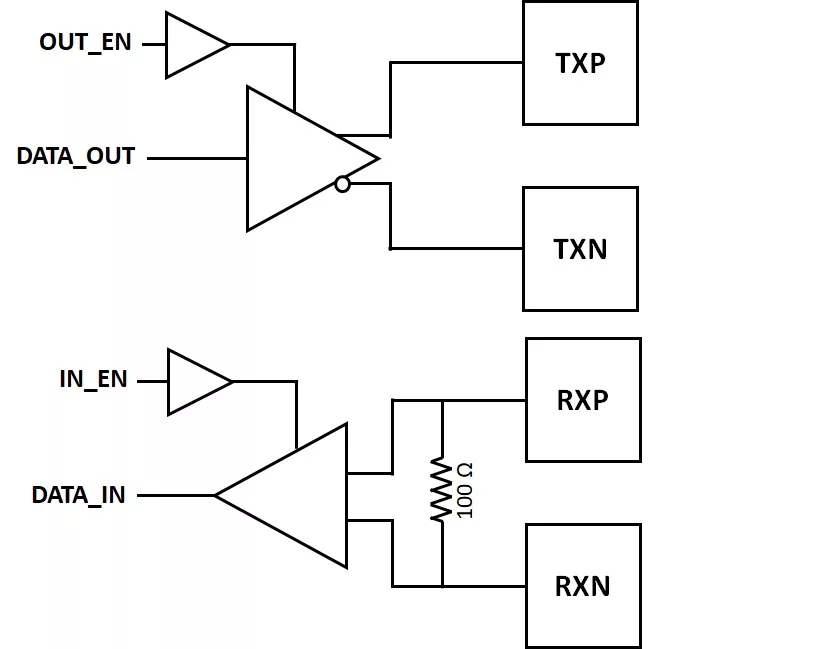
Certus provides full LVDS RX & TX IOs in GlobalFoundries and other foundry technologies. The Certus LVDS solutions are ANSI/TIA/EIA-644-A compliant and are capable of data rates of up to 1.5Mbps. Unique to the Certus LVDS solution is that it is self-biased with no external reference blocks required. Our LVDS cell configurations also allow for flexible supply pad arrangements and dense IO placement without compromising signal integrity.
Built into our IO libraries, and also offered as a separate service, is our strong ESD expertise. Certus was founded by ESD engineers and our results speak for themselves. Not only do we address standard ESD such as HBM and CDM, but we can also provide on-chip solutions for standards such as IEC-61000-4-2, system-level ESD and Cable Discharge Events (CDE).
Certus also offers RGMII, SD, I2C, SMBUS, DDC, Analog/RF, HV and other IO variants across most major foundries and technology nodes. We are particularly suited at providing customized options in a cost-efficient framework. Please contact us for supplementary physical or electrical features to suit your needs.
Learn more about Single-Protocol PHY IP core
UniversalFlash Storage (UFS) was created for mobile applications and computer systems requiring high performance and low power consumption. These systems typically use embedded Flash based on the JEDEC standard eMMC. UFS was defined by JEDEC as the evolutionary replacement for eMMC offering significantly higher memory bandwidth. The standard builds on existing standards such as the SCSI command set, the MIPI Alliance M-PHY and UniPro as well as eMMC form factors to simplify adoption and development.
In this paper, we introduce a new high-level, dataflow programming language called C~ (“C flow”) that further increases productivity by raising the level of abstraction from behavioral descriptions, while overcoming the limitations of C for hardware design. We present the syntax and semantics of this language, and the framework that provides hardware and software code generation. This paper illustrates the benefits of using C~ for hardware design of a IEEE 802.3 MAC, synthesized for FPGA and for 90nm CMOS technology.
Universal Flash Storage (UFS) was created for mobile applications and computer systems requiring high performance and low power consumption. These systems typically use embedded Flash based on the JEDEC standard eMMC. UFS was defined by JEDEC as the evolutionary replacement for eMMC offering significantly higher memory bandwidth. The standard builds on existing standards such as the SCSI command set, the MIPI Alliance M-PHY and UniProSM as well as eMMC form factors to simplify adoption and development.
Since MIPI and MDDI standards both target interfaces to cameras and displays on mobile devices, are two separate standards really needed?
Enter the Inner Sanctum of RapidIO: Part 1
Networking software key to PICMG 2.16 optimization