Overview
OPENEDGES, the memory system IP provider, including DDR memory controller, DDR PHY, on-chip interconnect, and NPU IP together as an integrated solution or independent IP. They are tightly combined to bring synergy for high performance and low latency. OPENEDGES' integrated IP solutions are market and silicon-proven, featuring advanced architectures and proprietary technologies that enable customers to shorten their design and verification processes.
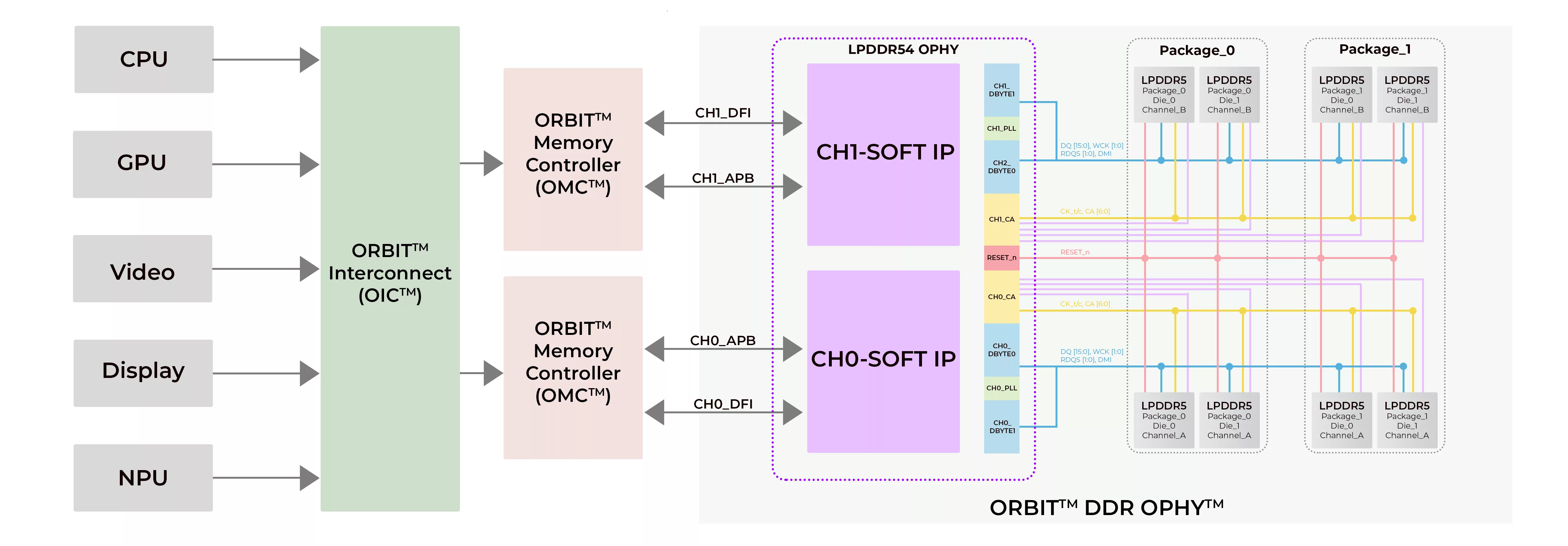
The LPDDR5X/5/4X/4 Combo OPHY introduces support for LPDDR5X speed bins and beyond, on top of the previously supported LPDDR5, 4X, 4 operating modes and speed bins. As with its predecessors, the 7nm LPLDDR5X/5/4X/4 OPHY test chip was brought up quickly in the lab and has achieved 8533 Mbps operation, the current maximum data rate for LPDDR5X, with dual-rank DRAM. The LPDDR5X OPHY will demonstrate quad-rank support in the near future. Also, it integrates key enhancements to its unique architecture, designed to enable maximum performance and flexibility while maintaining a footprint that is highly competitive to alternative LPDDR PHY solutions. In addition to the introduction of LPDDR5X support up to 8533 Mbps, the available configuration has been expanded to both 1x16 and 1x32, verified and ready for customer integration.
Supported Standards:
- JESD209-5A Low Power Double Data Rate 5 (LPDDR5)
- JESD209-5B Low Power Double Data Rate 5 (LPDDR5X)
- JESD209-4D Low Power Double Data Rate 4 (LPDDR4)
- JESD209-4-1 Low Power Double Data Rate 4X (LPDDR4X)
Learn more about LPDDR IP core
JEDEC has just released the LPDDR6 specification that is expected to take the LPDDR DRAM market to new heights with data transfer speeds that can reach up to 14.4Gbps, which is a 50% improvement over LPDDR5X speeds. LPDDR6 device density can range from 4 GB to 64 GB.
Next-generation automotive systems are advancing beyond the limits of currently available technologies. The addition of advanced driver assistance systems (ADAS) and other advanced features requires greater processing power and increased connectivity throughout the vehicle.
As AI workloads continue to diversify, the systems that support them are evolving just as quickly. AI is no longer confined to the hyperscale data center. It is moving to the factory floor, into vehicles, and increasingly to the edge, where power, cost, and form factor constraints can matter just as much as raw performance.
Small Outline Compression-Attached Memory Module (SOCAMM) has made its way into the data center as an alternative to external CPU memory, due to its high performance, low power, memory capacity, and scalability.
This post provides an in-depth look at the fundamentals of high-speed interconnects, AI/HPC trends (HBM/D2D/CPO), and the three critical requirements of Physical AI: Deterministic Latency, Functional Safety (ISO 26262), and Automotive Reliability (AEC-Q100).