Vendor: CSEM Category: CPU

Low-power 32-bit RISC-V processor

The icyflex-V 32-bit processor core is based on the RV32IMC open-instruction set architecture (ISA) defined by the RISC-V foundat…

Overview

The icyflex-V 32-bit processor core is based on the RV32IMC open-instruction set architecture (ISA) defined by the RISC-V foundation and, as such, is supported by standard state-of-the-art development tools (both open-source and proprietary). The 4-stage pipeline is optimized for power and area efficiency.

Additional customizations are available on demand (e.g. RV32E area efficient implementation).
The icyflex-V core targets traditional micro-controller applications and is well suited for IoT, wearables and mixed signal applications.

The core IP comes along with various bus interconnect IP’s and standard peripherals. For example, implementations relying on an embedded flash will benefit from an energy oriented cache architecture.

Key features

  • RISC-V RV32 instruction set:
    • I > full support
    • M > partial support: no hardware divider
    • C > full support
  • Machine mode only
  • 32 vectorized interrupts
  • Standard debug as defined per RISC-V
  • 3.06 CoreMark/MHz
  • 1.35 DMIPS/MHz
  • Gate count: 26 kgates

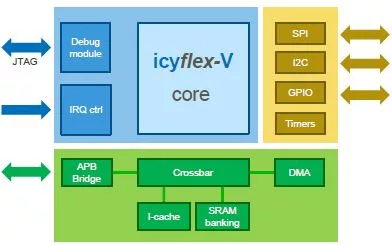
Block Diagram

Benefits

  • e.g. Implementation in TSMC 55 nm LP HVT
    • Core only area : 0.056 mm2
    • Max. frequency (SS corner, 1.08 V, -40 °C) : 120 MHz
    • Power consumption 18 uW/MHz (TT corner, 1.2 V, 25 °C)

Applications

  • IOT
  • Wearables
  • Mixed-signal applications

Files

Note: some files may require an NDA depending on provider policy.

Specifications

Identity

Part Number
icyflex-V
Vendor
CSEM

Provider

CSEM
HQ: Switzerland
CSEM is one of Europe’s leading low power ASIC design providers. With roots in the Swiss watch industry, CSEM is today an acknowledged reference in the fields of ultra low power and low-voltage analog, digital and mixed-signal ASIC design. Our strengths include: • Low power, low voltage RF & analog IC and SoC (e.g. 2mA Rx current radio) • Ultra low power RISC cores (e.g. 6µW/MHz in 65nm) • Smart vision sensors with edge computing • System-on-Chip integration & embedded software development Our expert designers have proven experience in translating customer requirements into high-quality ASIC designs to optimize cost, performance and time-to-market in close cooperation with the customer. Our proven design flow is complemented by state of the art design tools and measurement equipment to ensure quality and on-time delivery. CSEM provides a flexible engagement model, ranging from licensing of our ultra low power IP’s (e.g. icyflexTM 32-bit MCU/DSP core, low-leakage memories, etc) and customized analog IP block design for semiconductor vendors, through to full-custom ASIC and SoC design and delivery. Our fabless production service offers industrialization, test, qualification and small series production. We work with most of the major foundries, and cover technology nodes from 0.25µm down to 22nm CMOS. Served markets include portable medical, industrial, consumer, home automation and automated meter reading.

Learn more about CPU IP core

Announcing Arm AGI CPU: The silicon foundation for the agentic AI cloud era

For the first time in our more than 35-year history, Arm is delivering its own silicon products – extending the Arm Neoverse platform beyond IP and Arm Compute Subsystems (CSS) to give customers greater choice in how they deploy Arm compute – from building custom silicon to integrating platform-level solutions or deploying Arm-designed processors.

Encarsia: Evaluating CPU Fuzzers via Automatic Bug Injection

Hardware fuzzing has recently gained momentum with many discovered bugs in open-source RISC-V CPU designs. Comparing the effectiveness of different hardware fuzzers, however, remains a challenge: each fuzzer optimizes for a different metric and is demonstrated on different CPU designs.

Pie: Pooling CPU Memory for LLM Inference

Pie maintains low computation latency, high throughput, and high elasticity. Our experimental evaluation demonstrates that Pie achieves optimal swapping policy during cache warmup and effectively balances increased memory capacity with negligible impact on computation. With its extended capacity, Pie outperforms vLLM by up to 1.9X in throughput and 2X in latency. Additionally, Pie can reduce GPU memory usage by up to 1.67X while maintaining the same performance. Compared to FlexGen, an offline profiling-based swapping solution, Pie achieves magnitudes lower latency and 9.4X higher throughput.

Frequently asked questions about CPU IP cores

What is Low-power 32-bit RISC-V processor?

Low-power 32-bit RISC-V processor is a CPU IP core from CSEM listed on Semi IP Hub.

How should engineers evaluate this CPU?

Engineers should review the overview, key features, supported foundries and nodes, maturity, deliverables, and provider information before shortlisting this CPU IP.

Can this semiconductor IP be compared with similar products?

Yes. Buyers can compare this product with similar semiconductor IP cores or IP families based on category, provider, process options, and structured technical specifications.

×
Semiconductor IP