AES-XTS, Advanced Encryption Standard (256-bit key), XTS mode IP Core
XIP1183B from Xiphera is a balanced Intellectual Property (IP) core implementing the Encryption Standard (AES) with 256 bits long…
Overview
XIP1183B from Xiphera is a balanced Intellectual Property (IP) core implementing the Advanced Encryption Standard (AES) with 256 bits long key in XTS mode.
AES-XTS is block-oriented cipher used primarily for protecting the confidentiality of data at rest. Consequently, AES-XTS is widely used for encrypting the contents of hard drives and other storage devices.
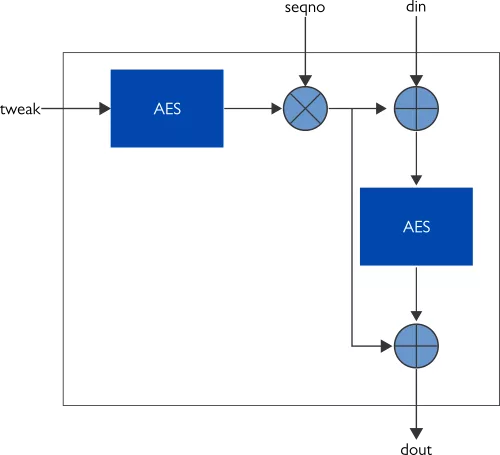
AES-XTS is a tweakable block cipher, and as it instantiates the underlying AES block cipher twice, the key material for AES-XTS is twice longer than for the constituent individual AES block ciphers.
The encrypted data depends not only on the plaintext and encryption key, but also on the logical address of the data on the storage device. This means that identical plaintexts get encrypted differently at different logical addresses.
XIP1183B has been designed for easy integration with FPGA- and ASIC-based designs in a vendor-agnostic design methodology, and the functionality of XIP1183B does not rely on any FPGA manufacturer-specific features.
XIP1183B has also been successfully validated in the CAVP (Cryptographic Algorithm Validation Program) by NIST (National Institute for Standards and Technology).
Key features
- Moderate resource requirements: The entire XIP1183B requires 6074 Adaptive Lookup Modules (ALMs) (Intel Cyclone ® 10 GX), and does not require any multipliers or DSPBlocks.
- Performance: XIP1183B achieves an impressive throughput in the Gbps range, for example 3.20+ Gbps in Xilinx Kintex ® UltraScale+.
- Standard Compliance: XIP1183B is compliant with both the Advanced Encryption Algorithm (AES) standard, and the XTS standard.
- Optional Ciphertext stealing support as defined in IEEE Std 1619-2018.
- Increased Performance can be achieved by paralle instantiations of XIP1183B.
Block Diagram
Benefits
- Fully digital design
- Portable to any ASIC or FPGA technology
- Fully standard compliant
- Easy to integrate
- Several bus interfaces available
- IP core designed in-house at Xiphera
- Technical support by the original designers and cryptographic experts
- CAVP validated
Applications
- XIP1183B protects the confidentiality of the encrypted plaintext, and identical plaintext is encrypted into a different ciphertext at different memory addresses.
- When using XIP1183B XIP1183B protects the confidentiality of the encrypted plaintext, and identical plaintext is encrypted into a different ciphertext at different memory addresses.
- When using XIP1183B with storage media whose natural bit width is smaller than 128bits, it is recommended to integrate XIP1183B with a memory controller IP core to enable encrypting and decrypting 128-bits data units.
- with storage media whose natural bit width is smaller than 128bits, it is recommended to integrate XIP1183B with a memory controller IP core to enable encrypting and decrypting 128-bits data units.
What’s Included?
- Please contact sales@xiphera.com for pricing and your preferred delivery method. XIP1183B can be shipped in a number of formats, including netlist, source code, or encrypted source code.
- Additionally, synthesis scripts, a comprehensive testbench, and a detailed datasheet including an integration guide are included.
Files
Note: some files may require an NDA depending on provider policy.
Specifications
Identity
Provider
Learn more about Symmetric Crypto IP core
CXL - The Latest Specification in Secured Network Traffic
Securing your apps with Public Key Cryptography & Digital Signature
RoT: The Foundation of Security
Tailoring Root Of Trust Security Capabilities To Specific Customer Needs
Symmetric Cryptographic Offload Options for SoC Designers
Frequently asked questions about Symmetric Cryptography IP cores
What is AES-XTS, Advanced Encryption Standard (256-bit key), XTS mode IP Core?
AES-XTS, Advanced Encryption Standard (256-bit key), XTS mode IP Core is a Symmetric Crypto IP core from Xiphera Ltd listed on Semi IP Hub.
How should engineers evaluate this Symmetric Crypto?
Engineers should review the overview, key features, supported foundries and nodes, maturity, deliverables, and provider information before shortlisting this Symmetric Crypto IP.
Can this semiconductor IP be compared with similar products?
Yes. Buyers can compare this product with similar semiconductor IP cores or IP families based on category, provider, process options, and structured technical specifications.