Vendor: Racyics GmbH Category: Clock Generator

ULP 10MHz Clock-Generator - GLOBALFOUNDRIES 22FDX

Ultra-low power 10 MHz dock multiplier from a low frequency reference.

GlobalFoundries 22nm FDX View all specifications

Overview

Ultra-low power 10 MHz dock multiplier from a low frequency reference.

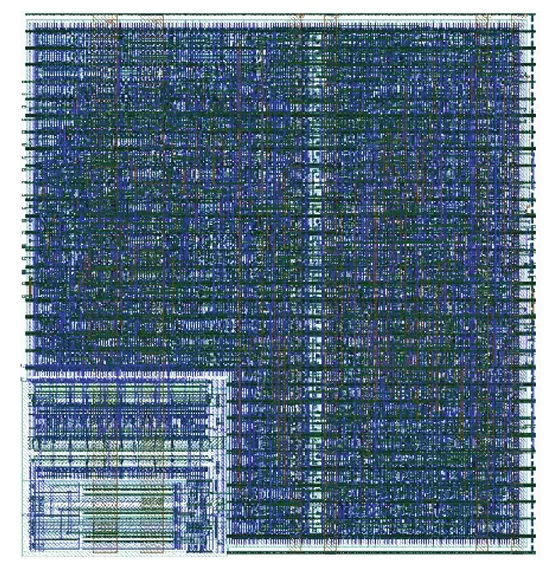
The Racyics® clock generator is designed to generate a 10 MHz clock from a low-frequency reference with as little power and area overhead as possible.

For highest flexibility, a wide range of reference frequencies is supported. The generated clock can be fed to the Racyics® ABX® generator.

SPECIFICATION

  • Supply Voltages [V]: 0.80
  • ZBB (Zero Bias): yes

Key features

  • The All Digital Frequency Locked Loop (ADFLL) architecture is reduced to the minimum amount of hardware necessary to generate a 10 MHz clock
  • High energy efficiency: Only 5 μW are consumed during operation
  • A reference clock divider allows reference clock frequencies from 32 kHz to 1 MHz

Block Diagram

What’s Included?

  • Verilog simulation models
  • .lib/.db timing and power models (NLDM)
  • .lef layout abstract views
  • NDM and Milkyway libraries
  • GDSII files
  • LVS netlist

Files

Note: some files may require an NDA depending on provider policy.

Silicon Options

Foundry Node Process Maturity
GlobalFoundries 22nm FDX

Specifications

Identity

Part Number
ri_gf22fdx_clkgen_10m
Vendor
Racyics GmbH

Provider

Racyics GmbH
HQ: Germany
Racyics is an experienced System-on-Chip design service provider with focus on advanced semiconductor nodes. We offer our customers a wide range of design services including custom IP and turnkey SoC solutions.

Learn more about Clock Generator IP core

Generating multiple clock frequencies using Specman "real" feature in mixed (Analog/Digital) design environments

Using our “Specman agent approach for the Mixed Verification” along with exploiting “real” feature of Specman version 8.2, we can introduce directed/constrained randomization to the frequencies needed for the analog modules which are interacting with the DUT (Design Under Test). This approach gives complete controllability over the clock frequencies, which can be directly randomized and modified on-the-fly from the testcase, as the scenario may demand.

M31 on the Specification and Development of MIPI Physical Layer

MIPI is the abbreviation of "Mobile Industry Processor Interface". This article will introduce the physical layer specifications of MIPI architecture, and explain the features and benefits of D-PHY and C-PHY respectively. Then, the MIPI perspective on the development and challenges of automotive electronics and the professional MIPI technical services that M31 can provide will be shared.

Silicon-Accurate Fractional-N PLL Design

Fractional-N PLLs are a useful class of PLLs and not well understood. This paper explains in simple terms how these differ from a regular integer PLL. Common applications are listed along with a brief description of the key performance parameter – jitter.

FPGA Implementation of DLX Microprocessor With WISHBONE SoC Bus

DLX is an open source microprocessor, it’s free and it has never been implemented in a commercial ASIC (Application Specific Integrated Circuit) design. The objective of this project is to use the DLX microprocessor implemented with Wishbone bus interface for a SoC (System-on-Chip) design.

Mixed Signal Drivers for Ultra Low Power and Very High Power Applications

Evolving niche markets, such as ICs for biomedical applications, are very challenging in respect to power consumption and on chip power dissipation, namely, wide range from ultra low power (ULP) functionality (<uW) where IC is battery powered, e.g. mobile micro transducers, to very high power (VHP, >5W), e.g. coded energy transfer from RFID¡¯s for remote sensing and animal tracking.

Frequently asked questions about Clock Generator IP cores

What is ULP 10MHz Clock-Generator - GLOBALFOUNDRIES 22FDX?

ULP 10MHz Clock-Generator - GLOBALFOUNDRIES 22FDX is a Clock Generator IP core from Racyics GmbH listed on Semi IP Hub. It is listed with support for globalfoundries.

How should engineers evaluate this Clock Generator?

Engineers should review the overview, key features, supported foundries and nodes, maturity, deliverables, and provider information before shortlisting this Clock Generator IP.

Can this semiconductor IP be compared with similar products?

Yes. Buyers can compare this product with similar semiconductor IP cores or IP families based on category, provider, process options, and structured technical specifications.

×
Semiconductor IP