Processor Architecture for High Performance Video Decode
Processor Architecture for High Performance Video Decode
SIN_X calculates the sine of an angle.
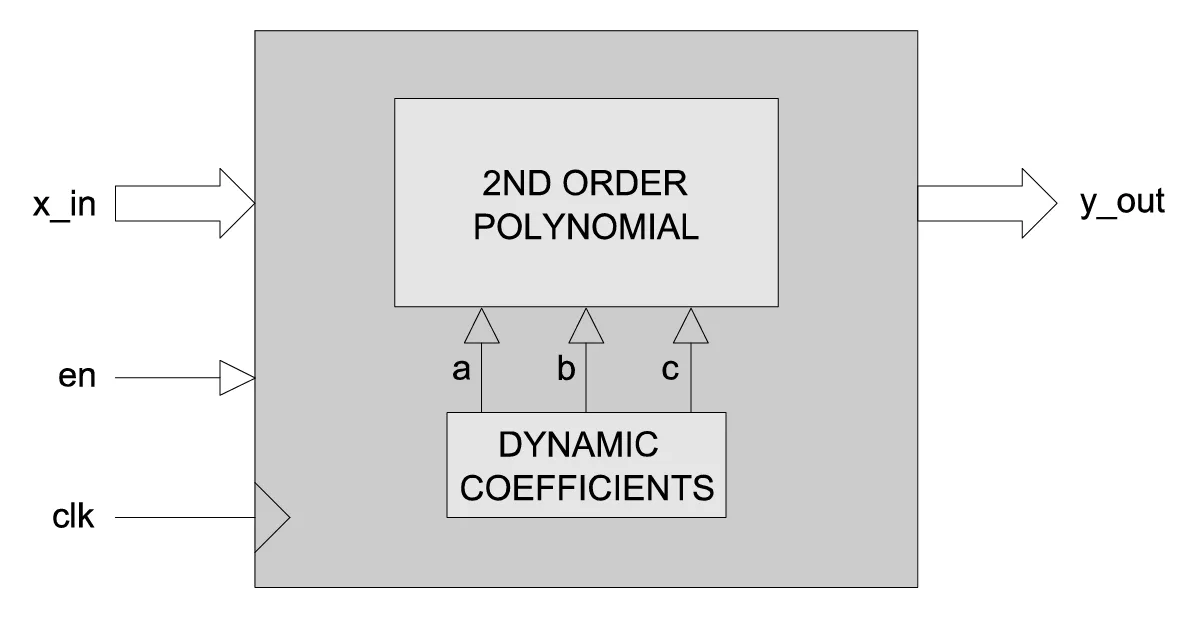
SIN_X calculates the sine of an angle. It has a fully pipelined architecture and uses fixed-point mathematics throughout. Input values are accepted as 16-bit unsigned values in the range 0 to π/2. Output values are 16-bit unsigned values in the range 0 to 1. For input values greater than π/2, the output saturates to 1.0. Both input and output values are in [16 15] format with 1 integer bit and 15 fraction bits. As an example the input value 0xC000 would signify the value 1.5.
Internally, the function uses a 2nd order polynomial of the form:
y = ax2 + bx + c
The coefficients a, b and c dynamically change with respect to the input value in order to generate a more accurate approximation. The output result is accurate to within 0.0002.
Values are sampled on the rising clock-edge of clk when en is high. The function has a 3 clock-cycle latency.
Note: some files may require an NDA depending on provider policy.

Sine Function is a Filters Transforms IP core from Zipcores Electronic Systems Engineering S.L. listed on Semi IP Hub.
Engineers should review the overview, key features, supported foundries and nodes, maturity, deliverables, and provider information before shortlisting this Filters Transforms IP.
Yes. Buyers can compare this product with similar semiconductor IP cores or IP families based on category, provider, process options, and structured technical specifications.