OTL Verification IP
The OTL Verification IP Product is the comprehensive OTL interface protocol validation solution.
Overview
The OTL Verification IP Product is the comprehensive OTL interface protocol validation solution. ITU-T recommendation G.709 annexure C defines OTL interface mechanism by which OTU4 and OTU3 signals can be car ried for short-reach client side applications. OTU4 signals can be carried over 10 parallel lanes, which are formed by bit multiplexing of 20 logical lanes. OTU3 signals can be car ried over 4 parallel lanes.
The recommendation specifies the way in which OTU4 or OTU3 frames are first divided into 1020 groups of 16 bytes and sent on parallel lanes. Before doing that, the trans mitter follows various rules related with lane rotation.
The recommendation also specified the role of receiver, which is responsible for framing, multi- lane alignment and deskews of in coming data before forming OTU4 and OTU3 frames.
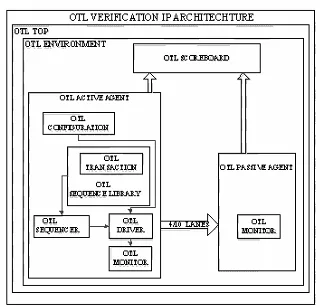
OTL Verification IP developed at eInfochips can be used to verify a transmitter or receiver functionality for both OTU4 and OTU3 inter faces. It is developed in System Verilog HVL and using UVM as verification methodology. The use of methodology allows the single VIP instance be configured as either transmitter or receiver thereby easing the work of VIP integration in testbench. This VIP can be configured as per the user requirements and various hooks provided with it allows user to control behaviour of various VIP components completely while testing its own application.
OTL VIP can be used as active, passive or passive only monitor to verify Networking based design having OTL interface in different scenarios.
OTL VIP comprises of following major elements.
- Driver
- Monitor
- Generator : Sequences & Sequencer
- Protocol Checkers
- APIs
- Coverage Capability
- Assertions
- Configuration
- Report Generator
Key features
Transmitter features:
- OTUk Frame division in 16 bytes chunk ( k = 3,4).
- Round robin distribution of OTUk frame (k = 3,4).
- Lane rotation using MFAS in case of 40G.
- LLM generation in case of 100G.
- Bit multiplexing of logical lanes in case of 100G
- User Configurable Support For Scram bling
- Generation of Fixed, Incremental or random data.
- Support to generate PRBS data.
- Flexibility to map any logical lanes to any physical lane.
- Error injection in Frame Alignment Sequence (FAS) and Multi Frame Align ment Sequence (MFAS).
- Support for Frame Slip generation.
- Error injection in Logical Lane Mark er(LLM) in case of 100G
- 10^(-3) Bit Error rate generation
- User Configurable Support For defect and alarm thresholds
Receivers features:
- OTUk Framing on each lanes( k = 3,4)
- Lane identifier recovery
- Multilane alignment
- OTU3 mode de-skew capacity
- OTU4 mode de-skew capacity
- Receiver Bit Error Rate tolerance before error correction
- Framing Alignment State machine error recovery
- Multilane alignment state machine error recovery
- LOFLANE defect generation per lane
- OOFLANE defect generation per lane
- Deskew Fail defect generation
- OLA defect generation per lane
- LOR defect generation per lane
- User configurable support for Descram bling
- User Configurable Support For defect and alarm thresholds
Extended Capabilities:
- Fully compliant to UVM Methodology – UVM1.1.
- Supported Simulator VCS E-2011-03.
- Supports Directed, Constrain Random and Fully Random stimulus generation.
- Supports generic TLM interface for layered sequences support.
- Supports variety of Error Injection via sequences/call-backs and supports other protocol specific errors.
- Supports full OTL3.4 and OTL4.10 pro tocols.
- Built-in protocol checkers for OTL inter face.
- Supports Functional Coverage collection.
- Supports flexibility to use VIP in IP as well as SoC verification.
- Support for directed, constrained and random testing.
- Support for Data Integrity Check.
- Support for automated defect and alarms checks.
Block Diagram
What’s Included?
- OTL VIP System-Verilog Source Code.
- User Guide and Release Notes.
- Test cases mentioned in the Test Plan along with the list of Sanity Test cases
- Test Plan + Coverage Plan
- Various prototype examples on topological usage of active, passive or passive monitor.
- Sample Verification Environment.or passive monitor.
- Sample Verification Environment.
Files
Note: some files may require an NDA depending on provider policy.

Specifications
Identity
Provider
Learn more about Optical Transport IP core
Encrypting Telecoms
TPACK's role in Altera designs
Part 2: Opening the 5G Radio Interface
How 224G SerDes Unifies Today’s AI Fabrics
Securing the Future of Terabit Ethernet: Introducing the Rambus Multi-Channel Engine MACsec-IP-364 (+363)
Frequently asked questions about Optical Transport IP cores
What is OTL Verification IP?
OTL Verification IP is a Optical Transport IP core from eInfochips listed on Semi IP Hub.
How should engineers evaluate this Optical Transport?
Engineers should review the overview, key features, supported foundries and nodes, maturity, deliverables, and provider information before shortlisting this Optical Transport IP.
Can this semiconductor IP be compared with similar products?
Yes. Buyers can compare this product with similar semiconductor IP cores or IP families based on category, provider, process options, and structured technical specifications.