MSP7-32 MACsec IP core for FPGA or ASIC
Implementation of the LAN security standard IEEE 802.1ae (MACsec) requires the NIST standard AES cipher in the GCM mode for encry…
Overview
Implementation of the LAN security standard IEEE 802.1ae (MACsec) requires the NIST standard AES cipher in the GCM mode for encryption and message authentication, as well as header parsing and formatting operations on the transmitted and received packets. MACsec Security Processor (MSP) IP cores by IP Cores, Inc. are designed for high data rates and implement complete line-rate packet processing with no per-packet CPU intervention.
MSP7-32 cores are tuned for 6-15 Gbps applications in the FPGA and ASIC technologies that require 256 bit AES keys.
The design is fully synchronous and available as RTL source code.
Function Description
The MSP7 implementation fully supports the IEEE 802.1ae (MACsec) algorithm for 128-bit bit keys, including AES support in Galois Counter Mode (GCM) per NIST publication SP800-38D http://csrc.nist.gov/publications/nistpubs/800-38D/SP-800-38D.pdf.
The core is designed for flow-through operation. MSP7 supports encryption and decryption modes (encrypt-only and decrypt-only options are available.
- Tx Processing
On encryption, for each frame the core:
- Obtains the SC index from the LLID and looks up the current SA key
- Inserts the SecTag, including the PN and an optional SCI
- Encrypts and authenticates the frame, based on the values on the E and C inputs
- Appends the ICV tag to the packets
- Updates the PN
- Updates the statistics counters
- Rx Processing
On decryption, for each frame the core:
- Obtains the SC index from the LLID and looks up the current SA key
- Allows pass-through fro KaY frames
- Validates the SecTag and SCI, if present
- Checks that the packet number PN is within the PN window
- Decrypts the frame, if encrypted
- Calculates the ICV tag, if the frame is authenticated, and compares to the one in the frame
- Removes the ICV tag, appended to the frame
- Updates the PN window
- Updates the statistics counters
Key features
- Small size combined with high performance:
- 5 Gbps performance at the 15+ MHz clock rate
- 12.5 Gbs performance at the 390+MHz clock rate
- Flow-through design with back-to-back packet processing
- 41-byte-long shortest input packet on encryption
- 56-byte-long shortest input packet on decryption at full data rate
- 16,000 bytes maximum packet size
- Low latency, for the 10 Gbps configuration
- 34 clocks input-to output on encryption(start-to-start of the packet), 36-37 clocks(last-to-last word of the packet
- 39 clocks for decryption(start-to-start), 37 clocks(last-to-last)
- 32-bit wide aligned AXI-S data interface with flow control
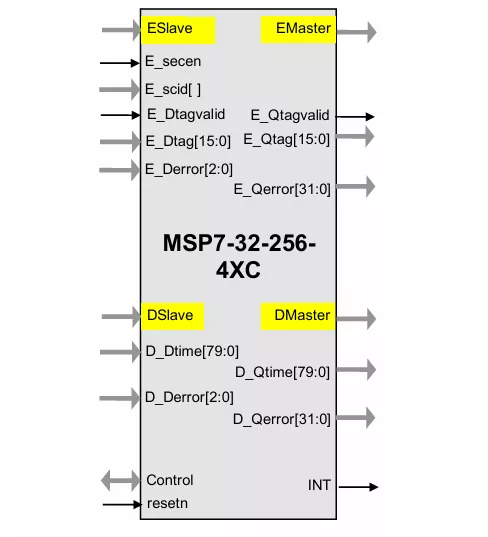
- The MSP7 contains two datapaths, one for Tx(encryption), one for Rx(decryption).The Tx datapath presents a sink(slave) interface to the unecrypted side, source(master) interface on the encrypted side. Rx datapath presents a sink to the encrypted, source to the unecrypted side
- Core utilizes three clocks: one for the Tx datapath, one for Rx and one for control
Block Diagram
What’s Included?
- Synthesizable Verilog RTL source code
- Testbench (self-checking)
- User Documentation
- Optional GCMVS NIST validation
- Optional UNH validation
Files
Note: some files may require an NDA depending on provider policy.

Specifications
Identity
Provider
Learn more about MACsec IP core
Securing The Road Ahead: MACsec Compliant For Automotive Use
Unveiling Ultra-Compact MACsec IP Core with optimized Flexible Crypto Block for 5X Size Reduction and Unmatched Efficiency from Comcores
How the MACsec Protocol Keeps Ethernet Networks Secure
O-RAN Fronthaul Security using MACsec
MACsec for Deterministic Ethernet applications
Frequently asked questions about MACsec IP cores
What is MSP7-32 MACsec IP core for FPGA or ASIC?
MSP7-32 MACsec IP core for FPGA or ASIC is a MACsec IP core from IP Cores, Inc. listed on Semi IP Hub.
How should engineers evaluate this MACsec?
Engineers should review the overview, key features, supported foundries and nodes, maturity, deliverables, and provider information before shortlisting this MACsec IP.
Can this semiconductor IP be compared with similar products?
Yes. Buyers can compare this product with similar semiconductor IP cores or IP families based on category, provider, process options, and structured technical specifications.