Vendor: Silvaco, Inc. Category: Single-Protocol PHY

LVDS I/O IP - High Frequency Transceiver

The Low Voltage Differential Signaling (LVDS) I/O library is a high-frequency interface that uses differential signals for data t…

Overview

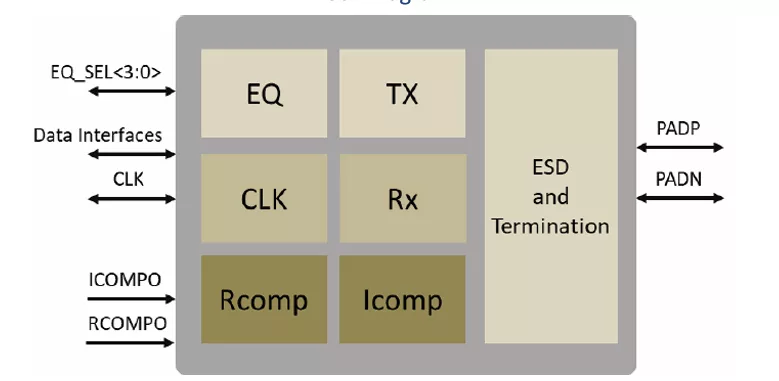
The Low Voltage Differential Signaling (LVDS) I/O library is a high-frequency interface that uses differential signals for data transmission. Typical LVDS I/O applications include displays, printers, and other high-speed data interfaces. This LVDS IP includes a transmitter, receiver, and a novel equalization design supporting programmable pre-emphasis at the transmitter. Operating at 1 GHz, this LVDS supports data transfers rates up to 2 Gbs. Including built-in termination resistors, DFT compliance, and robust ESD, this LVDS I/O delivers the most reliable performance and is silicon proven.

Key features

  • Up to 1 GHz operation (2 Gbs)
  • Novel equalization with programmable emphasis
  • Compensation block provides PVT-invariance
  • Built-n termination resistors
  • Common mode support of both RX and TX
  • 2 KV HBM ESD compliance
  • Operating temperature of -40°C to 125°C•Silicon proven

Block Diagram

What’s Included?

  • Models
  • IBIS
  • Timing
  • LEF
  • GDSII
  • Datasheet

Files

Note: some files may require an NDA depending on provider policy.

Specifications

Identity

Part Number
LVDS I/O IP - High Frequency Transceiver
Vendor
Silvaco, Inc.

Provider

Silvaco, Inc.
HQ: United States
Silvaco focuses on enabling the next generation of AI/ML, Cloud/Datacenter, Automotive and Autonomous Driving, IoT and 5G designs through a comprehensive offering of Silicon proven IP. Our portfolio includes a complete catalog of Interface IP, Amba Peripherals, Subsystems, MIPI IP and Automotive Communication Controller IP. Our experienced ASIC and Embedded Software designers have a rich history of designing SOCs with embedded microprocessors which are crucial to building small connected smart chips.

Learn more about Single-Protocol PHY IP core

UFS Goes Mainstream

UniversalFlash Storage (UFS) was created for mobile applications and computer systems requiring high performance and low power consumption. These systems typically use embedded Flash based on the JEDEC standard eMMC. UFS was defined by JEDEC as the evolutionary replacement for eMMC offering significantly higher memory bandwidth. The standard builds on existing standards such as the SCSI command set, the MIPI Alliance M-PHY and UniPro as well as eMMC form factors to simplify adoption and development.

Design IP Faster: Introducing the C~ High-Level Language

In this paper, we introduce a new high-level, dataflow programming language called C~ (“C flow”) that further increases productivity by raising the level of abstraction from behavioral descriptions, while overcoming the limitations of C for hardware design. We present the syntax and semantics of this language, and the framework that provides hardware and software code generation. This paper illustrates the benefits of using C~ for hardware design of a IEEE 802.3 MAC, synthesized for FPGA and for 90nm CMOS technology.

Universal Flash Storage: Mobilize Your Data

Universal Flash Storage (UFS) was created for mobile applications and computer systems requiring high performance and low power consumption. These systems typically use embedded Flash based on the JEDEC standard eMMC. UFS was defined by JEDEC as the evolutionary replacement for eMMC offering significantly higher memory bandwidth. The standard builds on existing standards such as the SCSI command set, the MIPI Alliance M-PHY and UniProSM as well as eMMC form factors to simplify adoption and development.

Can MIPI and MDDI Co-Exist?

Since MIPI and MDDI standards both target interfaces to cameras and displays on mobile devices, are two separate standards really needed?

Frequently asked questions about Single-Protocol PHY IP

What is LVDS I/O IP - High Frequency Transceiver?

LVDS I/O IP - High Frequency Transceiver is a Single-Protocol PHY IP core from Silvaco, Inc. listed on Semi IP Hub.

How should engineers evaluate this Single-Protocol PHY?

Engineers should review the overview, key features, supported foundries and nodes, maturity, deliverables, and provider information before shortlisting this Single-Protocol PHY IP.

Can this semiconductor IP be compared with similar products?

Yes. Buyers can compare this product with similar semiconductor IP cores or IP families based on category, provider, process options, and structured technical specifications.

×
Semiconductor IP