Vendor:
Altera
Category:
HDMI
HDMI Intel® FPGA IP Core
The HDMI Intel FPGA intellectual property (IP) core provides support for the next generation of video display interface technolog…
Overview
The HDMI Intel FPGA intellectual property (IP) core provides support for the next generation of video display interface technology. Due to its ability to send high-definition audio and video, High-Definition Multimedia Interface (HDMI) has become the most common digital connection in consumer electronics.
The HDMI cable and connectors carry four differential pairs that are composed of three Transition-minimized differential signaling (TMDS) data channels and one clock channel in HDMI 2.0 or four Fixed Rate Link (FRL) data channels in HDMI 2.1. You can use these channels to carry video, audio, and auxiliary data at a raw bit rate of up to 3.4/6/8/10/12 Gbps per channel. HDCP-encrypted transmission can also be integrated into our IP through the newly released Intel® FPGA HDCP core.
Features
|
IP Core Feature |
Description |
|---|---|
|
Color support |
|
|
Symbols per clock |
1, 2, 4 or 8 symbols per clock |
|
Video |
Support up to 8k |
|
Audio |
Up to 32 channels of embedded audio |
Block Diagram
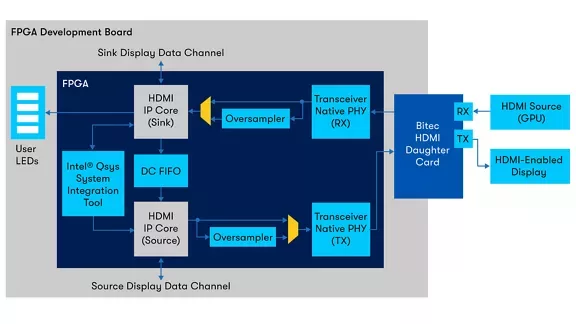
HDMI Intel® FPGA IP Core block diagram
Files
Note: some files may require an NDA depending on provider policy.
Specifications
Identity
Part Number
HDMI Intel® FPGA IP Core
Vendor
Altera
Type
Silicon IP
Provider

Altera
HQ:
USA
Altera, an Intel Company, provides leadership programmable solutions that are easy-to-use and deploy in applications from the cloud to the edge, offering limitless AI possibilities. Our end-to-end broad portfolio of products including FPGAs, CPLDs, Intellectual Property, development tools, System on Modules, SmartNICs and IPUs provide the flexibility to accelerate innovation.
Our innovation of programmable logic started in 1983 in Silicon Valley. In 1984, Altera unveiled the world’s first programmable logic device capable of being programmed, erased, and reprogrammed altering the future of innovation.
Learn more about HDMI IP core
The Power Of HDMI ARC
Dynamic HDR in HDMI 2.1: The Ideal Display for TV and Mobiles
HDMI: How Scrambling Enables Higher Data Rates
High Resolution Displays for Mobile, TV, PC and Automotive Enabled by DSC 1.2 in HDMI 2.1
HDMI 2.1: How it Became the Most Popular Display Interface
Frequently asked questions about HDMI IP cores
What is HDMI Intel® FPGA IP Core?
HDMI Intel® FPGA IP Core is a HDMI IP core from Altera listed on Semi IP Hub.
How should engineers evaluate this HDMI?
Engineers should review the overview, key features, supported foundries and nodes, maturity, deliverables, and provider information before shortlisting this HDMI IP.
Can this semiconductor IP be compared with similar products?
Yes. Buyers can compare this product with similar semiconductor IP cores or IP families based on category, provider, process options, and structured technical specifications.