HDLC & SDLC Protocol Controller
The HSDLC IP core implements a controller for the High-Level Data Link Control (HDLC) and the Synchronous Data Link Control (SDLC…
Overview
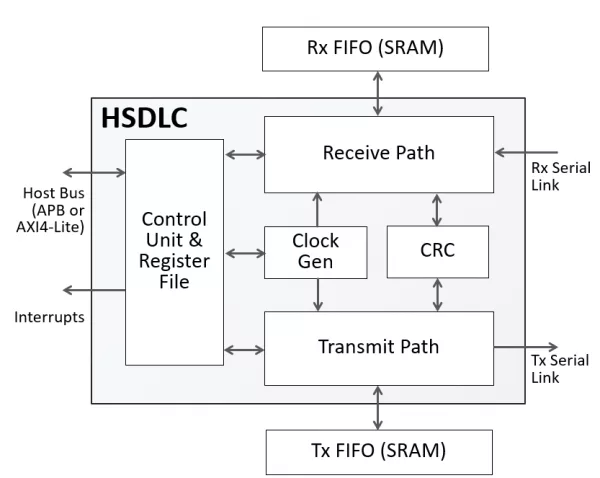
The HSDLC IP core implements a controller for the High-Level Data Link Control (HDLC) and the Synchronous Data Link Control (SDLC) protocols. It is based on the Intel® 8XC152 Global Serial Channel (GSC) working in SDLC mode, and adds features to support HDLC or proprietary frame transmission under host processor control.
The core operates as a peripheral to a host processor, and is easy to integrate with both modern and legacy processors. Control and status registers are accessible via an APB or a generic 80C51-like bus interface, and a comprehensive set of interrupt signals facilitates interrupt-based operation.
The controller’s great flexibility enables a variety of serial link setups. It provides two independent interfaces, one for transmitting and one for receiving data. Both interfaces provide control signals for the link drivers to support both full- and half-duplex operation. The controller can be programmed to use hardware flow control signals (RTS/CTS) and it can also detect collisions. The baud rate is programmable and limited only by the link drivers and the core’s clock frequency. The core derives the receive clock from the received serial data, or uses an externally provided receive clock.
The HSDLC is available in two versions: Normal, and Safety-Enhanced. The Safety-Enhanced version implements triple-modular redundancy (TMR) to provide full immunity to single-bit upsets and errors and complies to Design Assurance, Level A (DAL-A) of the DO-254 standard.
The HSDLC controller core is designed for reuse and is rigorously verified and scan-ready. Although designed to manage serial links, the core contains no latches or tri-states, and is fully synchronous with a single clock domain. The core is available in Verilog RTL or as a targeted FPGA netlist. Deliverables provide everything required for a successful implementation, including sample scripts, an extensive testbench, and comprehensive documentation.
Key features
- Controller for both the SDLC and HDLC (ISO 13239) transmission protocols
- Based on the Intel® 8XC152 Global Serial Channel (GSC), operating in SDLC Mode
- Additional features support HDLC and proprietary serial protocols.
- Safety Enhanced DO-254/DAL-A Version (Optional)
- Implements TMR for all internal registers
- Delivered with a complete DO-254 Certification Data Package
- Flexible Frame Formatting
- Programmable preamble pattern and preamble length
- Programmable inter-frame space
- Single- or double-byte address field
- Address filtering allowing multicast and broadcast
- Raw transmit and receive testing modes
- Back-to-back transmit & back-to-back receive
- NRZ, NRZI, Bi-Phase-S, and Manchester Data Encoding & Decoding
- Bit Stuffing and Bit Stripping
- 16-bit (CRC-16, CCITT or IBM) and 32-bit (CRC-32) frame check sequence
- CRC, Bit-stuffing/stripping, and abort and idle sequences detection can be independently enabled/disabled
- Receiver FIFO Packet counter
- Flexible Serial Link Interface
- Full or Half Duplex
- Programmable Baud Rate
- Modem Controls (RTSn/CTSn)
- Collision detection
- Internal baud generator, or external transmit clock with strobe
- Automatic receive clock recovery, or external receive clock with strobe
- Easy to Integrate
- Suitable for interrupt-based or polling-based operation
- Configurable size, transmit & receive FIFOs
- 80XC152-like control status registers
- APB or AXI4-Lite
Block Diagram
Files
Note: some files may require an NDA depending on provider policy.
Specifications
Identity
Provider
Learn more about HDLC IP core
CAST Provides a Functional Safety RISC-V Processor IP for Microchip FPGAs
D32PRO, scalable & royalty free 32-bit CPU
Generic Driver Model using hardware abstraction and standard APIs
Synthesizable verification IP speeds design cycle
Synthesizable Verification IP
Frequently asked questions about HDLC IP cores
What is HDLC & SDLC Protocol Controller?
HDLC & SDLC Protocol Controller is a HDLC IP core from CAST listed on Semi IP Hub.
How should engineers evaluate this HDLC?
Engineers should review the overview, key features, supported foundries and nodes, maturity, deliverables, and provider information before shortlisting this HDLC IP.
Can this semiconductor IP be compared with similar products?
Yes. Buyers can compare this product with similar semiconductor IP cores or IP families based on category, provider, process options, and structured technical specifications.