Vendor: Centar Category: FPU

Floating-point (IEEE 754) IP based on Arria 10 and Stratix 10 FPGAs

This circuit uses Altera’s new Arria and Stratix 10 FPGAs with hardwired support for floating-point operations (IEEE754).
Overview

This circuit uses Altera’s new Arria and Stratix 10 FPGAs with hardwired support for floating-point operations (IEEE754). Since Centar's FFT engine consists only of floating-point primitives (add, accumulate, multiply), there is a substantial reduction in LUT and register usage. Thus, high precision FFTs no longer use substantial FPGA resources, e.g., x2 and x6 less LUT/register usage compared to Centar's and Altera's fixed-point FFT IEEE754 implementation. Also, our Arria 10 versions use x2 fewer ALMs than Altera's. Finally, the locality, simplicity and regularity of the processing core keeps interconnect delays lower than cell delays, leading to reduced power dissipation and much higher throughputs.

Key features

  • Applications: Eliminates design costs and time required to create custom fixed--point circuitry
  • Implementation: Using Altera Arria 10 and Stratix 10 FPGAs, LUT/register usage reduced by up to x6
  • FFT size: Any size power-of-two or non-power-of-two
  • Dynamic Range: single precision floating point
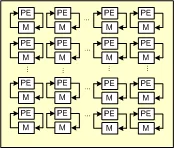
  • Scalability: Array based architecture means higher throughputs are obtained by increasing array size
  • Power: Array interconnects are entirely local, reducing parasitic routing capacitance to keep power dissipation low and clock speed high
  • Data I/O: Streaming, normal order I/O; IEEE754 standard words

Block Diagram

Benefits

  • Programmable architecture easily modified to meet application requirements
  • Combined non-power-of-two and power-or-two options
  • Fastest commercially available throughputs
  • Minimal FPGA hardware resource usage
  • Run-time selection forward/inverse

Applications

  • Radar imaging, medical imaging, industrial measurement, process control, high performance computing, advanced noise cancellation, high precision signal processing, signal intelligence

What’s Included?

  • Netlist (e.g., for Altera FPGAs a *.qxp file for synthesis; a *.vo file or Modelsim library file for simulation)
  • Synthesis constraints (e.g., for Altera FPGA’s an *.sdc file)
  • Modelsim Testbench (*.vo file for DFT circuit plus verilog testbench for control). Matlab verification utilities also available.
  • Matlab behavioral bit-accurate model (p-code)
  • Documentation

Specifications

Identity

Part Number
Floating-Point FFT (hardwired)
Vendor
Centar
Type
Silicon IP

Files

Note: some files may require an NDA depending on provider policy.

Provider

Centar
HQ: USA
Centar is a full service resource for development of embedded signal processing circuit designs requiring use of a discreet "Fourier transform” (DFT), typically implemented as a “Fast Fourier Transform” (FFT). Centar’s FFT technology is programmable, so that different FFT functionality, including non-power-of-two transform sizes, can be developed by simply re-programming the same circuit, significantly lowering the licensing cost of a design to customers. At the same time Centar uses an array-based implementation to provide high-performance, scalable throughputs and by design all circuit communications are "localized" leading to high clock speeds and low power implementations.

Learn more about FPU IP core

A formal-based approach for efficient RISC-V processor verification

In this article, we go through a formal-based, easy-to-deploy RISC-V processor verification application. We show how, together with a RISC-V ISA golden model and RISC-V compliance automatically generated checks, we can efficiently target bugs that would be out of reach for simulation.

Efficient Verification of RISC-V processors

Processor verification, however, is never trivial but requires combining the strengths of multiple verification techniques. This technical paper considers how to efficiently verify a RISC-V processor using a multi-layered approach known as the Swiss cheese model adapted from the world of avionics.

Frequently asked questions about FPU IP cores

What is Floating-point (IEEE 754) IP based on Arria 10 and Stratix 10 FPGAs?

Floating-point (IEEE 754) IP based on Arria 10 and Stratix 10 FPGAs is a FPU IP core from Centar listed on Semi IP Hub.

How should engineers evaluate this FPU?

Engineers should review the overview, key features, supported foundries and nodes, maturity, deliverables, and provider information before shortlisting this FPU IP.

Can this semiconductor IP be compared with similar products?

Yes. Buyers can compare this product with similar semiconductor IP cores or IP families based on category, provider, process options, and structured technical specifications.

×
Semiconductor IP