Overview
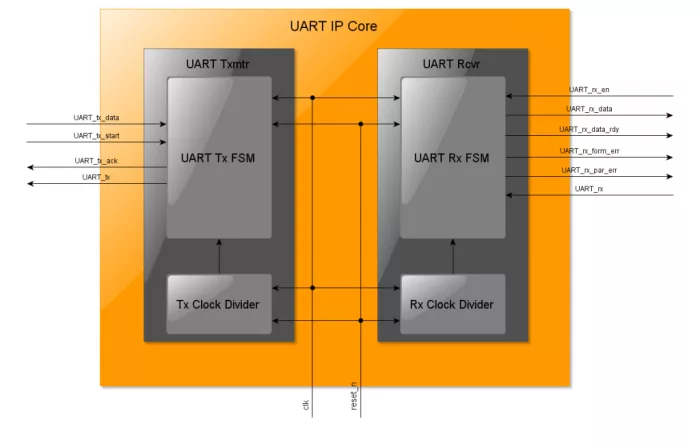
The Universal Asynchronous Receiver/Transmitter (UART) is a hardware device that translates data between parallel and serial forms. UARTs are commonly used in conjunction with communication standards such as TIA (formerly EIA) RS-232, RS-422 or RS-485. The universal designation indicates that the data format and transmission speeds are configurable. The electric signaling levels and methods (such as differential signaling etc.) are handled by a driver circuit external to the UART.
The UART IP Core has been developed to DAL A according to the DO-254 / ED-80 and is accompanied by a Certification Kit. For lower DAL levels reduced documentation sets are available. The core is also available as a netlist for DAL D or projects not needing the full RTL source.
Implementation Details
Unless otherwise specified all the runs have been performed with the default options of the respective tool. Register placement on the IO has been disabled.
No constraints were added, so the results listed under the column “Maximum frequency of operation” are the worst case scenario (no multicycle, false paths, etc. defined).
The results are provided for an UART Core with the following configuration generics (see Table 1):
- ‘g_ASYNC_INPUT’ – TRUE
- ‘g_CLOCK_DIVIDER’ – 139
- ‘g_DATA_WIDTH’ – 8
- ‘g_PARITY_ENABLE’ – ‘1’
- ‘g_ODD_PARITY’ – ‘0’
- ‘g_2_STOP_BITS’ – ‘1’
and without TMR (Triple Module Redundancy), if TMR is used the number of registers will be triplicated, the combinatorial logic will also increase and there might be a penalty on the maximum ‘clk’ frequency.
ACTEL / MICROSEMI
| FPGA Type |
Maximum ‘clk‘ Frequency |
Logic Modules (CORE) |
| ProASIC3
(A3P015 68QFN I Std)
|
132 MHz |
163 |
| IGLOO
(AGL030V5 100VQPF I Std)
|
127 MHz |
163 |
| Fusion
(AFS090 180QFN I Std)
|
132 MHz |
163 |
| Axcelerator
(RTAX250S 208CQFP Mil Std)
|
141 MHz |
SEQUENTIAL (R-cells): 63
COMB (C-cells): 74
|
ALTERA
| FPGA Type |
Maximum ‘clk’ Frequency |
Flip-Flops |
ALUTs |
ALMs |
Logic Cells |
| MAX II
(EPM240F100I5)
|
127 MHz |
57 |
– |
– |
83 |
| Cyclone III
(EP3C5E144I7)
|
> 340 MHz |
57 |
– |
– |
83 |
| Stratix II
(EP2S60F484I4)
|
> 420 MHz |
59 |
66 |
42 |
– |
| Stratix III
(EP3SE110F780I3)
|
> 550 MHz |
57 |
63 |
41 |
– |
| Stratix IV
(EP4SGX70HF35C2)
|
> 670 MHz |
58 |
64 |
41 |
– |
XILINX
| FPGA Type |
Maximum ‘clk‘ Frequency |
Flip-Flops |
4-LUTs |
Slices |
Macrocells |
| CoolRunnerII
(XC2C128-6-TQ144)
|
126 MHz |
57 |
– |
– |
58 |
| Spartan3
(XC3S50-4PQ208)
|
189 MHz |
56 |
91 |
53 |
– |
| Virtex2
(XC2V40-4FG256)
|
174 MHz |
56 |
90 |
53 |
– |
| Virtex4
(XC4VLX15-12SF363)
|
> 460 MHz |
56 |
92 |
53 |
– |
| Virtex5
(XC5VLX30-3FF324)
|
> 390 MHz |
56 |
– |
35 |
– |
Learn more about UART IP core
With the increasing number of high-profile data and privacy breaches in the Internet of Things (IoT) systems, businesses and consumers have a greater awareness of the need for security when buying connected products.
The universal asynchronous receiver/transmitter (UART) is an old friend to embedded systems engineers. It's probably the first communications protocol that we learn in college. In this article, we will design our very own UART using MyHDL.
Post-quantum cryptography (PQC) is moving from theory to engineering reality. With NIST-standardized algorithms ML-KEM (FIPS 203) and ML-DSA (FIPS 204) now finalized, FPGA developers face a practical challenge: How to integrate these algorithms efficiently on resource-constrained hardware?
In today’s connected world, where data is a crucial asset in SoCs, Part V of our series explores how to protect and encrypt data, whether at rest, in transit, or in use building on our earlier blog posts of the series: Essential security features for digital designers, key management, secure boot, and runtime integrity.
Most foundries provide GPIO libraries to their fabless customers. These libraries contain different elements like supply/ground pads, analog I/Os, digital I/Os, corner cells, filler cells, power-on-reset circuits. Frequently the foundry includes cells for different voltage domains. In 40nm CMOS the IC designer can use cells for 1.8V, 2.5V and 3.3V for instance.
Build safety-critical automotive, aeronautic, space and other systems with the Functional Safety RISC-V Processor IP core from CAST and PolarFire® FPGAs.