Amplifier linearization promotes efficiency in multi-carrier WCDMA basestation
Amplifier linearization promotes efficiency in multi-carrier WCDMA basestation
DPSYS is a Digital Precorrection (Predistortion) system designed to compensate for the non-linear characteristic of a high-power …
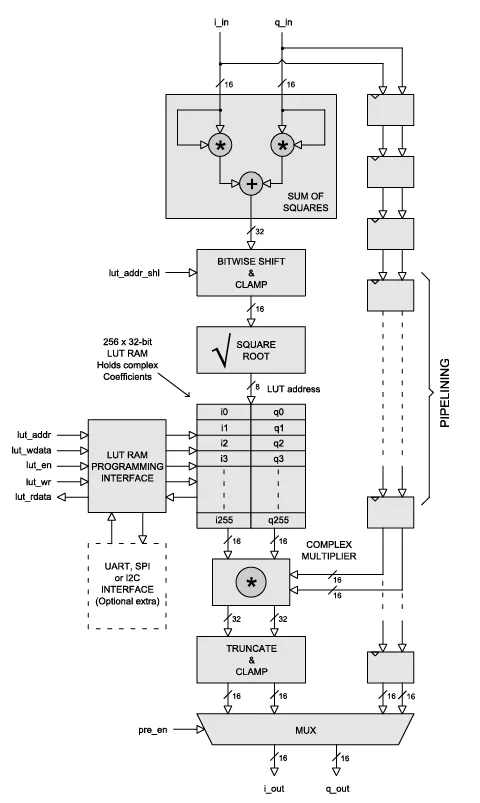
DPSYS is a complete Digital Precorrection (Predistortion) system designed to compensate for the non-linear characteristic of a high-power RF Amplifier. The system is capable of adjusting both the gain and phase of a complex input signal. This is achieved by means of a complex multiplication of the input with a complex polynomial function stored in the LUT. Complex inputs are sampled on the rising edge of clk when en is high.
The LUT contains the inverse PA characteristic and is applied before the amplification stages (either at baseband or IF frequencies). By programming the LUT with the inverse gain/phase PA response, the resultant PA response is linearized. After linearization, the output signal is much cleaner with reduced intermodulation distortion. This is most readily observed by the absence of raised 'shoulders' at either side of the signal of interest.
The system may be used in open-loop or closed-loop configuration. For open loop operation, the LUT coefficients are static and programmed during initial setup of the PA precorrection system. For closed-loop operation, an external circuit may compare the baseband inputs and PA outputs and adjust the LUT coefficients dynamically in order to automate the linearization process.
The first stage of the pipeline computes the magnitude of the complex input signal. The magnitude serves as an address into a LUT which in turn indexes a pair of complex coefficients (I & Q). The complex input is multiplied by the complex coefficients in order to modify the gain and phase of the input accordingly. Finally the output is truncated and clamped to 16-bit precision.
Note: some files may require an NDA depending on provider policy.

RF Power Amplifier Precorrection System is a Amplifier IP core from Zipcores Electronic Systems Engineering S.L. listed on Semi IP Hub.
Engineers should review the overview, key features, supported foundries and nodes, maturity, deliverables, and provider information before shortlisting this Amplifier IP.
Yes. Buyers can compare this product with similar semiconductor IP cores or IP families based on category, provider, process options, and structured technical specifications.