Vendor: CAST Category: MACsec

CANsec Acceleration Engine

The CAN-SEC IP core implements a hardware accelerator for the CANsec extension of the CAN-XL protocol, as defined in CiA’s 613-2 …

Overview

The CAN-SEC IP core implements a hardware accelerator for the CANsec extension of the CAN-XL protocol, as defined in CiA’s 613-2 specification.

The CANsec specification provisions two ciphers with key lengths of 128, 192, or 256 bits to protect CAN XL frames’ payload, all of which are supported by the hardware accelerator. Specifically, the core secures frames exchanged over CAN bus networks using AES-CMAC to protect integrity and authenticity and AES-GCM to additionally protect confidentiality. CANsec also secures communication between different groups of nodes physically connected on the same bus using the concept of secure channels, where each channel uses a different encryption key and freshness value. The CAN-SEC core enables its host system to participate in up to 256 secure channels.

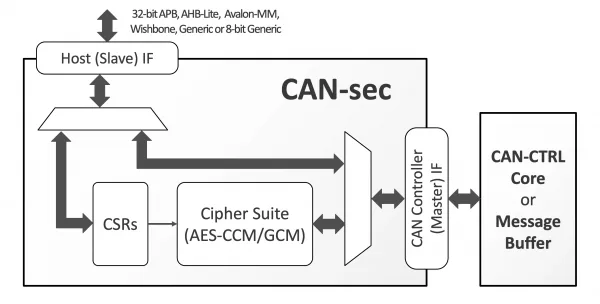
This CANsec hardware accelerator has been designed for ease of integration. It presents itself as a peripheral that communicates to the host system via a generic 32-bit memory-mapped slave interface and a configurable interrupt line. The core is delivered with bridges that convert this generic host interface to a generic 8-bit memory-mapped interface, or to a 32-bit APB, AHB-Lite, Avalon-MM, or Wishbone interface. Its operation is also rather simple: the host puts the CANsec or CAN XL messages to be processed in a buffer mapped on the core’s address space, and the core returns the processed CAN XL or CANsec message to the same buffer and notifies the host. The message buffer can be implemented by means of a simple SRAM attached to the CAN-SEC core via a master memory-mapped port. This master port can be used to connect the CAN-SEC core to the CAN-CTRL CAN controller core available from CAST. In this case, the CAN-SEC accesses the CAN controller’s message buffers, saving the extra message buffer space and message transfers.

Consistent with CAST’s quality standards, this core has been rigorously verified, is LINT-clean and scan-ready, and is delivered with everything required for a trouble-free implementation. It is available in System Verilog RTL source code or as a targeted FPGA netlist, and its deliverables include a sophisticated testbench, sample synthesis and simulation scripts, and comprehensive documentation. Software integration is facilitated by a low-level Hardware Abstraction Layer (HAL) and a Linux Driver. A MISRA C bear-metal driver is also optionally available.
Key features

  • CANsec Acceleration Engine
    • Receives and outputs CAN frames compliant to:
      • CAN XL protocol (CiA 610-1)
      • CAN XL add-on services, Part 1: Simple/extended content indication (CiA 613-1)
      • CAN XL add-on services, Part 2: Security (CiA 613-2)
    • Implements all ciphers and key sizes provisioned by the CANsec specification: 
      • AES-CMAC for encryption-only, or 
      • AES-GCM for authenticated-encryption 
      • Key size of 128, 192, or 256 bits 
    • Supports up to 256 CANsec secure channels, each equipped with a different key and freshness value.
  • Easy to Integrate
    • Works with any CAN XL controller
      • Optimizes memory usage and bus transfers when used with the CAN-CTRL controller core available from CAST
    • Uses a generic 32-bit slave interface & bridges to 32-bit APB, AHB-Lite, Avalon-MM, or Wishbone, or an 8-bit generic microcontroller interface.  
    • Reports status & error in CSRs and interrupts 
      • Supports configuration of interrupt sources. 
  • Straightforward to Implement
    • Available in LINT-clean, scan-ready, synthesizable RTL source code format or as a targeted FPGA netlist
    • Single clock-domain design with no multi-cycle or false paths  
    • Platform-Independent – Can be implemented on any FPGA device or ASIC technology 
       

Block Diagram

Files

Note: some files may require an NDA depending on provider policy.

Specifications

Identity

Part Number
CAN-SEC
Vendor
CAST
Type
Silicon IP

Provider

CAST
HQ: USA
CAST is a silicon intellectual property (IP) developer, aggregator, and integrator providing IP cores and subsystems since 1993. Our product line features both leading-edge and standards-based digital IP, including compression engines and image processing functions; 8051 microcontrollers and low-power 32-bit BA2X™ processors; industry-leading automotive interfaces; a complete family of SoC security modules; and a variety of peripherals, interfaces, and other IP cores. Our goal is to maximize IP benefits for our customers by delivering high quality, easy to use, cost effective solutions for real system development challenges. We minimize customer risk through rigorous development standards, complete deliverables with comprehensive documentation, and superlative customer support. We maximize customer value thorough competitive pricing and simple licensing—including royalty-free options—and long-term partnerships with all leading silicon providers and select technology leaders. Our product standards and business practices have been uniquely honed through successful projects with hundreds of systems designers since the very beginnings of the IP industry, making CAST one of the best IP partners available.

Learn more about MACsec IP core

O-RAN Fronthaul Security using MACsec

With 5G being deployed for time-sensitive applications, security is becoming an important consideration. At the same time, Open Radio Access Networks (RAN) are gaining more interest from mobile carriers and governments. Yet, Open RAN networks have serious security challenges, especially in the RAN fronthaul where there are strict timing requirements. This paper proposes MACsec as an efficient data link layer security solution that can assist in meeting these challenges.

Frequently asked questions about MACsec IP cores

What is CANsec Acceleration Engine?

CANsec Acceleration Engine is a MACsec IP core from CAST listed on Semi IP Hub.

How should engineers evaluate this MACsec?

Engineers should review the overview, key features, supported foundries and nodes, maturity, deliverables, and provider information before shortlisting this MACsec IP.

Can this semiconductor IP be compared with similar products?

Yes. Buyers can compare this product with similar semiconductor IP cores or IP families based on category, provider, process options, and structured technical specifications.

×
Semiconductor IP