Vendor:
Ceva, Inc.
Category:
DSP Core
Audio and control DSP
The Ceva-BX1 audio digital signal controller IP handles both modest signal-processing and control workloads with up to 8 GMACs pe…
Overview
The Ceva-BX1 audio digital signal controller IP handles both modest signal-processing and control workloads with up to 8 GMACs per second performance and high-level-language programming. Yet it is power-efficient enough for always-on applications and use in wearables and TWS earbuds. The Ceva-BX1 supports a range of integer and floating-point data types for a wide range of applications, from audio signal processing to light AI workloads, with remarkably compact code size. Optimized high-speed interfaces expedite Ceva-BX1 connection to coprocessors or accelerators, and a rich software partners ecosystem provide ready-to-use application-level solutions.
The Solution
The Ceva-BX1 combines the capabilities of signal processing and control-code execution into a single compact, low-power DSP core. Computational speed comes from dual-32×32 and quad-16×16 MACs with added support for 16×8 and 8×8 MAC operations, implemented in an 11-stage pipeline. A floating-point unit supporting half, single, and double-precision IEEE floating-point is optional. These resources are directed by a four-way VLIW instruction set architecture with optimizations for single-instruction-multiple-data (SIMD) operation. A hardware loop buffer speeds kernel code execution, while efficient execution of control code is aided by dynamic branch prediction and a branch target buffer. Trusted execution modes enable secure operation. On signal-processing tasks the Ceva-BX1 can reach up to 8 GMACs per second, and on control workloads it can achieve up to 4.41 CoreMark/MHz. The hardware design is optimized for speed, achieving 2 GHz operation when implemented in a TSMC 7nm process node using only common standard cells and memory compilers.
Key features
- 4-way VLIW architecture with dual 32×32 or quad 16×16 MACs and optional half/single/double-precision IEEE floating-point unit
- Support for 8, 16, 32, and 64-bit integer operations, including 16×8 and 8×8 MAC operations for neural-network computations
- Sophisticated optimizations for control flow, including hardware loop buffer, branch target buffer, and dynamic branch prediction
- Trusted execution modes for secure operation
- Performance up to 8 GMACs per second and 4.41 CoreMark/MHz
- Hardware provisions for attaching coprocessors and accelerators
- Supported by LLVM compiler, Eclipse debug environment, and extensive libraries
Block Diagram
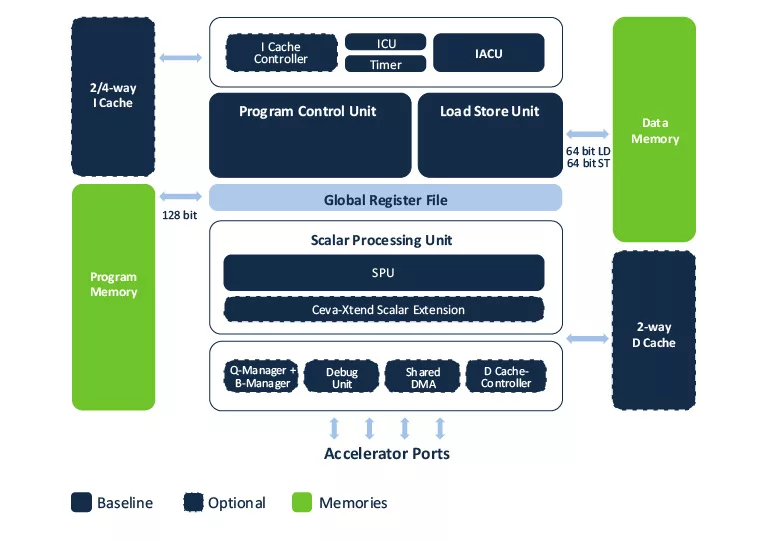
Ceva-BX1 block diagram
Benefits
- The Ceva-BX1 delivers the capabilities of both a compact audio DSP core and a capable MCU to power-constrained environments, handling both signal-processing and control workloads in a single core. DSP performance is sufficient for multi-microphone environmental noise cancellation, light AI processing, and high-accuracy sensor fusion, for examples.
- High-speed ports with automatic queuing and buffer controls make it easy to attach coprocessors and accelerators with the DSP.
- With a hardware design optimized for very low power and high speed, the performance of the Ceva-BX1 can be achieved without assembly-coding, using only C/C++ code generated by an LLVM compiler. The compiler, an RTOS, an Eclipse-based tool chain, extensive libraries for DSP and neural-network operations, and support for neural-network frameworks are all provided.
Applications
- Consumer IoT
- Automotive
Files
Note: some files may require an NDA depending on provider policy.
Specifications
Identity
Part Number
Ceva-BX1
Vendor
Ceva, Inc.
Type
Silicon IP
Provider

Ceva, Inc.
HQ:
USA
The Smart Edge runs on Ceva!
Ceva is the leader in innovative silicon and software IP solutions that enable smart edge products to connect, sense, and infer data more reliably and efficiently.
At Ceva, we are passionate about the smart edge. Providing the technology and market expertise our customers need to be successful is what we do best, and we’ve been doing it for over 30 years.
With the industry’s only portfolio of comprehensive communications and scalable edge AI IP, Ceva powers the connectivity, sensing, and inference in today’s most advanced smart edge products across consumer IoT, mobile, automotive, infrastructure, industrial, and personal computing. More than 17 billion of the world’s most innovative smart edge products from smartphones to drones to cellular base stations and more are powered by Ceva.
We create innovative technologies that help our customers turn great ideas into extraordinary products. We license our portfolio of wireless communications and scalable edge AI IP to our customers, breaking down barriers to entry and enabling them to bring new cutting-edge products to market faster, more reliably, efficiently, and economically.
Ceva is a trusted partner to over 400 of the leading semiconductor and OEM companies including Actions, Artosyn, ASR, Atmosic, Autotalks, Beken, Bestechnic, Brite, Broadcom, Celeno, Ceragon, Cirrus Logic, Dialog Semiconductor, DSP Group, Espressif, FujiFilm, GCT Semi, iCatch, InPlay, Intel, Itron, Leadcore, LG Electronics, Mediatek, Microchip, Nextchip, Nokia, Novatek, NXP, ON Semiconductor, Optek, Oticon, Panasonic, RDA, Renesas, Rockchip, Rohm, Samsung, Sanechips, Sharp, Siflower, SigmaStar, Socionext, Sony, Socionext, Sonova, STMicroelectronics, Toshiba, Unisoc, Vatics, Yamaha and ZTE all leverage Ceva’s industry-leading IP. These companies incorporate our IP into application-specific integrated circuits (“ASICs”) and application-specific standard products (“ASSPs”) that they manufacture, market and sell to consumer electronics companies.
Headquartered in Rockville, Maryland, Ceva has over 400 employees worldwide, with design centers in Israel, Ireland, France, United Kingdom, United States, Serbia, and sales and support offices located in Europe, the U.S. and throughout Asia.
Ceva is a sustainable and environmentally conscious company, adhering to our Code of Business Conduct and Ethics. As such, we emphasize and focus on environmental preservation, recycling, the welfare of our employees and privacy – which we promote on a corporate level. At Ceva, we are committed to social responsibility, values of preservation and consciousness towards these purposes.
Learn more about DSP Core IP core
Wireless 5G BTS Need Super DSP core... CEVA XC-12
Eric Esteve
CEVA-X1 DSP Core Targets Cellular IoT Opportunities
Oxford Digital Offers Small Audio DSP Core With Graphical Programming
icyflex: an ultra-low power DSP core for portable applications
The icyflex family of ultra low power 16/32-bit RISC processor cores developed by CSEM offers a flexible architecture that allows for different com-binations of control and DSP functionality. These processors target applications requiring long battery life at the same time as on-chip processing power. Three silicon-proven icyflex cores are available, consuming as little as 6 μW/MHz.
FPGA configures DSP core in imaging app
FPGA configures DSP core in imaging app
Frequently asked questions about DSP Core IP cores
What is Audio and control DSP?
Audio and control DSP is a DSP Core IP core from Ceva, Inc. listed on Semi IP Hub.
How should engineers evaluate this DSP Core?
Engineers should review the overview, key features, supported foundries and nodes, maturity, deliverables, and provider information before shortlisting this DSP Core IP.
Can this semiconductor IP be compared with similar products?
Yes. Buyers can compare this product with similar semiconductor IP cores or IP families based on category, provider, process options, and structured technical specifications.