Overview
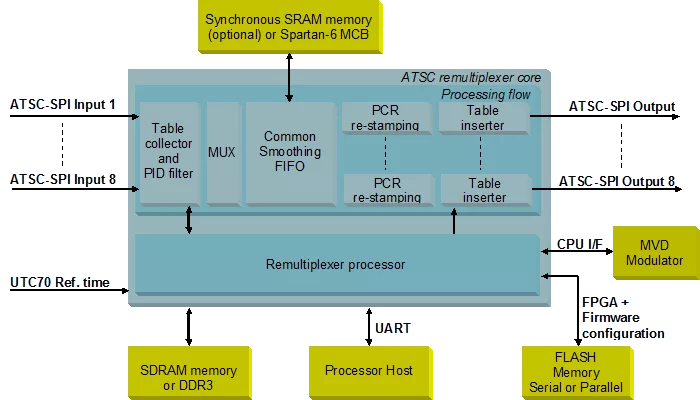
The MVD ATSC Remultiplexer core analyses the MPEG TS stream inputs and gives access to the followings information and statistics :
• Incoming TS Stream features ( TS_ID, Version, Tables ...)
• Incoming/ Payload/ Outcoming rates
• Program List and bandwidth for each program.
• Program Information (Short Name, Program Number, Access Control Flags (VCT & PID Frame Header), etc...)
Then, it filters user selected programs and regenerates PSIP tables such as such as PAT, CAT, PMTs (according to configuration), MGT, STT, VCT (Cable or Terrestrial) , EIT0->EIT3, RRT.
Not filtered PMT program and others PID which do not correspond to any program or PSIP tables are filtered.
PMTs are re-generated according to the modifications to apply to the output stream.
CAT and related PIDs are filtered according to the configuration of the remultiplexer.
The ATSC Remultiplexer core allows the filtering of programs of ATSC MPEG TS flows compliant with the standards:
• ISO13818-1
• A53/Part 3; A65:2009
Learn more about Broadcast IP core
High definition video content is becoming rampant as more and more countries are now transitioning into digital life. The ways to deliverHigh definition content in a bandwidth limited channel have become challenge in itself. To cater to such highly demanding broadcast & professional video markets, we require a compression / decompression standard that allows no compromise on the quality of the video that has to be broadcasted over a bandwidth constrained networks.
In this paper, we developed low power transport demultiplexer to support MPEG-2 transport streams for ATSC and DVB digital broadcast standards. Novel window based packet identification (PID) and section filtering is presented to provide a cost effective and flexible solution.
In this paper, we developed low power transport demultiplexer to support MPEG-2 transport streams for ATSC and DVB digital broadcast standards. Novel window based packet identification (PID) and section filtering is presented to provide a cost effective and flexible solution.
The proliferation of high-definition television (HDTV) video content creation and the method of delivering these contents in a bandwidth-limited broadcast channel environment have driven new video compression standards and associated video image processin
Flexible Embedded Processors for Developing Multi-Standard OFDM Broadcast Receivers
Emerging H.264 standard supports broadcast video encoding