Overview
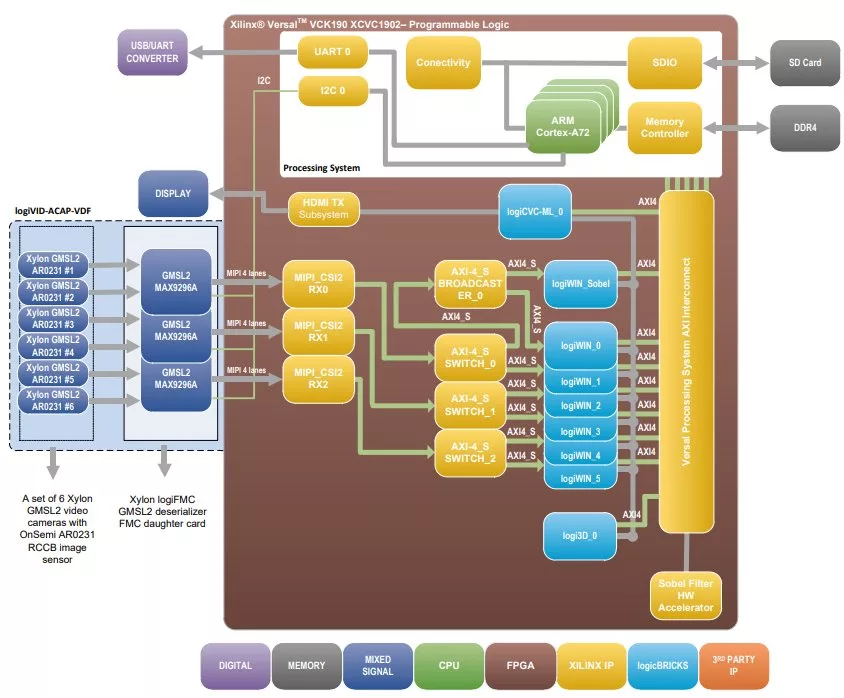
The logiREF-ACAP-VDF "ACAP IP Framework for Multi-Camera Vision Applications" enables Xylon logiVID-ACAP-6CAM ACAP Vision Development Kit users to quickly utilize the provided hardware platform for the development of AMD-Xilinx Versal Adaptive Compute Acceleration Platform (ACAP) based embedded multi-camera vision systems. The framework includes pre-verified logicBRICKS reference design for video capture from six Xylon video cameras and the display output under Linux OS. The framework showcases the advantages of the Versal ACAP platform by visualizing 6 camera streams in parallel, with or without running advanced image filters, and with real-time LIDAR data that is visualized instantly on the screen in the form of a 3D point cloud.
Instead of starting from scratch and having to spend months designing and building a new design framework, users of the logiREF-ACAP-VDF design framework can immediately focus on specific vision-based parts of their next ACAP design. This design implements six parallel video inputs from Xylon video cameras and the display output with RGB overlay. All video inputs are stored in the video memory, and by mean of on-board push buttons, the user can select each of them for the single camera or all cameras full screen display output.
All logicBRICKS IP cores are supplied with bare-metal and appropriate Linux software drivers. The provided video capture and display demo applications run in Linux OS.
Learn more about Vision Subsystem IP core
Priya Balasubramanian, Cadence
With artificial intelligence (AI) being used for a growing number of use cases in an expanding set of industries, semiconductor providers face immense pressure to keep pace with rising workload complexity and specialization. From real-time language processing to vision-based applications and instruction-driven models, AI workloads require silicon solutions that are not only powerful but also efficient, optimized for specific use cases, and able to scale with the extension of AI infrastructure.
Physical AI will enable the next generation of autonomous robots to sense the world around them, think to create a plan based on their role and situational understanding, and act to implement that plan.
TIP SMitra, Cadence
The world of artificial intelligence is moving beyond the cloud and into our everyday devices from smart sensors to robotics and AR/VR headsets.