Vendor: BitSim NOW Category: MIPI

Very compact (500 LUTs) Camera Sensor Receiver Interface Converting from MIPI CSI-2 to AXI4-Stream Video Standard

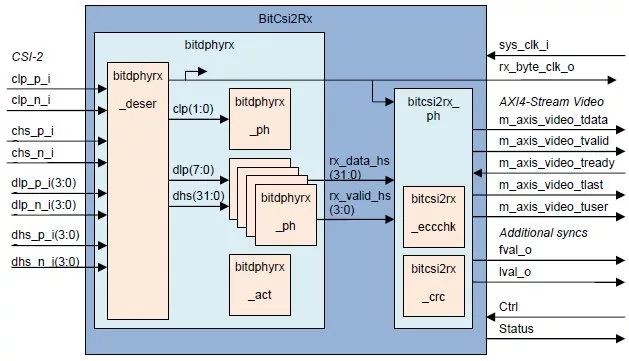
The BitCsi2Rx IP is a receiver for camera sensor signals, to be used in an FPGA or ASIC.

Overview

The BitCsi2Rx IP is a receiver for camera sensor signals, to be used in an FPGA or ASIC.
It receives camera signals in accordance with the MIPI CSI-2 and D-PHY specifications. BitCsi2Rx converts these signals to parallel video signals for AXI4- Stream Video standard. To make it easier to interface BitCsi2Rx with various other design blocks, it also outputs fval (frame valid) and lval (line valid) signals for synchronization.

Third generation of the IP, so it very compact, from only 500 LUTs/FFs, including the D-PHY.

A MIPI CSI-2 transmitter IP is also available from BitSim, BitCsi2Tx.
It has been used with SoCs like: i.MX8-series (NXP), OMAP (TI), MPSoC (Xilinx), Snapdragon (Qualcomm) and Xavier (Nvidia).

Key features

  • 1 to 4 data lanes
  • Number of data lanes can be configured statically at synthesis time and dynamically during run-time
  • Supported CSI-2 Primary Data Types: like RAW8/10/12/14/16, YUV422_8/10, RGB888, Generic, User Defined
  • Up to 2.5 Gb/lane
  • Also supports Xilinx UltraScale+ with embedded D-PHY IOs
  • AXI4-Stream Video output with additional synchronization signals
  • Virtual Channel Support
  • ECC checking and correction for packet headers and short packets
  • Checksum checking for packet payload data
  • D-PHY protocol decoding included
  • Clock-lane/data-lanes deskew
  • Full High Speed/Low Power mode support ? Test/debug features
  • Written in VHDL, prepared for instantiation in Verilog or SystemVerilog design

Block Diagram

Applications

  • Automotive
  • Industrial
  • Medtech
  • Consumer
  • Vision
  • Radar etc

What’s Included?

  • Encrypted or readable source code
  • VHDL test benches and scripts
  • HW-platform/reference kit available

Files

Note: some files may require an NDA depending on provider policy.

Specifications

Identity

Part Number
Bit-MIPI CSI-2
Vendor
BitSim NOW
Type
Silicon IP

Provider

BitSim NOW
HQ: Sweden
BitSim, is a leading design house in the development of advanced electronics for cameras/imaging detectors/sensors, data acquisition, and video/graphics.

Learn more about MIPI IP core

MIPI CCI over I3C: Faster Camera Control for SoC Architects

Imagine a camera subsystem that responds in microseconds, consumes less power, and offers a more straightforward route to time-to-market. For SoC architects and IP integration teams, that vision is increasingly possible with MIPI Camera Control Interface (CCI) over I3C.

MIPI MPHY 6.0: Enabling Next-Generation UFS Performance

High-speed chip-to-chip data transfer is continuously evolving to meet increasing performance demands. MIPI MPHY is a high-speed physical layer interface developed by the MIPI Alliance. This protocol is used for high-speed chip-to-chip interfaces, mainly in mobile and automotive devices.

MIPI: Powering the Future of Connected Devices

From the first monochrome mobile displays to today’s ultra-high-definition automotive dashboards and immersive AR/VR headsets, MIPI technology has quietly become the backbone of modern data connectivity. Let’s explore how MIPI standards have evolved, the markets they serve, and why Rambus is at the forefront of this transformation.

Frequently asked questions about MIPI IP cores

What is Very compact (500 LUTs) Camera Sensor Receiver Interface Converting from MIPI CSI-2 to AXI4-Stream Video Standard?

Very compact (500 LUTs) Camera Sensor Receiver Interface Converting from MIPI CSI-2 to AXI4-Stream Video Standard is a MIPI IP core from BitSim NOW listed on Semi IP Hub.

How should engineers evaluate this MIPI?

Engineers should review the overview, key features, supported foundries and nodes, maturity, deliverables, and provider information before shortlisting this MIPI IP.

Can this semiconductor IP be compared with similar products?

Yes. Buyers can compare this product with similar semiconductor IP cores or IP families based on category, provider, process options, and structured technical specifications.

×
Semiconductor IP