Overview
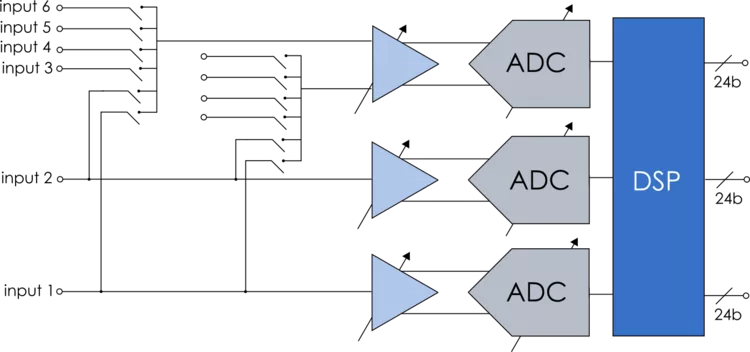
STAR1000 is a state of the art ultra-low power multi-input interface and ADC. Using a break through design and patented technology it can digitize up to six inputs through three channels with less than 340uW (200uW for the ADC and 140uW for the interface) per channel while achieving better than 90dBA dynamic range and 0.01% THD. The ADC by itself achieves better than 96dBA performance.
STAR1000's power is so low that it can achieve full audio performance with the power that many competing solutions use in a low performance, stand by mode. As such, it is very well suited to always-on applications such as voice assistants. Moreover the architecture of STAR1000 is highly configurable – enabling scalable power vs bandwidth and resolution trade-offs to yield optimized performance for a variety of different inputs with state-of-the-art performance.
STAR1000 can be configured to operate in a variety of non-inverting opamp configurations or lower distortion inverting opamp configurations. The highly flexible interface enables a wide variety of inputs to be digitized, such as microphones, audio line-in, battery voltages, sensor inputs, and most inputs found in IoT applications. Hence STAR1000 is a single IP which can be used for multiple applications.
The ADC operates in either continuous time Delta Sigma mode for high dynamic range and wide bandwidth inputs, or can be configured to operate in incremental mode which is optimal for Nyquist rate digitization of low bandwidth applications. Incremental mode also enables the six inputs to be time interleaved and digitized by a single ADC.
The design is GDS ready and silicon proven in a TSMC 40nm LP process and with functional range down to 0.87V is extremely well suited for ultra low power applications.
Learn more about Audio Analog IP core
In the massive world of multimedia, sound stands as a vital component that adds depth to the overall encounter. Whether it's streaming services, video games, or virtual reality, sound holds a crucial role in crafting immersive and captivating content.
Design and evaluation of power-efficient SoCs
By integrating an audio analog codec that implements the 'audio hub' functionality and is able to process and mix audio signals from asynchronous sources, system designers can free the scarce main processor resources for more relevant tasks and simplify the system design, thus achieving a more effective solution.
Consumer IC Advances -> Altering algorithms to create '3D' sound
Efficient audio is essential for low-power 3G mobiles
The virtual validation of subsystem performances (Pop-up Noise, Signal-to-Noise Ratio, Power supply Noise, Power consumption...) requires the modeling and simulation of complete subsystems. Application Hardware Modeling (AHM) consists in addressing the risks of performance degradation while integrating a Silicon IP in its Integrated Circuit (IC) and this IC on its Printed Circuit Board (PCB). The selection of relevant models for a subsystem performance, along with the creation and validation of models through equivalence checking, are the basics of Application Hardware Modeling for right-on-first-pass subsystems!