Vendor:
Weasic Microelectronics
Category:
Temperature Sensor
Temperature Sensor 1.8 V
The WEA10TS45 temperature sensor operates from -40 oC to 140 oC and produces an output voltage from 0 to 1.2 V.
Overview
The WEA10TS45 temperature sensor operates from -40 oC to 140 oC and produces an output voltage from 0 to 1.2 V. The core of the sensor can be detached from the processing unit and placed to the silicon area of interest. The sensor has an absolute accuracy of +/- 5oC and after offset and gain calibration the maximum residual error is below +/-1.25 oC. The control is done through two 16 digital control signal bus in a linear way. The sensor operates from a supply of 1.8 V. It requires 1.0 V digital supply for the calibration control.
Key features
- Absolute accuracy: +/- 5 oC uncalibrated, +/- 1.25 oC calibrated
- Voltage slope: 4.72 – 6.78 mV/oC (16 steps)
- Voltage offset: +/- 90.0mV (16 steps)
- Output voltage: 0V – 1.2V (-40 oC / 140 oC)
- Area: 0.016 mm2 (core),0.161 mm2 (processing)
- Dissipation: 365 uW
Block Diagram
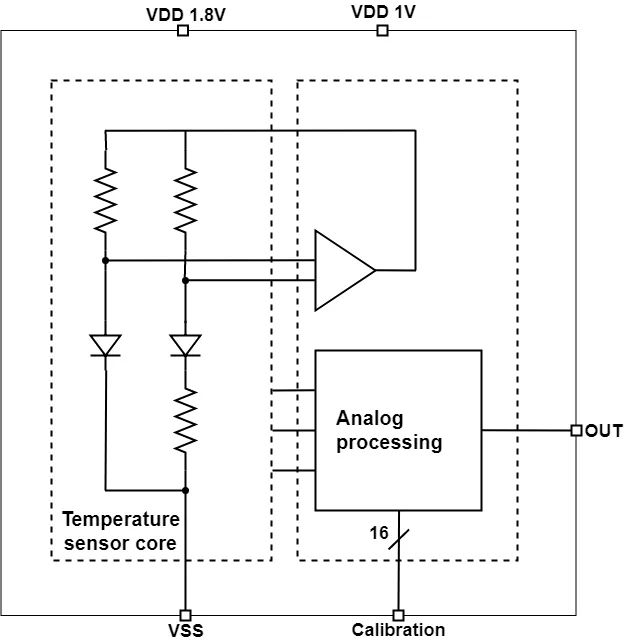
WEA10TS45 block diagram
Specifications
Identity
Part Number
WEA10TS45
Vendor
Weasic Microelectronics
Type
Silicon IP
Files
Note: some files may require an NDA depending on provider policy.
Provider

Weasic Microelectronics
HQ:
Greece
Weasic develops and markets mmWave Analog and Mixed-Signal IP for 5G backhaul, Automotive RADARs and Satellite Radios. Weasic’s world class design team has a strong record of successfully delivering first-pass silicon for the most challenging design specifications in performance, power consumption and silicon area. Weasic’s IP is in production with multiple customers world-wide, including some of the largest names in the industry sectors we serve. Weasic was founded in 2014 and is based in Athens, Greece.
Learn more about Temperature Sensor IP core
Power Management for Internet of Things (IoT) System on a Chip (SoC) Development
There are many factors that must be considered when developing a custom System on a Chip (SoC) for Internet of Things (IoT) applications. Chief among these are the power management circuits on the die. Vidatronic offers this white paper to discuss these considerations and all of the various circuit blocks that can be found in this application. Vidatronic IP solutions are discussed and the benefits they bring to IoT SoC designers.
Smart Transit Solution
Surveillance and security has become increasingly important during modern days for government/law enforcement, public or private transit authorities and for the fleet management. To monitor or investigate accidental damage, theft, harassment or left packages, producing/collecting evidences and analyze the occurrence of situation is challenge. This white paper describes how smart transit solution can generate evidences and help in analyze the situation of an incident. Smart transit solution improves profitability by enabling batter safety, security and service.
High-Performance DSPs -> Voice control enhances appliance apps
High-Performance DSPs -> Voice control enhances appliance apps
Context Based Clock Gating Technique For Low Power Designs of IoT Applications - A DesignWare IP Case Study
This paper discusses about the intelligent low power techniques such as context based clock gating and how they are useful for IoT applications. It also describes how it improves the overall power efficiency of the system. The power statistics shared shows how the overall idle power and functional power consumption is significantly reduced. Further we discuss about how it can be combined with few other low power techniques to reduce the overall power
Custom ASICs for Internet of Industrial Things (IoIT)
This white paper commences with an overview of the IoIT (Internet of Industrial Things) opportunity, the market drivers, and how the semiconductor industry is responding to this need. We then include an example of a customisable SoC intended for use in various industrial applications where low power consumption, remote deployment, reduced production costs and short time-to-market are vital.
Frequently asked questions about Temperature Sensor IP cores
What is Temperature Sensor 1.8 V?
Temperature Sensor 1.8 V is a Temperature Sensor IP core from Weasic Microelectronics listed on Semi IP Hub.
How should engineers evaluate this Temperature Sensor?
Engineers should review the overview, key features, supported foundries and nodes, maturity, deliverables, and provider information before shortlisting this Temperature Sensor IP.
Can this semiconductor IP be compared with similar products?
Yes. Buyers can compare this product with similar semiconductor IP cores or IP families based on category, provider, process options, and structured technical specifications.