Inside MIPI RFFE v2.1: Enabling the 5G transformation
Jim Ross (Skyworks Solutions) & Victor Wilkerson (Qorvo US)
Mobile radio communication is trending towards complex multi-radio systems comprising several transceivers.
Mobile radio communication is trending towards complex multi-radio systems comprising several transceivers. Arasan supports the latest MIPI RFFE standard v3.0 controller IP. The MIPI RFFE bus is a 2-wire serial interface that utilizes a bus frequency of up to 52 MHz and timing accurate trigger mechanisms to allow control of timing-critical functions. It is used to connect a digital RFIC to RF front end components, like Power Amplifiers, Low-Noise Amplifiers, and Antenna Sensors, which are considered RFFE Slaves.
One key component of MIPI RFFE v3.0 controller IP was to retain backward-compatibility, especially for MIPI RFFE v2.0 and v1.0 Slave devices. This requirement enables MIPI RFFE v2.0 and v1.0 Slave devices to function properly in a MIPI RFFE v3.0 controller IP system. Of course, such MIPI RFFE v1.0 and v2.0 -compliant Slave devices in a MIPI RFFE v3.0 controller IP system are limited to their MIPI RFFE v1.0 and v2.0 functionality respectively.
Arasan’s MIPI RFFE v3.0 IP compatible Slave device implements the following new optional features:
The MIPI RFFE Slave IP core typically resides in the RFIC in a mobile platform, and utilizes the RFFE bus to identify, program, and monitor the registers in RF front end Slave devices through programmed IO. It is designed to support existing standards such as LTE, UMTS, HSPA and EGPRS, and is usable in configurations ranging from single Master/single Slave to multi-Master/multi-Slave.
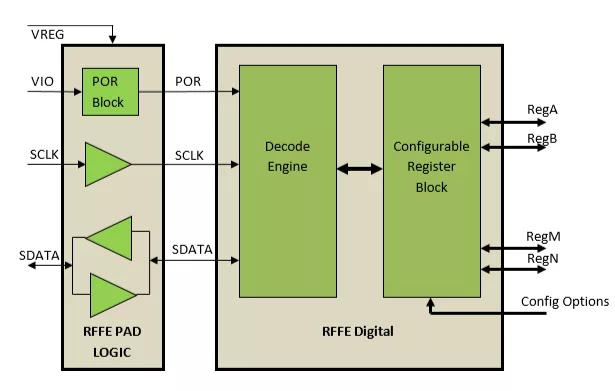
The MIPI RFFE Slave V3.0 IP Core resides in each RF front end component. At a minimum, Arasan delivers MIPI RFFE Slave in RTL form. Physical designs of the complete MIPI RFFE Slave, including the Pad Logic block for CLK and DATA as shown below, can be provided upon request.
Note: some files may require an NDA depending on provider policy.

RFFE Slave IP Core is a MIPI RFFE IP core from Arasan Chip Systems Inc. listed on Semi IP Hub.
Engineers should review the overview, key features, supported foundries and nodes, maturity, deliverables, and provider information before shortlisting this MIPI RFFE IP.
Yes. Buyers can compare this product with similar semiconductor IP cores or IP families based on category, provider, process options, and structured technical specifications.