Overview
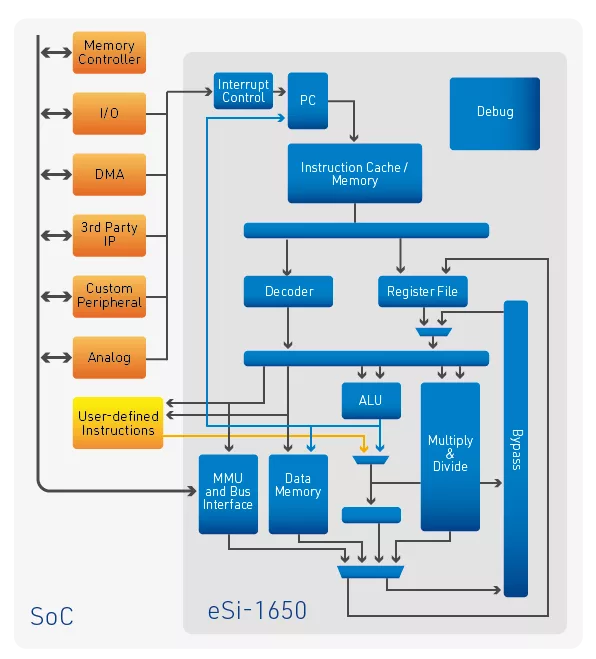
The eSi-1650 16-bit CPU with instruction cache is targeted specifically for low-power applications, where typically an 8-bit CPU may have previously been used or where a 32-bit CPU is too big or power hungry. The instruction cache provides a high performance, area and power efficient solution when running from on-chip NVM or Flash.
The use of the cache allows higher CPU frequencies when in mature technologies as frequency is typically limited by the memory speed. Power is reduced as a small cache require less power to read than flash. A cache can be much smaller than a full shadow RAM.
Even though it is 16-bit, the gate count is equivalent to many 8-bit cores due to the simplicity of the RISC pipeline. With a wider datapath and 16 general purpose registers, application programs are able to execute in far fewer clock cycles. This can save a significant amount of power by either allowing the CPU to be clocked at a lower frequency or by being able to enter a power down state sooner.
The eSi-1650’s instruction set includes a variety of arithmetic instructions such as a full 32-bit multiply, multiply and accumulate and divide. There are also a number of optional application specific instructions and addressing modes. Bit manipulation instructions such as bitfield extract and insert, count leading zeros, population count, find first set and bit reverse can be included. Integer square root, absolute value, min/max, CRC and parity are also available. Wait-for-interrupt instructions allow fast entry to low power states, enabling clock and power gating.
For those applications that require extreme performance or ultra low power operation, user-defined instructions and registers can be implemented.
The processor supports both user and supervisor operating modes, with privileged instructions and memory areas via the optional MPU, to allow an O/S kernel to be fully protected from user applications.
Hardware debug facilities include hardware breakpoints, watchpoints, trace, performance counters, null pointer detection and single-stepping for fast debugging of ROM, FLASH and RAM based programs.
Learn more about CPU IP core
For the first time in our more than 35-year history, Arm is delivering its own silicon products – extending the Arm Neoverse platform beyond IP and Arm Compute Subsystems (CSS) to give customers greater choice in how they deploy Arm compute – from building custom silicon to integrating platform-level solutions or deploying Arm-designed processors.
The ChiPy DSL is Quadric's Python framework for building complete on-chip pipelines. Using YOLOX-M as a case study, we show how backbone inference, box decoding, and NMS run entirely on the Chimera GPNPU — no host CPU intervention, no DDR round-trips, just Python compiled to silicon.
As part of the new Arm Lumex compute subsystem (CSS) platform, the Arm C1 CPU cluster – the first built on the Armv9.3 architecture – is the next evolution of our highest performing CPU cluster for consumer devices, designed to unleash the full potential of on-device AI and elevate the user experience.
Hardware fuzzing has recently gained momentum with many discovered bugs in open-source RISC-V CPU designs. Comparing the effectiveness of different hardware fuzzers, however, remains a challenge: each fuzzer optimizes for a different metric and is demonstrated on different CPU designs.
Unlock ultra-efficient performance, advanced AI processing, and robust security with the Cortex-A320—designed to power the future of IoT and edge AI innovation.
Pie maintains low computation latency, high throughput, and high elasticity. Our experimental evaluation demonstrates that Pie achieves optimal swapping policy during cache warmup and effectively balances increased memory capacity with negligible impact on computation. With its extended capacity, Pie outperforms vLLM by up to 1.9X in throughput and 2X in latency. Additionally, Pie can reduce GPU memory usage by up to 1.67X while maintaining the same performance. Compared to FlexGen, an offline profiling-based swapping solution, Pie achieves magnitudes lower latency and 9.4X higher throughput.