Vendor: Chipus Microelectronics Category: Voltage Reference

Low-Noise Bandgap Reference - Low Noise: 63nV/√Hz, PSRR: -80dB - TSMC 0.18um CMOS (CLM18)

This macro-cell is a low noise, high PSRR voltage reference core designed for TSMC 0.18um (CLM18) CMOS technology.

TSMC 180nm BCDG2 View all specifications

Overview

This macro-cell is a low noise, high PSRR voltage reference core designed for TSMC 0.18um (CLM18) CMOS technology. The core is ideal for applications where noise performance is critical.

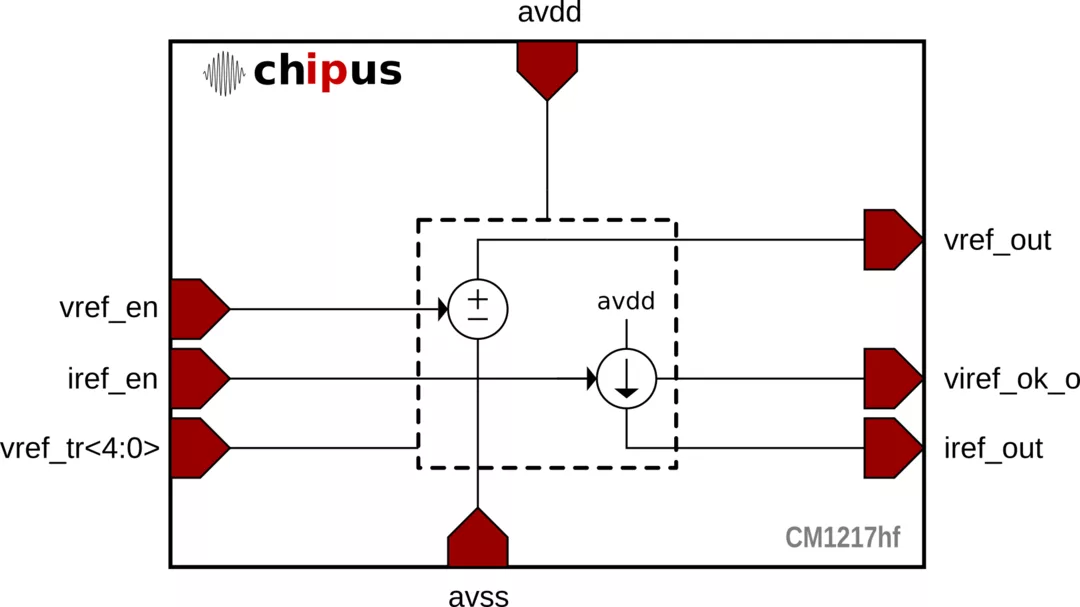
The circuit generates a buffered 1.185V, temperature-compensated bandgap voltage reference (40ppm/°C). A 5-bit trimming is available and guarantees ±1.5% output voltage accuracy. A 25uA reference current source (PTAT) for external use is also included.

The core is easily re-targeted to any other CMOS technology.

Key features

  • Reference Voltage: 1.185V ±1% (w/ trimming)
  • Low noise: 63nV/√Hz (10Hz to 25kHz)
  • High PSRR: –80dB (up to 100kHz)
  • Temperature compensated: < 40ppm/oC
  • Supply voltage: 5.0V ±10%
  • Buffered reference output: 100uA (max)
  • PTAT reference current output available
  • Area: 0.101mm2

Block Diagram

Applications

  • Battery powered equipment
  • Active RFID tag ICs
  • Energy Haversting ICs
  • Hearing Aids

What’s Included?

  • Datasheet/Integration Guide
  • HDL Model
  • Flat GDSII database/LVS netlist
  • Customer Support

Silicon Options

Foundry Node Process Maturity
TSMC 180nm BCDG2

Specifications

Identity

Part Number
CM1217hf
Vendor
Chipus Microelectronics
Type
Silicon IP

Files

Note: some files may require an NDA depending on provider policy.

Provider

Chipus Microelectronics
HQ: Brazil
Chipus Microelectronics (ISO 9001:2015 certified) is a semiconductor company focused on the development of mixed-signal ASICs, intellectual property (IP) blocks and IC design services. The company has more than 200 analog IP blocks in process nodes from 22nm to 0.35um of various foundries. Since its foundation in 2008, Chipus has worked with customers worldwide (South and North America, Europe, and Asia) with firm commitment and flexible client support. Besides analog and mixed-signal expertise, Chipus also offers custom digital IC design services having successfully delivered designs in FINFET technologies from RTL to backend. Headquartered in Florianópolis, Brazil, Chipus has a US subsidiary in Silicon Valley and sales teams in both USA and Europe.

Learn more about Voltage Reference IP core

Analog and Power Management Trends in ASIC and SoC Designs

The design of modern Application Specific Integrated Circuits (ASICs) and Systems on a Chip (SoCs) in advanced process nodes can be differentiated by the on-die integration of analog functions, such as power management. Vidatronic offers this white paper to give some historical background on this trend and delve specifically into the integration of power management. Vidatronic IP solutions and the benefits they bring to ASIC and SoC designers are discussed.

How to specify and integrate successfully a measurement analog front-end including its power computation engine in an energy metering IC

Based on the system specification of a typical smart meter, this article demonstrates the importance of carefully selecting the power metering IP solution so that its specification matches the standard requirements and copes with the application challenges. This article then pinpoints thoroughly the various issues that must be taken into account for the selection of the Silicon IP and helps identify the possible trade-offs between the performance of the Mixed-signal Front-end (MFE) and that of the Power and energy Computation Engine (PCE).

Silicon Qualified SuperViC: the only way to safe SoC integration

System integrators often encounter problems on application boards too late in the design cycle, when bringing together Virtual Components (ViCs of silicon IPs) into a system. Some ViC performances may be degraded at higher levels (SoC and PCB), and thus the final system does not perform as well as expected. In other words, assembling high-performance ViCs together does not guarantee high-performance SoCs or systems when fundamental integration aspects are not addressed or key issues are violated during the integration process.

Analog IP Reuse in Nano Technologies

Presented in this paper is a tool that automatically migrates analog designs from one process to another while keeping circuit and layout topologies.

Frequently asked questions about Voltage Reference IP cores

What is Low-Noise Bandgap Reference - Low Noise: 63nV/√Hz, PSRR: -80dB - TSMC 0.18um CMOS (CLM18)?

Low-Noise Bandgap Reference - Low Noise: 63nV/√Hz, PSRR: -80dB - TSMC 0.18um CMOS (CLM18) is a Voltage Reference IP core from Chipus Microelectronics listed on Semi IP Hub. It is listed with support for tsmc.

How should engineers evaluate this Voltage Reference?

Engineers should review the overview, key features, supported foundries and nodes, maturity, deliverables, and provider information before shortlisting this Voltage Reference IP.

Can this semiconductor IP be compared with similar products?

Yes. Buyers can compare this product with similar semiconductor IP cores or IP families based on category, provider, process options, and structured technical specifications.

×
Semiconductor IP