Vendor: T2M GmbH Category: GNSS

GNSS (GPS, Galileo, GLONASS, Beidou3, QZSS, SBAS) Ultra-low power RF Receiver IP

This GNSS RF Receiver IP is silicon-proven in TSMC40nm ULP process node, offers comprehensive support for all current satellite-b…
Overview

This GNSS RF Receiver IP is silicon-proven in TSMC40nm ULP process node, offers comprehensive support for all current satellite-based navigation systems, encompassing GPS (US), Galileo (EU), GLONASS (Russia), Beidou (China), QZSS (Japan), and SBAS. Tailored for battery-powered IoT and M2M applications, it concurrently accommodates L1/L2 and L5 frequencies.

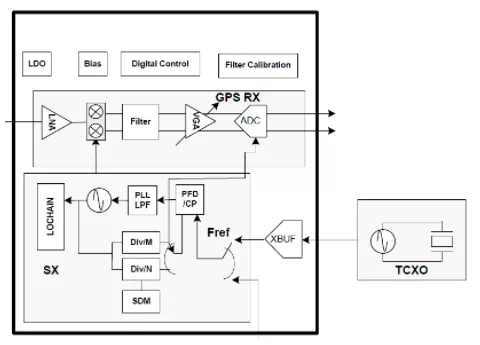
Integrated within this IP are both integer-N (default) and dual-mode fractional-N frequency synthesizers, facilitating the utilization of a singular reference frequency across multiple modes. Its fully integrated Frequency Synthesizer (SX) features a wide-ranging VCO tuning capability, ensuring coverage across various frequency requirements and process corners. Moreover, it supports both single-system and multi-system operations.

This can be ported to any technology node subject to the availability of the RF front end. It can be supplied with the most stable firmware for accurate highly reliable location tracking along with support and upgrades.

This GNSS RF Receiver IP boasts high-level programmability, allowing optimization of power consumption and functionality across diverse scenarios. It is particularly well-suited for IoT and mobile tracking applications, thanks to its ultra-low power design. Furthermore, the RF IP incorporates an integrated reference clock buffer to ensure a stable reference frequency, thereby enhancing overall performance.

Key features

  • Multiple Constellation tracking simultaneously
  • Fully integrated transceiver
  • Supports all constellations including GPS, Galileo, GLONASS, Beidou3, QZSS, NavIC, SBAS, A-GPS
  • Supports L1 and L5 bands
  • Proven in TSMC 40nm ULP RF CMOS
  • Can be ported to other process nodes.
  • Very low power consumption
  • Concurrent reception of multiple systems
  • Flexible frequency plan
  • Integrated DC offset cancellation
  • To implement low leakage, current the RF IP supports PMU (Power management Unit)
  • Exceedingly small die area
  • Integrated 8-bit quadrature SAR ADC for better blocker tolerance. Optional integrated LDOs to improve supply rejection

Block Diagram

Applications

  • Indoor Navigation.
  • Precise Tracking and Navigation
  • Infotainment systems
  • Avionics
  • Military and Defense
  • Wildlife conservation

Files

Note: some files may require an NDA depending on provider policy.

Specifications

Identity

Part Number
GNSS Ultra-low power RF Receiver IP
Vendor
T2M GmbH
Type
Silicon IP

Provider

T2M GmbH
T2M GmbH is the leading Global Technology Company supplying state of the art complex semiconductor connectivity IPs and KGDs, enabling the creation of complex connected devices for Mobile, IoT and Wearable markets. T2M's unique SoC White Box IPs are the design database of mass production RF connectivity chips supporting standards including Wifi, BT, BLE, Zigbee, NFC, LTE, GSM, GNS. They are available in source code as well as KGD for SIP / modules. With offices in USA, Europe, China, Taiwan, South Korea, Japan, Singapore and India, T2M’s highly experienced team provides local support, accelerating product development and Time 2 Market.

Learn more about GNSS IP core

Frequently asked questions about GNSS IP cores

What is GNSS (GPS, Galileo, GLONASS, Beidou3, QZSS, SBAS) Ultra-low power RF Receiver IP?

GNSS (GPS, Galileo, GLONASS, Beidou3, QZSS, SBAS) Ultra-low power RF Receiver IP is a GNSS IP core from T2M GmbH listed on Semi IP Hub.

How should engineers evaluate this GNSS?

Engineers should review the overview, key features, supported foundries and nodes, maturity, deliverables, and provider information before shortlisting this GNSS IP.

Can this semiconductor IP be compared with similar products?

Yes. Buyers can compare this product with similar semiconductor IP cores or IP families based on category, provider, process options, and structured technical specifications.

×
Semiconductor IP