Vendor: CAST Category: GPIO

General-Purpose I/O Controller Core

The GPIO core is used to create functions in a system that are not implemented with dedicated controllers, and require simple inp…

Overview

The GPIO core is used to create functions in a system that are not implemented with dedicated controllers, and require simple input and/or output software-controlled signals.

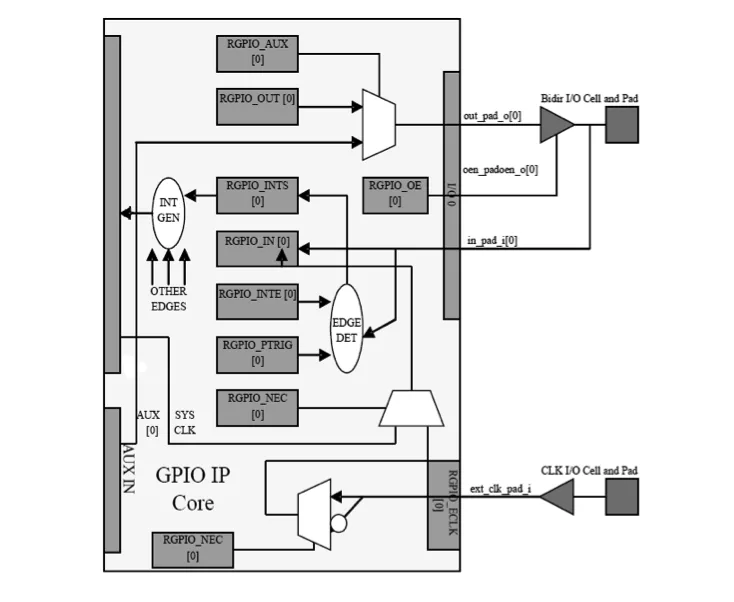
The number of general-purpose I/O signals is user selectable ranging from 1 to 32. For more I/O signals, several GPIO cores can be used in parallel. Each GPIO signal can be programmed individually as an input, an input in interrupt mode, an output, a bi-directional I/O, or as driven by an auxiliary input. GPIO signals programmed as inputs can be registered at the rising edge of the system clock or at a user-programmed edge of the external clock.

The GPIO core is rigorously verified, silicon-proven and available in RTL source or as a targeted FPGA netlist.

Key features

  • User selectable number of GPIO signals from 1 to 32
  • All GPIO signals can be bi-directional (external bi-directional I/O cells are required in that case)
  • All GPIO signals can be tri-stated or open-drain enabled (external tri-state or open-drain I/O cells are required in that case)
  • GPIO signals programmed as in-puts can cause an interrupt request to the CPU
  • All GPIO signals are programmed as inputs at hardware reset
  • Auxiliary inputs to the GPIO core bypass outputs from RGPIO_OUT register
  • Alternative input reference clock signal from external interface
  • 32-bit AHB interface (contact CAST for other interfaces)
  • Extremely configurable (implementation of registers, external clock inverted versus negative edge flip-flops etc.)

Block Diagram

Applications

  • The GPIO core can be used in a wide range of applications where simple I/O control is needed.

What’s Included?

  • Synthesizable RTL or FPGA netlist
  • Testbench & sample test cases
  • Simulation & synthesis scripts
  • Documentation

Specifications

Identity

Part Number
GPIO
Vendor
CAST
Type
Silicon IP

Files

Note: some files may require an NDA depending on provider policy.

Provider

CAST
HQ: USA
CAST is a silicon intellectual property (IP) developer, aggregator, and integrator providing IP cores and subsystems since 1993. Our product line features both leading-edge and standards-based digital IP, including compression engines and image processing functions; 8051 microcontrollers and low-power 32-bit BA2X™ processors; industry-leading automotive interfaces; a complete family of SoC security modules; and a variety of peripherals, interfaces, and other IP cores. Our goal is to maximize IP benefits for our customers by delivering high quality, easy to use, cost effective solutions for real system development challenges. We minimize customer risk through rigorous development standards, complete deliverables with comprehensive documentation, and superlative customer support. We maximize customer value thorough competitive pricing and simple licensing—including royalty-free options—and long-term partnerships with all leading silicon providers and select technology leaders. Our product standards and business practices have been uniquely honed through successful projects with hundreds of systems designers since the very beginnings of the IP industry, making CAST one of the best IP partners available.

Learn more about GPIO IP core

GPIO Solutions for CERN’s Radiation-Hardened Applications

For over a decade, Sofics has collaborated with CERN, the European Organization for Nuclear Research. Sofics has delivered advanced GPIO cells tailored for radiation-hardened applications, supporting CERN’s groundbreaking particle physics experiments.

A Generic Solution to GPIO verification

This paper provides a complete solution to the GPIO Verification for any SoC. GPIO interface is available in every ASIC. To avoid duplicate efforts and (save) time to verify the GPIO interface, we have produced this Generic GPIO verification suite. It is a UVM-based verification environment, with all the necessary subcomponents that are required to verify any GPIO design.

Ensuring reliability in Advanced IC design

To complete our task as engineers we rely on the tools we use. We collaborated with Siemens EDA solutions back in 2025 on a webinar about how we use their tools to develop our designs and layouts.

Integrating Post-Quantum Cryptography (PQC) on Arty-Z7

Post-quantum cryptography (PQC) is moving from theory to engineering reality. With NIST-standardized algorithms ML-KEM (FIPS 203) and ML-DSA (FIPS 204) now finalized, FPGA developers face a practical challenge: How to integrate these algorithms efficiently on resource-constrained hardware?

From I2C to I3C: Evolution of Two-Wire Communication in Embedded Systems

The I2C (Inter-Integrated Circuit) Bus invented in 1980 by Philips Semiconductors (NXP Semiconductors today) was a massive step forward in simplifying communications in embedded systems. It is a simple two-wire interface for synchronous, multi-master/multi-slave, single ended serial communication. Fast forward 45 years to today and it is still widely used for attaching low speed peripheral Integrated Circuits (ICs), processors and microcontrollers. But silicon today has changed...

Frequently asked questions about GPIO IP cores

What is General-Purpose I/O Controller Core?

General-Purpose I/O Controller Core is a GPIO IP core from CAST listed on Semi IP Hub.

How should engineers evaluate this GPIO?

Engineers should review the overview, key features, supported foundries and nodes, maturity, deliverables, and provider information before shortlisting this GPIO IP.

Can this semiconductor IP be compared with similar products?

Yes. Buyers can compare this product with similar semiconductor IP cores or IP families based on category, provider, process options, and structured technical specifications.

×
Semiconductor IP